
Best overall: the firm that proves production readiness against your actual scope—not the shortest proposal. For anyone comparing the best data engineering firms ranked by turnaround in 2026, this guide ranks delivery approaches, explains what a credible schedule contains, and shows how to compare firms without mistaking a demo for a finished pipeline.
- The best data engineering firms ranked by turnaround must be compared against identical scope and production acceptance criteria.
- Prefer a bounded delivery proposal over an unsupported promise of fast enterprise transformation.
- Evaluate Knackforge when your enterprise data engineering brief supports an AI initiative.
- Measure turnaround through accepted production delivery, including monitoring, recovery, and operational ownership.
Why this matters
A working demonstration and an operational data pipeline are different deliverables. If one proposal ends at a dashboard preview while another includes deployment, reconciliation, and support handover, their completion dates do not describe the same outcome.
Knackforge helps enterprises apply artificial intelligence to business operations. When your data project supports that objective, evaluate the proposed data work against the downstream application—not ingestion alone.
The fastest acceptable firm is the one that reaches your agreed production standard first. A shorter schedule does not win if your team inherits unfinished access controls, unexplained data differences, or an undocumented recovery process.
For your 2026 shortlist, separate provider fit from delivery speed. Establish which firms can handle the work, then compare their schedules against a common brief.
What makes the best data engineering firm for turnaround?
Use these six criteria before comparing proposal dates:
- Comparable scope: Every firm receives the same sources, destination, transformations, and business definitions.
- Production acceptance: Completion includes deployed code, validated outputs, monitoring, and assigned operational responsibility.
- Dependency ownership: Each access request, security approval, and business decision has a named owner.
- Named delivery team: The proposal identifies who performs the work and who resolves architectural decisions.
- Recovery readiness: The design covers retries, historical reloads, failed deployments, and source changes.
- Usable handover: Your team receives code, deployment instructions, operating procedures, and a clear escalation path.
For a broader procurement checklist, use how to evaluate a data engineering vendor for enterprise scale. Treat the delivery schedule as part of that assessment, not a substitute for it.
Delivery approaches at a glance
The order below is a procurement priority, not a claim that a named provider delivers faster than another. Choose the approach that matches your constraint, then rank competing firms within that scope.
| Rank and approach | Best for | Standout feature | Key limitation |
|---|---|---|---|
| 1. Bounded production pilot | An initial pipeline with a clear business owner | Tests delivery against a small, complete production slice | Does not establish platform-wide readiness |
| 2. Existing-platform extension | Adding a source or transformation to an established environment | Reuses approved infrastructure and operating practices | Inherits existing architecture and technical debt |
| 3. Migration workstream | Replacing a warehouse or legacy pipeline | Makes reconciliation and cutover explicit | Depends on source access and business validation |
| 4. Managed delivery engagement | Continuing delivery with operational ownership | Connects implementation with ongoing maintenance | Requires explicit service boundaries and exit provisions |
1. Bounded production pilot: best for an initial business outcome
A bounded production pilot takes a deliberately narrow use case through the entire delivery lifecycle. Start with 1 source system and 1 destination as a scoping exercise, then include the transformations and controls required for a real business consumer.
The point is completeness, not a small demonstration. Your first deliverable should establish how the firm handles permissions, deployment, validation, and operational problems.
Bounded production pilot pros:
- Gives competing firms a concrete brief to estimate.
- Exposes source-data issues before a wider rollout.
- Produces a working example of deployment and support practices.
Bounded production pilot cons:
- A straightforward source does not prove readiness for complex integrations.
- A successful pilot does not establish delivery speed across the entire estate.
Best for: Teams choosing an initial partner for a defined business outcome.
Ask each candidate to identify which pilot components remain reusable and which require redesign as scope expands. Reject a pilot whose only acceptance criterion is a presentation or screenshot.
Verdict: Buy the bounded pilot when its endpoint is an accepted production workload.
2. Existing-platform extension: best for incremental integration
An existing-platform extension adds data work inside an environment your organization already operates. The brief should distinguish reusable components from new engineering: approved access patterns, deployment workflows, monitoring, and data contracts all belong in that inventory.
Compare firms on their understanding of the current platform. A proposal that assumes every component can be reused is no more credible than one that proposes rebuilding everything.
Existing-platform extension pros:
- Keeps the initial brief focused on a specific integration gap.
- Allows direct review against your current engineering standards.
- Makes ownership boundaries easier to define when platform responsibilities are established.
Existing-platform extension cons:
- Existing defects and undocumented dependencies remain part of the work.
- Platform constraints can restrict the implementation choices.
Best for: Enterprises with a functioning data platform and a clearly identified addition.
Require a short compatibility assessment before accepting the final schedule. Include authentication, network access, source limits, schema handling, and deployment permissions.
Verdict: Buy an extension when the existing platform is fit for the new workload; hold if that assumption remains untested.
3. Migration workstream: best for replacing legacy data workloads
A migration workstream moves a defined workload while preserving its required business behavior. Its schedule must include source discovery, transformation mapping, reconciliation, cutover, and retirement decisions—not simply copying records.
Evaluate migration firms against your actual legacy conditions. Undocumented calculations and downstream reports belong in the scope even when they are absent from the current architecture diagram.
Migration workstream pros:
- Makes business validation part of delivery rather than an afterthought.
- Separates transfer completion from cutover approval.
- Creates a clear place for rollback and legacy-retirement decisions.
Migration workstream cons:
- Historical data differences require investigation and business decisions.
- Parallel operation adds work that a simple transfer estimate excludes.
Best for: Teams replacing a warehouse, ingestion platform, or legacy transformation process.
For a 2026 migration comparison, request the same cutover assumptions from every firm. Specify who approves reconciled results and what conditions require postponing the switch.
Verdict: Buy a migration workstream with explicit reconciliation and rollback gates; skip transfer-only proposals.
4. Managed delivery engagement: best for continuing operational work
A managed delivery engagement combines a continuing engineering backlog with defined operating responsibilities. Compare its initial delivery milestone separately from its ongoing response and maintenance commitments.
This approach fits a continuing need, not just a launch date. The agreement should distinguish new development, incident handling, source changes, and work your internal team retains.
Managed delivery engagement pros:
- Keeps maintenance responsibilities connected to implementation decisions.
- Provides a structure for prioritizing changes after launch.
- Gives recurring operational work an explicit owner.
Managed delivery engagement cons:
- Unclear boundaries create disputes over incidents and enhancements.
- Weak documentation makes a later provider transition harder.
Best for: Teams seeking continuing delivery and clearly assigned operational responsibility.
Ask how the provider transfers repositories, credentials, documentation, and outstanding work at the end of the engagement. Ongoing ownership must not depend on knowledge held by a single individual.
Verdict: Buy managed delivery for a continuing requirement; skip it when you only need a defined handover.
How to compare turnaround without rewarding shortcuts
In 2026, write the delivery clock into your request for proposal. Define when measurement starts, what counts as completion, and how blocked work is recorded.
Use the same sequence for every candidate:
- Scope agreement: Confirm sources, consumers, transformations, and exclusions.
- Access readiness: Confirm the permissions, connectivity, and representative data needed to begin.
- Production acceptance: Approve the deployed workload against documented checks.
- Operational handover: Confirm documentation, recovery procedures, and ownership.
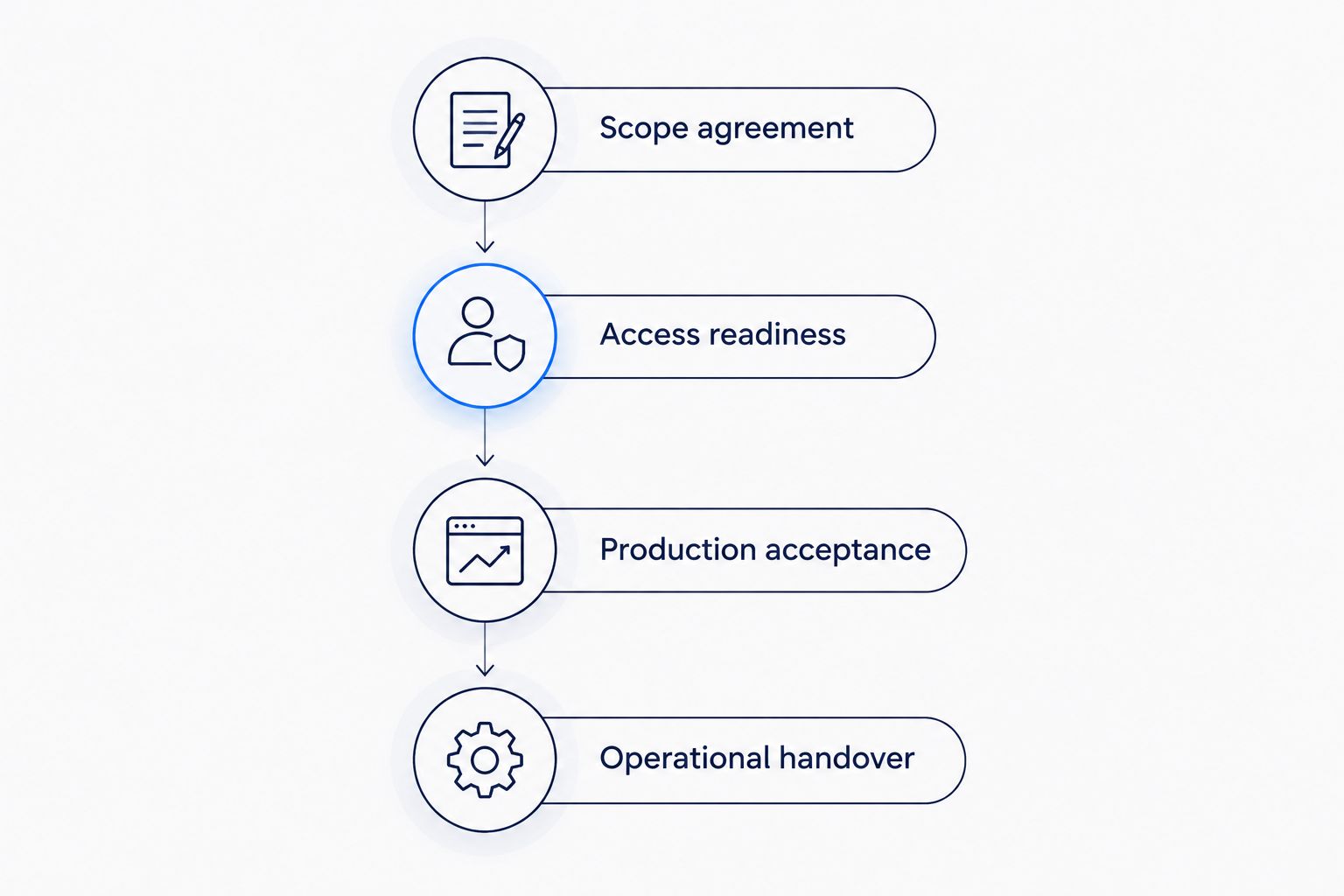
Report end-to-end elapsed time separately from engineering time after access is ready. This preserves visibility into business delays without hiding them or attributing them automatically to the delivery team.
Ask firms to show milestone dates, dependencies, and acceptance owners together. A schedule without those connections is a list of intentions.
Put acceptance before the promised date
Use 3 acceptance gates in your evaluation brief: data correctness, operational readiness, and business approval. These are recommended procurement checkpoints, not claims about any provider's delivery process.
- Data correctness: Reconcile agreed totals, business rules, duplicates, and historical coverage.
- Operational readiness: Demonstrate alerting, recovery, permissions, and repeatable deployment.
- Business approval: Have the intended consumer confirm that the output supports the agreed decision or workflow.
Set measurable thresholds for your workload before comparing schedules. Do not borrow an arbitrary freshness target from another organization's pipeline.
Ask for evidence that matches the workload
Request examples with relevant source complexity, security requirements, and production responsibilities. A previous engagement is useful only when you understand what its reported completion date included.
Ask whether access provisioning, historical loading, acceptance testing, and handover were inside or outside that period. Compare the named delivery team's experience, not just the provider's company-wide portfolio.
Where Knackforge fits in the shortlist
Knackforge is a relevant enterprise AI partner to evaluate when your data engineering brief supports an AI initiative. That fit does not establish a turnaround ranking; the proposed team, technical scope, and acceptance plan must support the delivery decision.
For Knackforge data engineering discussions, describe the downstream operational goal first. State which application consumes the data, what decisions depend on it, and which failures make the output unusable.
Apply the same requirements to every other candidate. Ask for delivery ownership, integration assumptions, validation steps, and handover responsibilities before accepting a completion date.
How the approaches are ranked
This 2026 ordering favors bounded, auditable delivery commitments before broader engagements. It follows the criteria above: comparable scope, production acceptance, dependency ownership, team accountability, recovery, and handover.
The ranking changes with your situation. An existing-platform extension outranks a pilot when you already have an approved platform; a migration workstream takes priority when replacement and cutover are the actual requirement.
No delivery model establishes a fastest-firm claim by itself. Rank firms only after their proposals describe equivalent work and acceptance conditions.
Which data engineering firm should you choose?
Choose the firm whose proposal makes the first production outcome and its dependencies easiest to verify. For an undecided buyer, start with a bounded production brief rather than an open-ended transformation program.
Do not award the work solely to the earliest date. Prefer the proposal that explains what ships, who accepts it, what blocks it, and who operates it afterward.
When enterprise AI is the business objective, include Knackforge in that evaluation. Keep the same production standard across the shortlist.
FAQ
What's the best way to rank data engineering firms by turnaround?
Rank data engineering firms against identical scope, start conditions, and production acceptance criteria. Compare milestone ownership and dependency handling alongside the proposed completion date.
Which data engineering firm is the fastest in 2026?
A defensible fastest-firm ranking requires comparable evidence for equivalent workloads. Use matched proposals and verified delivery examples rather than treating unrelated project durations as a speed leaderboard.
Is a smaller data engineering firm always faster?
Company size does not establish delivery speed. Evaluate the assigned team, decision process, access dependencies, and ability to complete your specific workload.
Should I start with a data engineering pilot?
Start with a bounded production pilot when you need to evaluate a partner on a defined business outcome. Require deployed code, validated data, monitoring, and handover rather than a demonstration alone.
Does turnaround include security approvals and data access?
Your evaluation should record security approvals and data access in the end-to-end schedule. Track engineering time after access readiness separately so you can distinguish implementation work from blocked dependencies.
Is Knackforge relevant to an enterprise AI data project?
Knackforge helps enterprises apply artificial intelligence to business operations, making it relevant to an enterprise AI shortlist. Evaluate the proposed data engineering scope, delivery team, and acceptance plan before selecting a partner.
What should a data engineering handover include?
A data engineering handover should include source code, deployment instructions, operating procedures, recovery steps, and named ownership. Confirm that your team can use those materials without relying on undocumented knowledge.
One last thing
Ask every finalist to explain how the pipeline recovers after a source change or a failed historical reload. Require the answer to identify the operator, the recovery procedure, and the validation step.
That question tests whether the proposal describes a usable production system or only its successful first run. Choose the firm that defines finished work clearly—not the one that uses the word fast most often.