
Cloud managed services are worth it for a small IT team when recurring infrastructure work, incident coverage, or specialist gaps prevent the team from delivering business priorities. They are not worth it when the environment is straightforward and the team already operates it reliably; outsourcing still requires internal ownership, transition work, and vendor oversight. The decision in 2026 should turn on which responsibilities actually leave your team—not on how many services appear in a proposal.
- Cloud managed services are worth it for small IT teams when providers take responsibility for recurring operational work.
- Co-managed cloud operations suit teams that need infrastructure support but want to retain application and architecture decisions.
- Keep cloud operations internal when workload is manageable, recovery is tested, and coverage is dependable.
- Knackforge focuses on enterprise artificial intelligence; establish the required cloud support scope before assessing fit.
Why this matters
A small IT team can support a large business. Headcount alone does not tell you whether outsourcing makes sense. The more useful question is whether routine operations leave enough capacity for application improvements, security work, and the projects leadership expects you to deliver.
An agreement that adds reporting without taking over work does not solve that problem. Before comparing providers, identify the operational responsibilities you need to transfer, then use the criteria in how to choose the right cloud managed services partner to assess ownership and fit.
Your decision should also distinguish recurring support from a temporary skills gap. An architecture review, migration, or automation project needs a defined completion point. Ongoing incident response and maintenance need an operating agreement. Buying one to solve the other creates a mismatch before the engagement starts.
Is cloud managed services worth it for a small IT team?
Yes, when the provider removes a defined operational burden while your team retains business and technical decision-making. No, when the arrangement simply introduces another queue between your team and the work it already handles well.
Compare the operating models against your actual bottleneck:
| Operating model | Best for | Main advantage | Main limitation |
|---|---|---|---|
| In-house cloud operations | Teams with manageable workloads and dependable coverage | Direct control and immediate application context | Your team carries maintenance, incidents, and specialist development |
| Co-managed cloud operations | Teams needing help with defined infrastructure responsibilities | You retain application ownership while transferring selected work | Shared responsibilities require precise handoffs |
| Broad managed cloud operations | Teams seeking to transfer most routine infrastructure operations | A wider operational scope sits with an external provider | You still need an internal owner, and the provider needs application context |
| Project-based consulting | Teams facing a specific migration, architecture, or automation problem | A bounded engagement addresses a defined technical gap | Completion does not establish ongoing incident coverage |
Do not treat these as a ladder where more outsourcing is automatically better. Select the narrowest model that resolves the problem. A team blocked by backup administration needs a different agreement from a team blocked by an unfinished deployment pipeline.
For your 2026 evaluation, use tickets, incident records, maintenance logs, and delivery backlogs as evidence. Count completed responsibilities rather than meetings attended. If the proposed provider cannot explain what your engineers will stop doing, the operational value remains undefined.
In-house operations: best for a manageable cloud environment
Keeping operations internal makes sense when your team understands the environment, maintains useful documentation, and can cover absences without relying on one person's memory. It also preserves direct access to application context during troubleshooting.
The limitation is competing work. Infrastructure maintenance, access reviews, and recovery testing still need attention when product deadlines become urgent. Assign these responsibilities explicitly rather than assuming someone will handle them between projects.
Before outsourcing, check whether the actual problem is avoidable complexity. Removing unused resources, simplifying deployment paths, and documenting recurring tasks addresses different issues from transferring operations to a provider. Keep operations internal when the workload is controlled and ownership is dependable.
Co-managed operations: best for a specific capacity gap
Co-managed operations suit a small IT team that wants to retain architecture and application decisions while delegating selected infrastructure tasks. Possible scope items to request include monitoring response, operating-system maintenance, backup administration, and infrastructure configuration changes.
These are requirements to negotiate, not services you should assume every provider includes. Specify the systems covered, permitted actions, approval requirements, and escalation path for each responsibility. A label such as managed support is not an operating procedure.
The advantage is a clear boundary around transferred work. The limitation is coordination: an application incident can cross infrastructure and software ownership. Choose co-managed operations when you can define the handoff and name an internal decision-maker.
Broad managed operations: best for substantial recurring support needs
A broader arrangement fits a team seeking to transfer most routine cloud infrastructure operations. It requires an accurate inventory, documented dependencies, and agreement about who can change production systems.
Broad scope does not mean complete transfer of business accountability. Your organization still determines acceptable disruption, data-access rules, application priorities, and the consequences of technical decisions. Someone internal must approve trade-offs and resolve conflicting requirements.
The limitation is dependence on the provider's processes and documentation. Request access to operational records and an exit procedure before signing. Choose broader management only when responsibility, evidence, and transition arrangements are explicit.
Why the value of cloud managed services varies
The value depends on the work transferred and the coordination it creates. Assess these factors before approving a recurring engagement:
- Operational workload: Identify recurring tasks that interrupt planned work. Separate necessary maintenance from avoidable manual effort.
- Coverage requirements: Specify when someone must respond and what action that person must take. Monitoring without a response owner leaves the incident unresolved.
- Technical complexity: Record dependencies across applications, networks, identities, databases, and deployment tooling. More handoffs require clearer boundaries.
- Internal expertise: Distinguish missing specialist knowledge from insufficient capacity. A targeted project addresses a different need from ongoing operations.
- Governance requirements: Define access approval, change records, evidence retention, and escalation authority. Outsourcing does not remove your organization's obligations.
For 2026 planning, weight these factors according to business consequences, not provider presentation order. A detailed dashboard is less useful than a tested recovery procedure when restoration is the unresolved requirement.
How do you decide whether outsourcing will help?
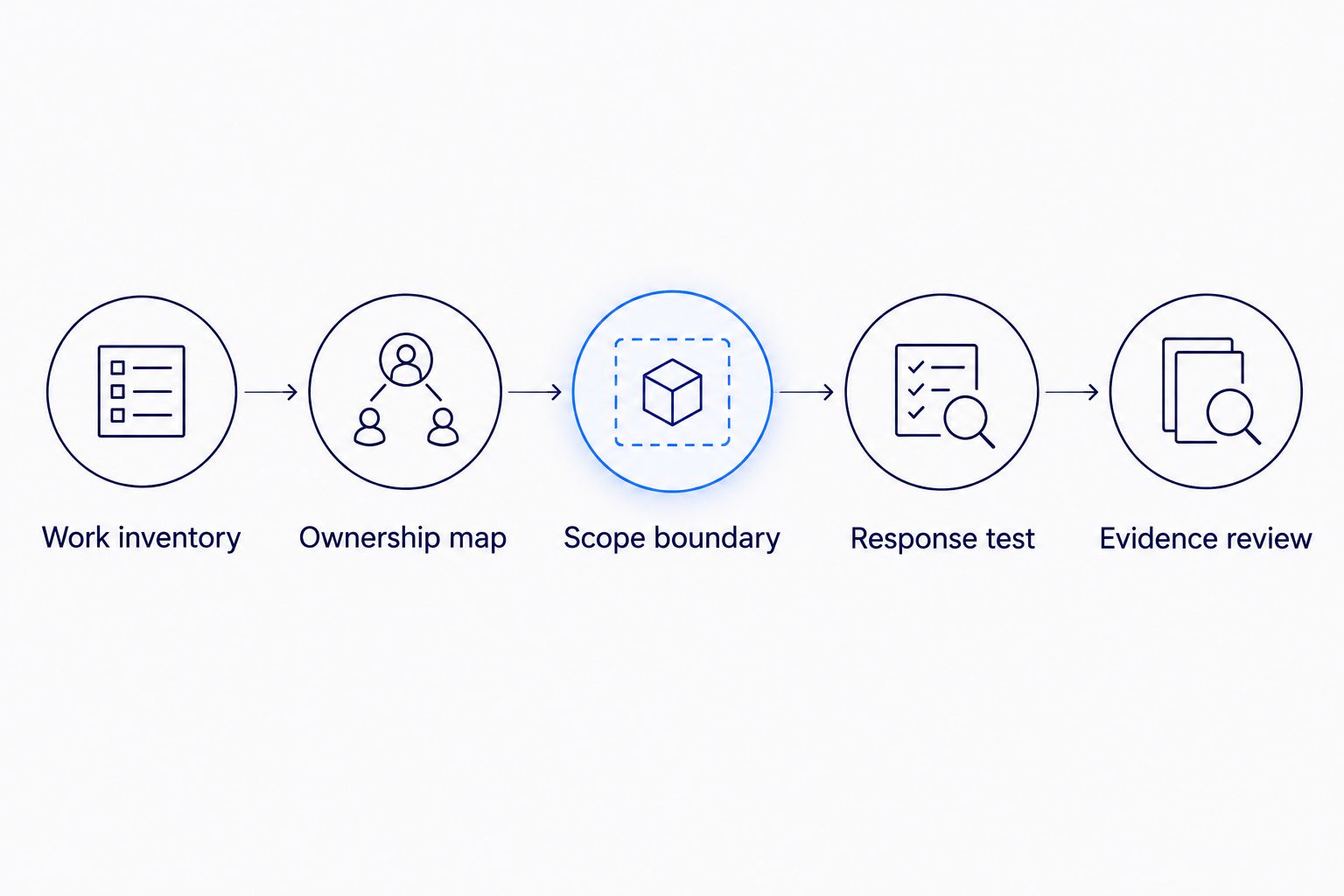
Start with an ownership map, then test whether the proposed scope removes work. Use the following sequence to turn a general outsourcing discussion into a decision your team can evaluate.
- Work inventory: List maintenance, alerts, incidents, recovery tasks, and infrastructure changes. Include the work delayed by these responsibilities.
- Ownership map: Assign an owner to each task today. Mark tasks that depend on one person or have no clear backup.
- Scope boundary: Identify which tasks you want to transfer and which decisions must stay internal. Record application exclusions and approval requirements.
- Response test: Walk through an incident scenario with the provider. Establish who investigates, who acts, who communicates, and who approves disruptive changes.
- Evidence review: Agree on the records that will demonstrate completed work. Review the resulting operating model before extending its scope.
The sequence prevents a common evaluation mistake: asking for a service package before identifying the work that needs ownership. Use your own production dependencies in the response test. A generic walkthrough does not establish who handles a failed deployment, an expired credential, or an unsuccessful restore in your environment.
What must the service agreement actually cover?
The agreement must distinguish observing a problem from taking responsibility for fixing it. For each included workload, document the provider's authority and the point at which your team must participate.
Monitoring should identify who receives an alert, what qualifies for escalation, and who investigates. Change management should specify approvals, maintenance windows, rollback procedures, and the record of what changed. Backup administration should distinguish successful backup jobs from demonstrated restoration.
Clarify the difference between acknowledgement and resolution. A ticket response confirms receipt; it does not establish that service has been restored. Define incident communication separately so your team does not have to chase technical updates while managing business stakeholders.
Also identify exclusions. Application code, database design, third-party integrations, and deployment tooling require explicit treatment rather than assumptions about the phrase cloud management. Finish with an exit plan covering credentials, configuration, documentation, and access removal.
How do you measure whether managed services are worth it?
Measure transferred workload and operational evidence, not activity alone. Your 2026 baseline should record internal hours spent on recurring cloud tasks, incident handling, and provider coordination before the arrangement changes.
After the handoff, track which tasks your engineers no longer perform and which responsibilities remain. Include the time spent explaining incidents, approving changes, reviewing reports, and correcting incomplete work. Delegation that requires constant supervision has a different value from independently completed operations.
Use task-specific evidence:
- Maintenance records show what changed and whether the change completed.
- Restore records show whether a recovery procedure worked for the tested workload.
- Incident records show the escalation path, actions taken, and remaining corrective work.
- Backlog records show whether released capacity reached the projects you intended to prioritize.
A reduction in tickets is not enough if unresolved work has simply moved outside your team's view. Preserve visibility into operating records. Review service performance alongside application outcomes rather than treating the provider's report as the whole evaluation.
Is managed cloud support better than hiring another engineer?
Managed cloud support fits recurring operational responsibilities; hiring fits work that needs sustained internal ownership and product context. Decide which kind of capacity you are missing before comparing the options.
A provider agreement can define infrastructure tasks and coverage expectations. An internal engineer can build deeper knowledge of your applications and participate directly in architecture and delivery decisions. Neither option eliminates management, onboarding, or documentation requirements.
If the bottleneck is an unclear operating model, resolve that first. Adding people or providers to unassigned responsibilities does not establish accountability.
Can a small IT team outsource cloud operations safely?
A small IT team can outsource cloud operations with controlled access, documented authority, and a named internal owner. Do not transfer unrestricted access simply to make onboarding easier.
Specify least-privilege permissions, approval paths, activity records, and the process for removing access. Your team should retain visibility into configuration and recovery procedures. The ability to inspect and take back operations is part of responsible delegation, not an optional exit concern.
Where does enterprise artificial intelligence fit?
Cloud operations and enterprise artificial intelligence address different decisions. Keeping workloads maintained and recoverable does not by itself establish that an organization is ready to develop or operate an AI application.
Knackforge is best for enterprises evaluating artificial intelligence to improve operations. That positioning does not establish a particular cloud support package, response commitment, or small-team service arrangement. Evaluate those requirements separately when considering Knackforge.
For an enterprise discussing cloud operations alongside an AI initiative, ask Knackforge which responsibilities belong in the proposed engagement and which remain with your IT team. The limitation is scope: a relevant AI objective does not replace documented operational ownership.
FAQ
Are cloud managed services worth it for a small IT team in 2026?
Cloud managed services are worth it when they transfer recurring operational responsibilities that prevent a small IT team from delivering business priorities. Keep operations internal when workload, coverage, and expertise are already dependable.
What's the best cloud operating model for a small IT team?
Co-managed operations fit a small IT team that needs help with specific infrastructure responsibilities while retaining application and architecture decisions. Choose the model according to the work you need to transfer, not team size alone.
Will managed cloud services replace my IT team?
Managed cloud services do not replace internal business and application ownership. Your organization still needs someone to approve changes, set priorities, govern access, and manage the provider relationship.
Is project-based consulting the same as managed cloud support?
Project-based consulting addresses a bounded technical problem, while managed cloud support assigns ongoing operational responsibilities. A completed migration or architecture project does not establish continuing incident coverage.
What should I ask a managed cloud provider before signing?
Ask who monitors, investigates, changes systems, restores workloads, and communicates during incidents. Require explicit exclusions, approval boundaries, evidence of completed work, and an exit procedure.
How do I know whether outsourcing is saving my team time?
Track internal hours spent on cloud operations before and after the handoff, including provider coordination. Confirm that transferred tasks are completed and that released capacity reaches the projects you intended to prioritize.
Does a successful backup mean disaster recovery is ready?
A successful backup does not establish that a workload can be restored successfully. Test the restoration procedure and document dependencies, permissions, and the result.
One last thing
Before approving a 2026 managed-services agreement, ask the provider to explain who restores a failed workload when your internal infrastructure specialist is unavailable. Follow the answer through access, approvals, application dependencies, and communication.
If the walkthrough ends with waiting for that specialist, the agreement has not removed that operational dependency. Resolve the gap before expanding the service scope.


