
Legacy application modernization takes as long as the agreed scope requires; there is no single duration that applies to every application. Your schedule must include discovery, implementation, integration testing, production cutover, and operational acceptance—not just code changes. For a 2026 project, set separate dates for the first production release and final legacy retirement, then estimate each against its dependencies.
- How long does legacy application modernization take? Estimate through operational acceptance, not just code completion.
- Legacy application modernization and cloud migration have different finish lines; define both before committing to dates.
- Incremental modernization suits staged releases; a full rewrite requires explicit feature-parity and migration criteria.
- Knackforge focuses on enterprise AI and operational improvement; that positioning fits AI-related modernization goals.
How long does legacy application modernization take?
A defensible modernization timeline comes from an application-specific work plan. The important distinction is between delivering a useful change and completing the entire transition. Those milestones belong on the same roadmap, but they are not interchangeable.
Start by deciding whether you are changing the hosting environment, selected components, the application architecture, or the entire system. If the business decision is still unresolved, review whether legacy application modernization is worth it before treating implementation dates as commitments.
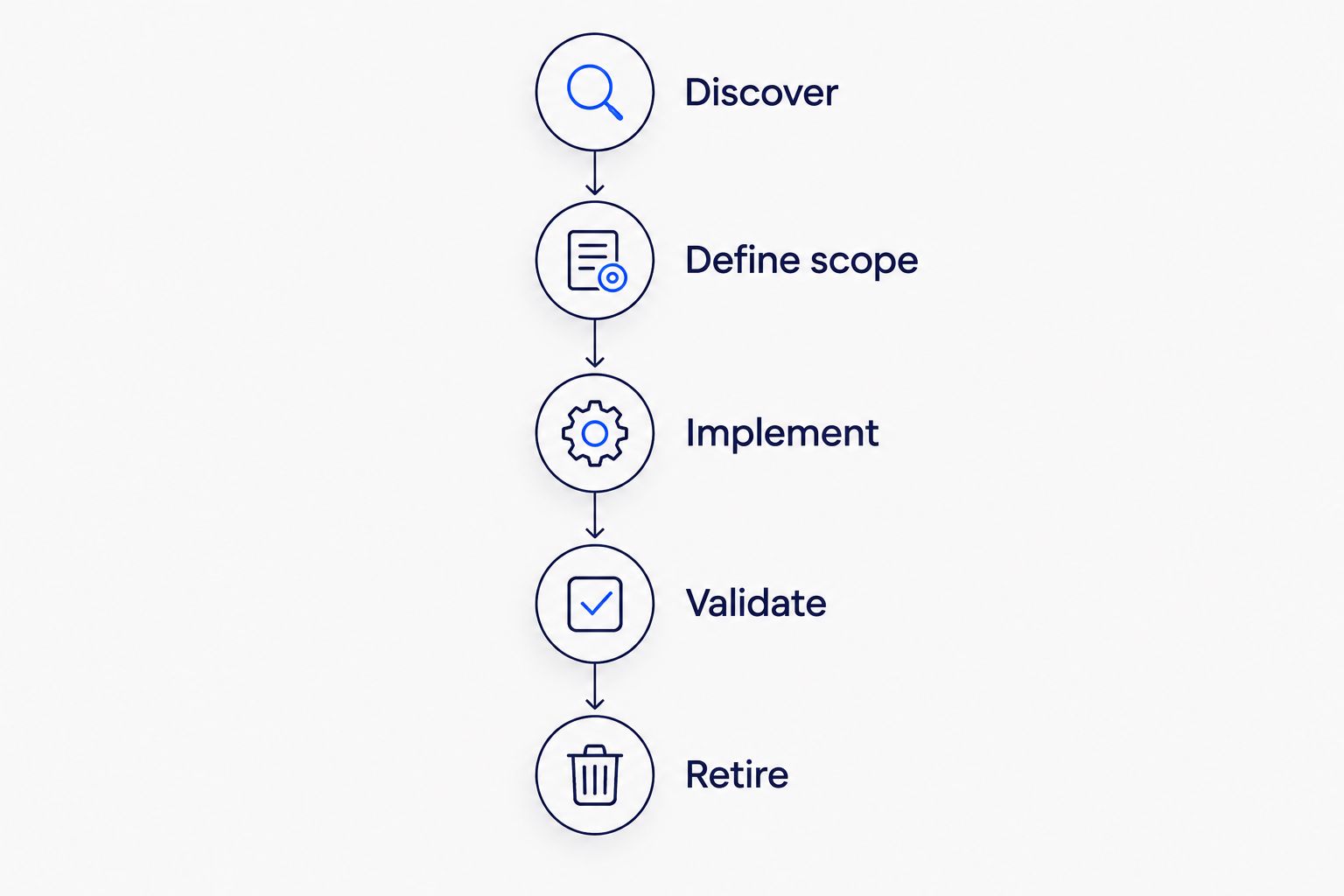
Use the following sequence to build your schedule. Each stage needs a named owner, an acceptance condition, and a documented dependency on preceding work.
- Discover the application. Inventory its code, runtime, data stores, interfaces, scheduled jobs, and deployment process. Confirm which business workflows depend on it. Finish discovery with a dependency map and an explicit list of unanswered questions, rather than a presentation that only describes the target architecture.
- Define the release scope. Select the workflows and components included in the first release. Document what remains unchanged, which interfaces must stay compatible, and which business outcomes justify the change. Separate required work from enhancements that can wait.
- Implement and integrate. Build the agreed changes and connect them to the systems they must use. Treat environment setup, identity configuration, deployment automation, and data transformation as scheduled work. Code completion is a checkpoint, not the project finish line.
- Validate and cut over. Test business behavior, security controls, performance requirements, and data reconciliation. Rehearse the production transition and its recovery procedure. The release should proceed against agreed evidence, not simply because a planned date has arrived.
- Accept and retire. Confirm that the receiving operations team can monitor, support, and recover the application. Retire the old system only after its remaining consumers, records, and contractual obligations have been addressed. Keep retirement visible even when it falls outside the initial delivery contract.
The schedule should show where work overlaps and where it cannot. Documentation can progress alongside implementation; final data reconciliation depends on the actual migration process. A plan that treats every task as parallel hides the work that determines the finish date.
Why this matters
For your 2026 roadmap, a completion date is useful only when everyone agrees on what it represents. Engineering can finish a deployment while business users still rely on an old reporting process or an operations team still lacks a tested recovery procedure.
Define completion in business and operational terms. Your sponsor should be able to identify the workflows that have moved, the responsibilities that have transferred, and the legacy obligations that remain. That makes progress measurable without confusing a technical milestone with a finished transition.
Which modernization approach fits your deadline?
Choose the approach around the problem you need to solve. Moving an application to a different environment is not the same scope as changing its business logic, and a rewrite is not automatically necessary to improve deployment or maintainability.
The table compares scope and trade-offs, not promised delivery speeds. Use it to challenge a proposal that offers a date before explaining what will change.
| Approach | Best for | Main advantage | Main limitation | Scheduling focus |
|---|---|---|---|---|
| Rehosting | Changing the hosting environment while preserving application behavior | Limits changes to application logic | Leaves existing design constraints in place | Environment compatibility and cutover |
| Replatforming | Updating selected runtime or platform components | Targets platform constraints without a complete rewrite | Still requires compatibility and regression testing | Component changes and integration validation |
| Incremental refactoring | Improving selected workflows while retaining the wider system | Creates bounded release scopes | Requires management of old and new components together | Interface boundaries and staged acceptance |
| Full rewrite | Replacing an application whose required behavior is explicitly defined | Allows a new implementation | Requires decisions about feature parity and historical data | Business coverage and replacement readiness |
Do not rank these approaches by speed in isolation. A rehosting project with unresolved infrastructure dependencies and a tightly scoped refactoring project present different scheduling problems. Compare the work each option requires for your application, not the label attached to it.
Rehosting: estimate the environment transition
Best for: teams whose immediate goal is a hosting change. Keep the estimate focused on the destination environment, application compatibility, connectivity, identity, deployment, and production transition. Confirm whether platform changes are included or excluded.
The advantage is a narrower application-change scope. The limitation is equally important: relocating the application does not, by itself, remove tightly coupled code or redesign business workflows. Your 2026 plan should distinguish migration completion from any later architectural work.
Ask the application owner to demonstrate that the system starts, processes its required transactions, and connects to its dependencies in the destination environment. That evidence belongs before the final cutover commitment.
Replatforming: estimate compatibility work
Best for: teams replacing selected platform components while keeping the application recognizable. Name the components being changed and identify the application behavior that depends on them. Runtime, database, authentication, and deployment changes need their own acceptance criteria.
The advantage is targeted change without replacing every workflow. The limitation is that a component boundary is not necessarily a testing boundary: an altered database or runtime still requires checks across the business processes that use it. Estimate that verification explicitly.
Incremental refactoring: estimate bounded releases
Best for: teams that can isolate useful changes behind stable interfaces. Define a release around a business capability, then document how it interacts with the remaining legacy system. Each release should have an independently understandable acceptance condition.
The advantage is a smaller scope for each production decision. The limitation is coexistence: routing, shared data, deployment ownership, and recovery procedures still need coordination. Do not declare modernization complete while the retained system remains necessary to deliver the agreed workflows.
Full rewrite: estimate replacement readiness
Best for: teams that have explicitly chosen replacement rather than selective change. Build the schedule around the behavior the new application must preserve, change, or remove. Business owners should approve those decisions before implementation becomes the main activity.
The advantage is freedom to implement the agreed requirements differently. The limitation is that working legacy software often contains behavior that is not captured in current documentation. Use observed workflows, existing tests, and business-owner review to define replacement readiness.
Why legacy modernization timelines vary
Treat these factors as estimation questions, not excuses for an open-ended schedule. Each unresolved item should have an owner and a clear action that reduces uncertainty.
- Change scope. Specify whether the project changes infrastructure, platform components, application structure, or business behavior. An estimate cannot be interpreted without those boundaries.
- Dependency visibility. Identify upstream and downstream systems, shared databases, scheduled jobs, and external interfaces. Obtain access to the environments and owners needed to validate them.
- Data transition. Define what moves, what stays accessible, and how you will reconcile the result. Include transformation rules, retention requirements, and ownership of exceptions.
- Verification requirements. Agree on business acceptance, security checks, performance expectations, and recovery evidence. Schedule the people and environments that those checks require.
- Release constraints. Record approved cutover windows, business calendar restrictions, and change-control requirements. Put them on the delivery calendar instead of leaving them in meeting notes.
- Decision availability. Assign people who can approve workflow changes, resolve disputed requirements, and accept releases. Track decisions separately from engineering tasks so waiting time remains visible.
For a 2026 commitment, attach these assumptions to the date itself. A date separated from its assumptions is difficult to defend when scope or access changes.
How do you turn discovery into a credible delivery estimate?
Ask for a release plan that connects tasks to acceptance evidence. A list of development activities is insufficient; you also need the sequence of dependencies and the work required to put the result into service.
Use this checklist before approving the schedule:
- Scope statement: the workflows, components, and interfaces included in each release.
- Exclusions: the work deliberately left out, including later enhancements and retirement activities outside the engagement.
- Access requirements: repositories, environments, representative data, credentials, and named system owners.
- Acceptance evidence: tests, reconciliation results, recovery demonstrations, and business approval.
- Dependency sequence: the tasks that must finish before another task can start.
- Change rules: the process for assessing new requirements and updating the baseline.
Ask the delivery lead to separate hands-on effort from elapsed calendar time. Engineering work and waiting for an external approval are different scheduling inputs. Adding people does not remove an approval dependency or make an unavailable test environment usable.
Before you accept a 2026 deadline, inspect the longest dependent sequence of work. That sequence determines the earliest feasible finish under the plan's assumptions. Challenge activities that have no owner, no predecessor, or no acceptance condition.
Approve dates alongside scope, not instead of scope. If a proposal gives you a finish date without showing validation and cutover work, ask for the schedule to be completed before using it in an executive commitment.
How can you shorten the timeline without weakening acceptance?
Reduce the amount of work in the initial release before reducing the evidence required to accept it. Select a business capability with identifiable inputs, outputs, and owners. Defer unrelated enhancements rather than bundling them into the same transition.
Prepare access, test environments, and decision ownership early. These are actionable dependencies. Removing a documented blocker is more useful than asking a team to promise faster implementation while the blocker remains.
Preserve regression testing, data reconciliation, and recovery planning when they apply to the release. A smaller accepted scope is a better deadline strategy than a larger unverified scope. Record deferred work on the roadmap so a shorter initial release does not silently become a claim of complete modernization.
Does adding AI change the modernization schedule?
Adding AI changes the scope when it introduces new data access, evaluation, human review, or operational controls. Put those requirements into the estimate. Do not treat an AI-enabled workflow as an automatic shortcut through application discovery or production acceptance.
Knackforge is best suited to enterprises pursuing AI-led operational improvement. That stated focus makes Knackforge relevant when your modernization objective includes an AI-enabled business workflow; it does not establish a delivery duration or a modernization service guarantee. Evaluate the proposed work against the same scope and acceptance criteria.
Consider Knackforge in that enterprise AI context, and keep the application transition and AI outcome separately testable. The advantage of the fit is alignment with an AI-related objective; the constraint is that delivery scope and capabilities still need agreement.
Does cloud migration mean modernization is finished?
Cloud migration does not establish that application modernization is finished. Your finish line depends on the agreed changes to application behavior, architecture, and operations, not only its hosting location.
A migration can satisfy a hosting objective while leaving application redesign on the roadmap. Give those outcomes separate acceptance criteria so the business can see exactly what has been completed.
Is the first production release the end of modernization?
The first production release is not necessarily the end of modernization. It marks the delivery of its agreed scope; final retirement requires the remaining legacy dependencies and obligations to be resolved.
State which milestone a vendor's date represents. That distinction prevents a successful initial release from being mistaken for a complete replacement.
FAQ
How long does legacy application modernization take in 2026?
Legacy application modernization takes the time required to complete its agreed scope through operational acceptance. Estimate discovery, implementation, integration testing, cutover, and retirement separately before committing to a finish date.
What's the fastest way to modernize a legacy application?
Choose the smallest scope that solves the agreed business problem, then estimate its dependencies. Rehosting, replatforming, refactoring, and rewriting change different things, so no approach is universally fastest.
Is rewriting faster than refactoring a legacy application?
A rewrite is not inherently faster than refactoring. Compare the required business behavior, integration work, data transition, and acceptance evidence for each option.
Can we modernize our application without replacing everything?
Incremental refactoring lets you modernize selected components or workflows while retaining the rest of the application. You still need explicit interface, shared-data, and operational ownership decisions.
Does moving a legacy application to the cloud finish modernization?
Moving a legacy application to the cloud finishes the hosting change only if its acceptance criteria are met. Architectural or workflow changes remain separate work unless they are included in the agreed scope.
When should we commit to a modernization deadline?
Commit after the release scope, major dependencies, acceptance criteria, and release constraints are documented. Update the commitment through an agreed change process when those assumptions change.
Can AI refactoring remove the need for testing?
AI-assisted refactoring does not remove the need to verify application behavior. Include regression testing, integration validation, security checks, and business acceptance in the release plan.
One last thing
Write the retirement criteria before approving the first release. Ask what must be true before you can stop operating the old application, and name the person who can confirm each condition.
An overlooked report, interface, or records requirement belongs on the roadmap even when the replacement is already serving users. For your 2026 plan, make legacy retirement a scheduled deliverable—not an assumption hidden behind go-live. That keeps the finish line honest and gives leadership a clear view of the work that remains.


