
Migrating a legacy monolith to microservices in 2026 means extracting one bounded business capability at a time behind an API, running it alongside the monolith through a routing layer, confirming parity, then retiring that piece of the old codebase. A full cutover in a single release is the highest-risk path and the reason most stalled migrations trace back to one decision made in month one, not month twelve. The part the headline advice always skips: the hard part isn't writing new services, it's splitting the shared database without breaking referential integrity, and that's where most migrations lose quarters, not weeks.
- The strangler fig pattern beats a big-bang rewrite for migrating legacy monolith applications to microservices in 2026 — extract one service at a time behind a routing layer.
- Splitting the shared database, not writing new service code, is the step that stalls most migrations.
- Kubernetes and a service mesh are common landing infrastructure, but neither is required to extract the first service.
- Migrations that succeed assign one team full ownership of each extracted service, end to end.
- KnackForge scopes legacy application modernization work around one domain first, never a full-system cutover.
Why this matters
A monolith isn't slow because the code is old — it's slow to change because every team ships through the same deployment pipeline and the same database. Microservices fix that by giving each team its own service, its own data store, and its own release schedule. The tradeoff: you trade one hard problem (a tangled codebase) for a different hard problem (distributed systems, network calls, data consistency across services). In 2026, the enterprises that get this right don't chase a full rewrite — they chase the smallest slice of the monolith that can be extracted, deployed, and proven in production before the next slice starts.
How do you migrate legacy monolith applications to microservices?
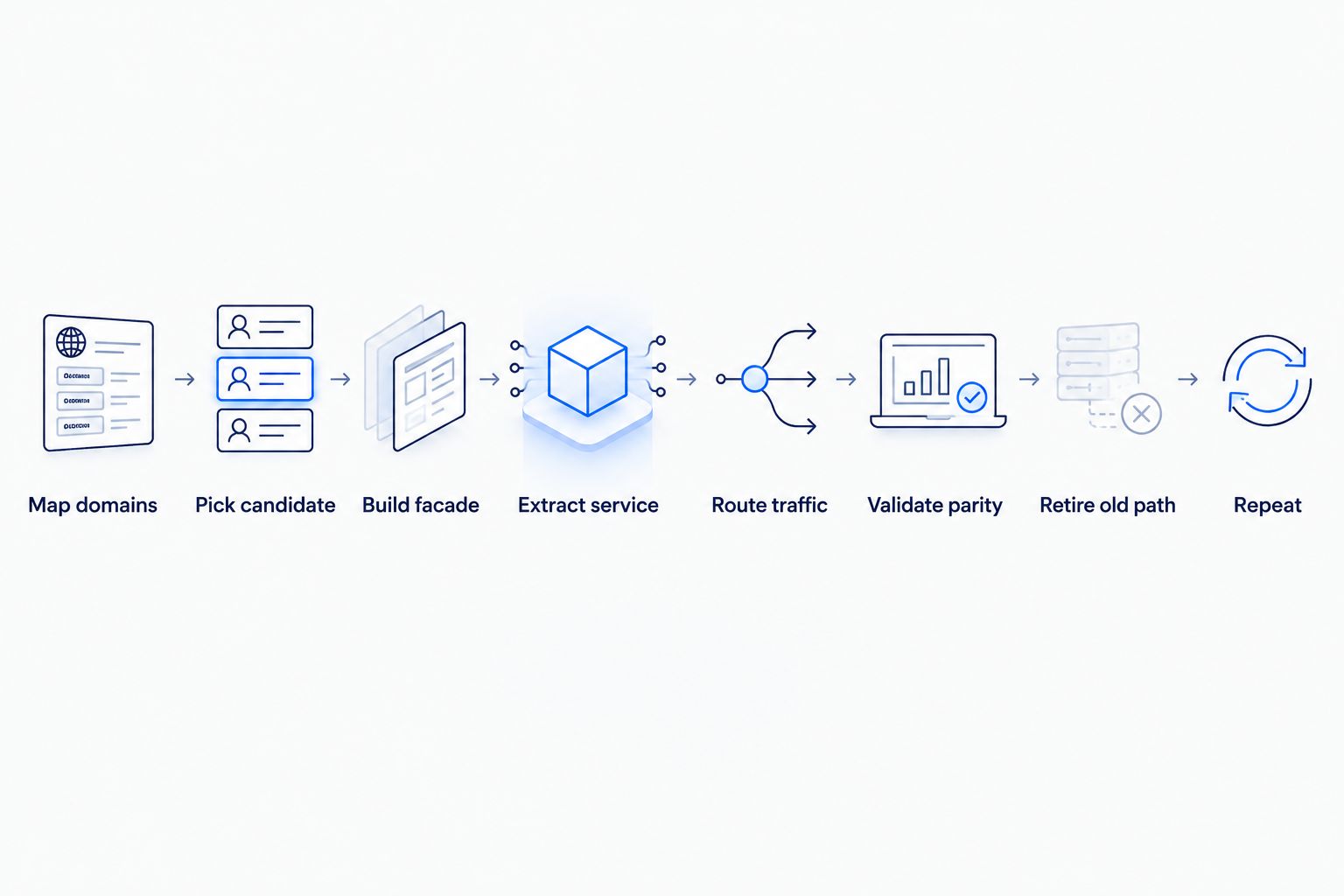
The process runs in eight repeatable steps, applied domain by domain rather than to the whole system at once:
- Map the monolith's domains. Identify the bounded contexts inside the codebase — billing, inventory, notifications — before touching a line of code.
- Pick the first extraction candidate. Choose a domain with low coupling to the rest of the system and clear business value, not the most exciting one.
- Build an API facade around it. Wrap the existing functionality behind an interface so callers don't know whether they're hitting the monolith or the new service.
- Extract the service and its data. Move the code and, separately, the data it owns into its own store — this step is where most timelines slip.
- Route traffic through a strangler facade. A routing layer decides, request by request, whether the monolith or the new service answers.
- Validate parity in production. Run both paths side by side and compare outputs before cutting traffic over fully.
- Retire the old code path. Once parity holds for a defined window, delete the monolith's version of that capability.
- Repeat for the next domain. Each pass gets faster because the routing and observability infrastructure is already built.
Teams working through this sequence often lean on AI-driven legacy code refactoring to speed up step 3 and step 4 — mapping dependencies and generating the facade code is exactly the kind of repetitive analysis that agentic tooling handles faster than a team doing it by hand.
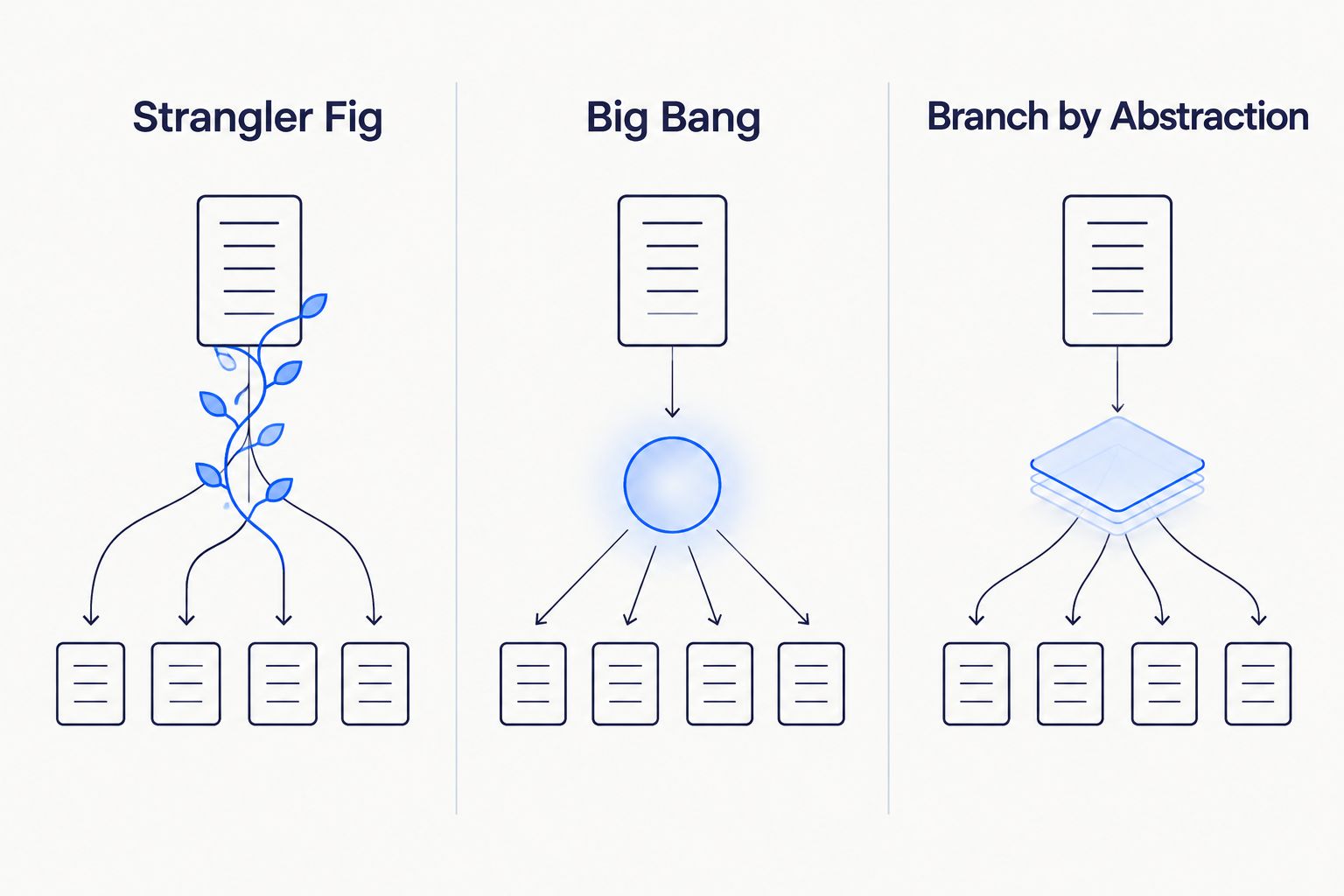
Strangler Fig vs. Big Bang vs. Branch by Abstraction
Three patterns cover almost every legacy monolith to microservices migration in 2026. They differ in risk profile, not in end state.
| Pattern | How it works | Best for | Verdict |
|---|---|---|---|
| Strangler Fig | Extract one domain at a time behind a routing facade | Enterprises that can't accept downtime or a frozen roadmap | Buy — the default choice for production systems |
| Big Bang Rewrite | Build the full microservices system in parallel, then switch over | Small systems with a hard deadline and low business risk | Skip — cutover risk is rarely worth it at enterprise scale |
| Branch by Abstraction | Introduce an abstraction layer inside the monolith, then swap implementations behind it | Teams that can't stand up parallel infrastructure yet | Hold — useful as a stepping stone into strangler fig, not an end state |
Why migration timelines vary
No two monolith migrations run on the same clock, even at similar company sizes. The variables that actually move the timeline:
- Data coupling. A monolith with one shared database across every table takes longer to split than one with clean module boundaries.
- Team structure. Conway's Law holds here — if one team owns the whole monolith, the extracted services tend to reassemble into a second monolith with extra network hops.
- Test coverage. Migrations without automated regression tests spend more time verifying parity by hand than writing new code.
- CI/CD maturity. Teams that already deploy independently per module move faster than teams still shipping one build for the whole system.
- Regulatory constraints. Data residency and audit requirements in regulated industries add review cycles that unregulated SaaS teams skip.
- Vendor and staffing gaps. Teams without in-house distributed-systems experience often bring in outside help rather than learn it mid-migration — worth checking a shortlist of legacy modernization companies before committing to a timeline internally.
How long does a monolith-to-microservices migration take?
Most enterprise migrations run in phases across multiple quarters rather than a single release, because each domain extraction includes its own build, validation, and cutover window. A system with a dozen bounded domains typically takes longer than a system with three or four, since the eight-step sequence repeats per domain rather than running once for the whole codebase.
Should you refactor the monolith or rewrite it from scratch?
Refactor, in nearly every case — a full rewrite means running two systems in parallel for the entire migration window with no partial wins along the way. Refactoring through the strangler fig pattern gets working microservices into production after the first domain extraction, not after the whole project finishes.
Do you need Kubernetes before you start migrating to microservices?
No — Kubernetes solves orchestration for services that already exist, not the extraction problem itself. Plenty of teams run their first two or three extracted services on simpler infrastructure and only adopt container orchestration once the service count justifies it.
KnackForge treats each of these variables as a scoping question before writing a migration plan, because a monolith with heavy data coupling and thin test coverage needs a different sequence than one with clean module boundaries and strong CI/CD. That's the difference between a migration that ships its first service in one quarter and one still debating architecture in its third.
Scope your microservices migration
Get a domain-by-domain migration plan before committing a team to it.
FAQ
What's the best way to migrate a legacy monolith to microservices?
The strangler fig pattern is the best approach for most enterprise systems in 2026 — extract one bounded domain at a time behind a routing layer instead of rewriting the whole system at once. It lets you ship working microservices before the full migration finishes and keeps the monolith running as a safety net.
Is a big-bang rewrite ever a good idea for microservices migration?
Rarely — a big-bang rewrite only makes sense for small, low-risk systems on a hard deadline. At enterprise scale the cutover risk of switching an entire system at once usually outweighs the speed benefit.
How much does it cost to migrate a monolith to microservices?
Cost depends on the number of bounded domains, the state of the shared database, and existing test coverage, so there's no single figure that applies across systems. A domain-by-domain scoping exercise is the standard way to build a real estimate before committing budget.
Do you need to migrate the database as well as the code?
Yes — splitting the shared database is usually the hardest part of a legacy monolith to microservices migration, harder than writing the new service code. Each extracted service needs its own data store to avoid recreating the tight coupling the migration was meant to remove.
What's the difference between strangler fig and branch by abstraction?
Strangler fig routes traffic between the monolith and a fully separate new service, while branch by abstraction inserts an abstraction layer inside the existing monolith first and swaps implementations behind it. Branch by abstraction works as a stepping stone when parallel infrastructure isn't ready yet.
Do you need Kubernetes to run microservices in production?
No, Kubernetes isn't required to start — it becomes useful once the number of extracted services grows enough to justify container orchestration. Early extractions can run on simpler infrastructure.
Can AI tools speed up a microservices migration?
AI-assisted tooling speeds up the analysis and facade-building steps — mapping dependencies inside legacy code and generating API wrappers — more than it speeds up the architectural decisions. Those decisions still need a team that understands the monolith's domain boundaries.
How do you know if a service is ready to be extracted?
A domain is ready when it has low coupling to the rest of the monolith and a team willing to own it end to end after extraction. Extracting a heavily coupled domain first is the most common reason migrations stall in 2026.
One last thing
The migrations that fail rarely fail on the code — they fail on ownership. If no single team owns an extracted service end to end, that service turns into a second monolith with extra network calls attached, and the organization ends up worse off than before it started. Assign ownership before you extract the first domain, not after.


