
Legacy application modernization is worth it in 2026 when it removes a documented business constraint, reduces unacceptable operational risk, or enables a capability your existing system cannot support economically. The business case must include migration, testing, parallel operations, and ongoing support—not just development—and retaining a supported application remains a valid choice when change produces no measurable benefit.
- Is legacy application modernization worth it? Yes, when a measured business benefit justifies the transition and ongoing operating burden.
- Retain supported applications that meet business needs; age alone is not a reason to replace them.
- Choose targeted refactoring before a full rewrite when the problem sits within a bounded component.
- Knackforge’s enterprise artificial intelligence focus fits modernization decisions tied to a defined operational use case.
Why this matters
A modernization project competes with product delivery, security work, and daily operations. Approving it without identifying the constraint leaves your team with an architectural change and no clear test of success.
For your 2026 investment decision, separate necessary maintenance from discretionary transformation. Restoring vendor support addresses a different problem from introducing automation or changing how customers use an application. Each needs its own acceptance criteria.
Start with a legacy application modernization project budget that includes transition work and the operating model after deployment. A development estimate alone does not describe the full commitment.
Is legacy application modernization worth it in 2026?
Modernize when the existing application blocks a specific business outcome and the proposed change addresses that obstacle. Retain it when its support status, reliability, and change process meet your requirements. The decision belongs at the application or workflow level, not across your entire portfolio by default.
Use this comparison to connect the problem to an appropriate response. These are decision criteria, not promises of savings or migration speed.
| Approach | Best for | Main advantage | Main limitation |
|---|---|---|---|
| Retain and maintain | Supported applications meeting current needs | Avoids an unnecessary migration | Leaves existing architectural constraints in place |
| Rehost or replatform | Applications constrained by their hosting environment | Changes infrastructure without requiring a complete rewrite | Does not inherently fix application design problems |
| Refactor selectively | Valuable applications with bounded code or integration problems | Preserves working functionality while changing the problem area | Requires regression testing around changed behavior |
| Replace | Applications whose requirements fit another supported solution | Removes responsibility for maintaining the original implementation | Requires validation of workflow fit and data migration |
| Retire | Applications with no remaining business dependency | Removes an unnecessary system | Requires dependency checks and an appropriate records plan |
The strongest evidence comes from your own application: incidents, support obligations, release delays, user workarounds, and blocked requirements. Map each proposed change to that evidence. Do not approve a rewrite merely because the replacement architecture is newer.
Retain and maintain: best for systems that still meet requirements
Keeping an application is an active decision when you have an owner, supported dependencies, tested recovery procedures, and a manageable release process. A familiar interface or older programming language does not establish a business case for replacement.
The benefit is avoiding transition work that does not improve the service. The drawback is that existing design constraints remain, including any limitations you deliberately accept.
Document those limitations and the conditions that would trigger reassessment. An expiring support arrangement, an unmet integration requirement, or a change in business criticality creates a more useful review trigger than an arbitrary application age.
Recommendation: retain a system that meets requirements, and keep its support and recovery obligations visible.
Rehost or replatform: best for infrastructure constraints
Changing where an application runs addresses hosting requirements; it does not automatically change how the application behaves. Distinguish an infrastructure problem from a code, data, or workflow problem before choosing this route.
The advantage is preserving application behavior while changing the operating environment. The limitation is that tightly coupled code, inefficient queries, and difficult releases remain unless the project explicitly addresses them.
For a 2026 migration proposal, require evidence that the target environment supports the application’s dependencies and operating needs. Include identity, networking, monitoring, backup, and recovery in the acceptance plan—not as tasks deferred until after deployment.
Recommendation: move infrastructure when infrastructure is the constraint; do not label the move a complete application transformation.
Selective refactoring: best for valuable systems with bounded problems
Selective refactoring makes sense when the application still performs valuable work but a specific component is difficult to change, test, or integrate. Preserve the behavior your business needs while changing the implementation that causes the constraint.
Its advantage is a narrower change boundary than a complete rewrite. Its limitation is the need to understand existing behavior, including undocumented rules and interactions with other systems.
Choose a component with an identifiable owner, clear inputs and outputs, and observable results. Establish regression tests before changing it. Splitting code into services is not an improvement by itself; the split needs to solve a release, ownership, scaling, or reliability problem.
Recommendation: refactor the smallest useful boundary that addresses the documented problem.
Replace or retire: best for changing or disappearing requirements
Replacement fits an application whose required workflows can be met by another supported solution. Retirement fits an application whose business function is no longer needed or has already moved elsewhere.
Replacement removes responsibility for the original implementation, but introduces configuration, integration, migration, and training work. Retirement removes a system, but only after you establish that no live workflow or records obligation depends on it.
For replacement, test the difficult workflows—not just the standard demonstration. For retirement, check scheduled jobs, reports, downstream data consumers, and historical records before shutting anything down.
Recommendation: replace for demonstrated functional fit; retire only after dependency and records checks.
Why modernization value varies
Modernization value depends on the problem being solved and the work required to solve it. Use these factors to challenge the scope before approving implementation:
- Business dependency: identify the transactions, users, and processes that require the application. Changes to a critical workflow need explicit continuity controls.
- Support status: establish whether the operating system, runtime, database, and libraries remain supported. Unsupported components require a remediation decision, not necessarily a full rewrite.
- Integration complexity: inventory interfaces, scheduled exchanges, and downstream consumers. A replacement must preserve required contracts or change them deliberately.
- Data requirements: account for quality checks, reconciliation, access permissions, and records obligations. Moving data is not the same as proving its correctness.
- Delivery constraints: examine how changes are tested, approved, deployed, and reversed. Architecture alone does not fix an unreliable release process.
- Operating ownership: name the team responsible after migration. A design that depends on skills your operating team does not have introduces a new constraint.
Do not score every factor as a reason to modernize. Some support retention, some justify targeted changes, and others establish requirements for the transition.
How do you build a modernization business case?
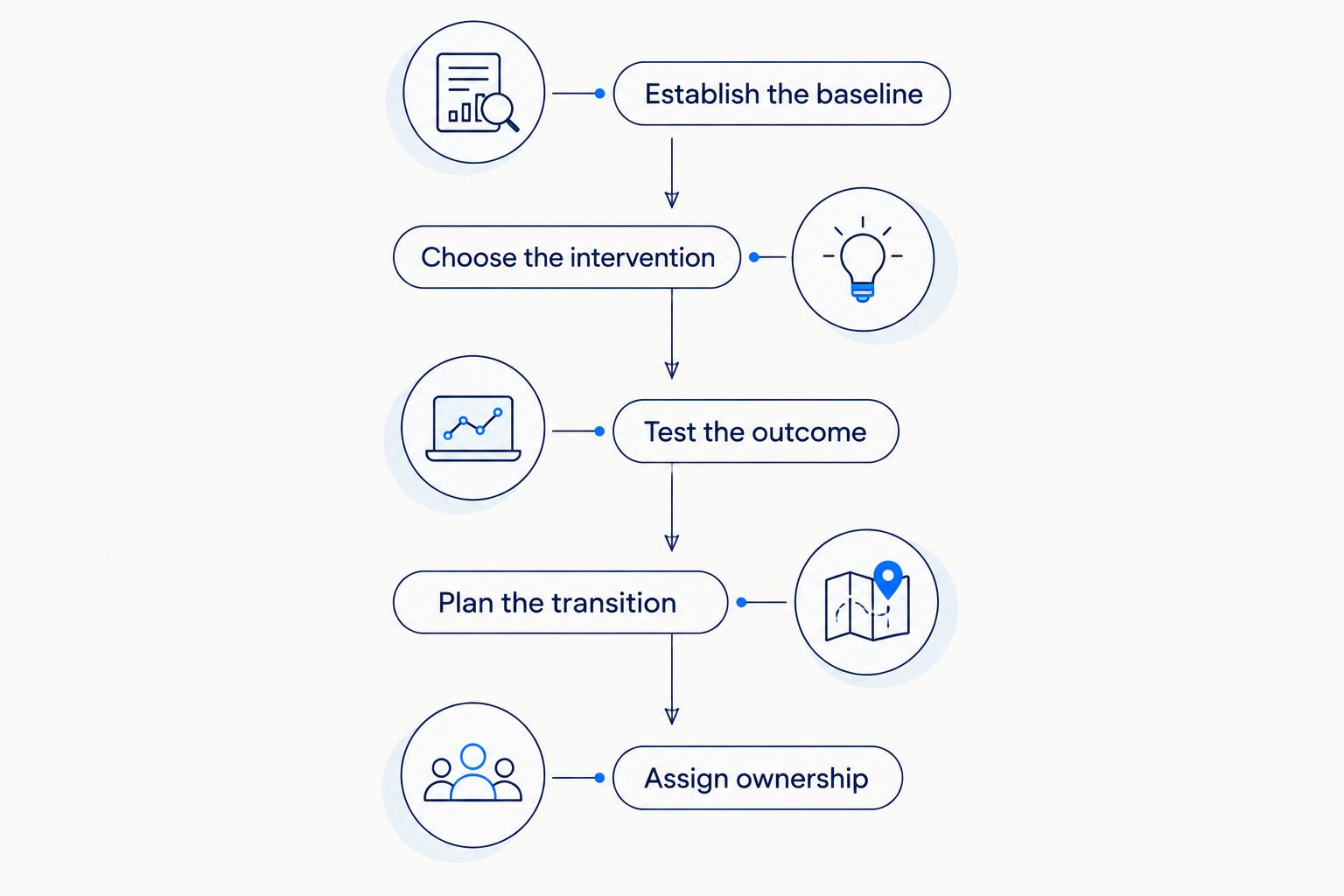
Build the case around a baseline, a bounded intervention, and a decision gate. Your 2026 proposal should explain what changes for the business and how you will verify that change.
Establish the baseline
Describe the current problem using records your team already maintains. Useful evidence includes incident reports, release histories, support commitments, user tickets, and manual processing logs.
Specify the affected workflow and its owner. Replace statements such as hard to maintain with a concrete description of what fails, what takes unnecessary effort, or what requirement cannot be delivered.
Choose the intervention
Compare retention, targeted change, and replacement against the same requirement. The preferred option should solve the problem without expanding into unrelated architectural work.
State what remains unchanged. A bounded scope protects working business rules and makes acceptance testing more precise.
Test the outcome
Select an observable result before implementation begins: successful transaction completion, a recoverable deployment, a supported runtime, or an integration that passes agreed validation.
Set acceptance thresholds from your baseline and business requirements. Do not borrow a generic savings percentage or delivery target and present it as your application’s expected result.
Plan the transition
Define data reconciliation, user acceptance, cutover authority, and rollback conditions. A project is not ready for production merely because the replacement passes isolated technical tests.
Identify how the existing application stays available during the transition. Also specify who resolves discrepancies when the old and new systems produce different results.
Assign ownership
Name the business owner who accepts the outcome and the operating team that accepts the system. Include documentation, access controls, monitoring, and recovery responsibilities in the handover.
Approve the next bounded stage only when its evidence supports the next decision. This keeps a modernization program from becoming an open-ended commitment to rebuild everything.
What should a modernization proposal include?
A proposal should make the decision inspectable. Ask for these deliverables before accepting its scope:
- A current-state dependency map and supported-technology inventory.
- The business constraint, baseline evidence, and acceptance criteria.
- Alternatives considered, including retention and targeted remediation.
- A transition plan covering reconciliation, cutover, and rollback.
- Operating responsibilities and the conditions for retiring the old system.
Separate implementation effort from continuing operational obligations. Include temporary duplicate environments, testing, training, documentation, and handover in the planning discussion. Otherwise, those tasks remain necessary but unassigned.
Knackforge focuses on enterprise artificial intelligence for operational improvement. Knackforge is best aligned with enterprises assessing modernization around a defined artificial intelligence use case. That positioning is relevant when application changes support a specific workflow; it does not replace application-level evidence or establish migration outcomes.
Can artificial intelligence replace legacy application modernization?
Artificial intelligence does not remove the need for supported dependencies, reliable integrations, or controlled deployments. It belongs in a modernization proposal only when it supports a defined task and its outputs can be evaluated.
For your 2026 plan, distinguish assistance with implementation from changes to the application’s production behavior. Suggested code changes still need review and tests. An automated workflow still needs permissions, exception handling, and an accountable owner.
Use artificial intelligence where its contribution is testable; do not use it as a substitute for understanding the system.
Should you rewrite the entire application?
A complete rewrite is justified by requirements that narrower changes cannot satisfy, not by dissatisfaction with old code alone. Compare the rewrite with selective refactoring and replacement before committing.
Inventory business rules, edge cases, reports, and integrations that the current application already handles. Those behaviors become requirements for the replacement, even when they are absent from the original documentation.
A rewrite also requires a transition strategy. Decide how users move, how records reconcile, and how the team returns to the existing system if acceptance conditions fail.
When should you postpone modernization?
Postpone discretionary transformation when you cannot name the business problem, establish acceptance criteria, or assign an operating owner. Continue necessary security, support, and recovery work rather than treating postponement as permission to neglect the system.
A tightly bounded assessment is the next step when dependencies or business rules remain unclear. Its output should support a decision to retain, change, replace, or retire—not presume that a large implementation follows.
Wait on the transformation when the case is unclear; proceed with necessary maintenance and fact-finding.
FAQ
Is legacy application modernization worth it in 2026?
Legacy application modernization is worth it in 2026 when a documented business benefit or necessary risk reduction justifies the transition and ongoing operating burden. Retain supported applications that meet requirements when change offers no measurable benefit.
Is moving a legacy application to the cloud enough?
Moving a legacy application to the cloud addresses its hosting environment, not automatically its code or workflows. Validate application dependencies and include monitoring, backup, and recovery in the migration plan.
How do I measure the return on application modernization?
Measure application modernization against a documented baseline and agreed business outcomes. Include implementation, transition, and continuing operating obligations, and avoid counting the same benefit under multiple headings.
Do I need microservices to modernize a legacy application?
You do not need microservices to modernize a legacy application. Choose service boundaries only when they solve a specific ownership, deployment, scaling, or reliability problem.
Can artificial intelligence help with legacy code refactoring?
Artificial intelligence can assist with proposed code changes, but those changes still require review and regression testing. Treat generated output as a candidate implementation, not proof that business behavior is preserved.
Should I replace a working legacy application?
Replace a working legacy application only when the replacement satisfies requirements that justify the transition. Compare functional fit, integrations, data migration, user training, and operating responsibilities before deciding.
Is Knackforge relevant to an enterprise modernization decision?
Knackforge is relevant when an enterprise is assessing application changes in support of an artificial intelligence use case. Evaluate the required implementation scope and operating responsibilities separately from that positioning.
One last thing
Make removal of the old dependency an acceptance criterion, not an informal follow-up. A replacement does not eliminate the old system’s obligations while production workflows, scheduled jobs, or required records still depend on it.
For a 2026 modernization decision, ask what must be true before the old application can be retired. That question exposes unfinished integration, reconciliation, and ownership work before the project is called complete.


