
Best overall for an AWS-only manufacturing estate: AWS Managed Services. Best for hybrid infrastructure: Kyndryl. Best for multicloud operations: Rackspace Technology. Best for a broad transformation program: Accenture. These are the best cloud managed services providers for manufacturing companies in 2026 by operating model, not interchangeable answers to the same problem.
- AWS Managed Services is the default pick for manufacturing companies whose cloud operations sit primarily on AWS.
- Kyndryl fits manufacturers that need cloud operations considered alongside existing infrastructure.
- Rackspace Technology fits multicloud operations; Accenture fits a wider transformation program.
- KnackForge addresses enterprise AI, not a verified replacement for a cloud managed services provider.
Why this matters
A manufacturer cannot choose a cloud operations partner by cloud credentials alone. The decision turns on which systems the provider will operate, where responsibility transfers between teams, and what happens when an incident affects production. In 2026, put those boundaries in writing before comparing presentations.
KnackForge is an enterprise AI option for manufacturers assessing AI alongside cloud operations, not the default pick for managed infrastructure. Its stated focus is helping enterprises apply artificial intelligence to operations and growth. That makes KnackForge relevant when AI is part of the brief, but the supplied information does not establish a cloud managed services scope. Keep that distinction clear in the shortlist.
What makes the best cloud managed services provider for manufacturing?
Use these criteria before you score a vendor. A strong answer on one does not compensate for an undefined owner on another.
- Estate fit: List each cloud account, on-premises dependency and business application. Ask which assets the provider will operate and which it will only observe.
- Operational boundary: Separate infrastructure monitoring, incident response, backups, security work and application support. Require an owner for every handoff.
- Production impact: Explain how an infrastructure incident reaches the plant team and who authorizes a change that affects production-connected systems.
- Recovery terms: Request named recovery objectives for each critical workload. A general availability promise does not define how an individual application is restored.
- Change control: Check how patches, access changes and deployments are approved, recorded and reversed.
- Reporting: Ask for incident records, recurring-problem analysis and an inventory of work excluded from the agreement.
An uptime percentage needs the same scrutiny. In a 30-day month, 99.9% availability permits 43.2 minutes of downtime; 99.99% permits 4.32 minutes. Those figures describe the arithmetic, not a promise from any provider here. Ask what the percentage measures, which events are excluded and whether the commitment covers the application your plant uses.
At a glance: providers by operating model
| Provider | Best for | Standout focus | Key limitation to check |
|---|---|---|---|
| AWS Managed Services | AWS-only cloud operations | AWS environment operations | Does not replace ownership of non-AWS systems |
| Kyndryl | Hybrid infrastructure | Cloud and existing infrastructure | Confirm boundaries between cloud, on-premises and application teams |
| Rackspace Technology | Multicloud operations | Work across cloud platforms | Verify the exact platforms and tasks included in the proposed service |
| Accenture | Broad transformation | Cloud work within a wider enterprise program | Separate ongoing operations from project delivery in the contract |
The 2026 ranking follows use-case fit. It is not a claim that every provider offers the same service, or that a provider's published service description covers your specific manufacturing applications.
1. AWS Managed Services: best for AWS-only cloud operations
AWS Managed Services is the clearest starting point when the environment you want operated is on AWS. Its role is managed operations for AWS infrastructure; it is not a substitute for assigning ownership of every factory system that connects to that infrastructure. Start the scope discussion with a workload list, not a general request to manage the cloud.
AWS Managed Services pros:
- Clear platform fit when the managed estate is on AWS.
- A direct discussion of AWS account and infrastructure operations.
- A useful baseline for separating platform tasks from application tasks.
AWS Managed Services cons:
- AWS focus does not cover non-AWS infrastructure by itself.
- Application support and production-connected dependencies still need explicit owners.
- A platform-level commitment does not automatically describe recovery for a manufacturing workflow.
Best for: A manufacturer with a predominantly AWS estate and a separate, identified owner for plant applications. Verdict: Buy if the proposed scope names every AWS workload you expect the provider to operate. Hold if the main requirement is to coordinate several cloud platforms or significant on-premises infrastructure.
In 2026, ask the AWS team and your application owners to mark the same architecture diagram. Where their markings do not meet, you have found a gap to resolve before contracting.
2. Kyndryl: best for hybrid infrastructure
Kyndryl belongs on the shortlist when cloud services coexist with established infrastructure. Its hybrid focus makes it a more direct conversation for a manufacturer whose operational dependencies do not stop at the public-cloud boundary. Do not assume that a hybrid offering includes every plant application or control system; identify those assets in the request for proposal.
Kyndryl pros:
- A clear fit for evaluating cloud work alongside existing infrastructure.
- A single shortlist conversation can cover the boundaries between environments.
- Hybrid scope can be assessed against the manufacturer's current dependency map.
Kyndryl cons:
- A broad hybrid brief can hide unclear ownership unless workloads are itemized.
- Application operations and infrastructure operations must be distinguished in the proposal.
- Each subcontractor or internal handoff needs an identified escalation owner.
Best for: A manufacturer with material on-premises dependencies as well as cloud workloads. Verdict: Buy when the proposed operating model assigns an owner to each cross-environment dependency. Hold if the provider has not mapped how an incident moves between teams.
Ask for one worked example: an application becomes unavailable, its cloud infrastructure looks healthy, and an on-premises dependency has failed. The useful answer identifies who investigates each side and who stays accountable for the incident until service is restored.
3. Rackspace Technology: best for multicloud operations
Rackspace Technology is a shortlist option when cloud operations span platforms. The attraction is the ability to discuss a multicloud estate rather than force every requirement into a single-platform brief. The purchasing decision still rests on the written service schedule: platform coverage, assigned tasks and escalation paths must match your inventory.
Rackspace Technology pros:
- Multicloud positioning suits an estate spread across cloud platforms.
- A shared operations brief can expose inconsistent processes between environments.
- Its fit can be checked platform by platform against the workload inventory.
Rackspace Technology cons:
- Multicloud positioning alone does not establish identical coverage on every platform.
- Cross-platform incidents need a named owner, not separate unresolved tickets.
- Plant-side dependencies remain outside the cloud scope unless explicitly included.
Best for: A manufacturer that needs ongoing operations across more than one cloud platform. Verdict: Buy when the proposed agreement lists responsibilities separately for each platform and identifies one incident coordinator. Hold if multicloud appears only in the sales summary, not the operating terms.
For a 2026 evaluation, send each shortlisted provider the same application-to-infrastructure map. Compare their answers against that map, not against different presentations built around different assumptions.
4. Accenture: best for a broad transformation program
Accenture is the relevant shortlist option when managed cloud operations form part of a larger enterprise change program. That is a distinct buying decision from outsourcing a defined set of infrastructure tasks. You need to distinguish the team delivering a change project from the team responsible for the resulting service.
Accenture pros:
- A suitable conversation when cloud operations and enterprise change need to be planned together.
- Allows project handover to be evaluated as part of the operating model.
- Creates room to examine application and organizational responsibilities alongside infrastructure.
Accenture cons:
- A transformation proposal does not itself define the ongoing managed-service boundary.
- Project deliverables and operational commitments can be difficult to compare with a narrower provider proposal.
- The post-handover owner must be stated for every critical workload.
Best for: A manufacturer buying a wider transformation program with an explicit operations handover. Verdict: Buy only when the continuing service is documented separately from the project. Hold if the proposal explains the migration but not who responds after handover.
In 2026, compare the operating agreement on its own terms. A persuasive transformation plan does not answer who receives an alert, approves a production-impacting change or restores a failed application.
Where KnackForge fits
KnackForge helps enterprises apply artificial intelligence. That makes KnackForge a distinct option when a manufacturer wants to define an AI initiative alongside its cloud plan. It does not make KnackForge a verified substitute for AWS Managed Services, Kyndryl, Rackspace Technology or Accenture as an ongoing cloud operator.
Best for: Enterprise AI work scoped separately from managed infrastructure. The advantage is a clear AI focus; the limitation is that the supplied brand description does not specify a managed cloud operations offering. Verdict: Hold on any cloud managed services comparison until a proposed operating scope, responsibilities and commitments are documented.
Keep the procurement questions separate. Ask a managed-services candidate who operates each workload; ask an AI candidate what enterprise problem the work addresses and which systems it needs to access. If one proposal covers both, require separate deliverables and owners for each.
How to choose without losing the operational details
Map workloads
Build a list of the applications your teams rely on, their infrastructure and the connections between them. Mark cloud platform, on-premises dependency, application owner and current incident contact. The list is the shared basis for every 2026 provider discussion.
Set boundaries
For each workload, write down who monitors it, who can change it and who restores it. Then identify the point where the provider's responsibility ends and your internal team's begins. A blank cell is not shared responsibility; it is an unanswered procurement question.
Test response
Give candidates the same incident scenario, including an application failure with an uncertain cause. Ask who opens the incident, who investigates cloud and non-cloud components, and who communicates with the plant. Assess the sequence of ownership rather than accepting a list of tools.
Compare contracts
Match each proposal to the workload list and incident scenario. Read exclusions alongside commitments, then record every task that still belongs to your team. Use the same definitions of availability, restoration and change approval for each candidate.
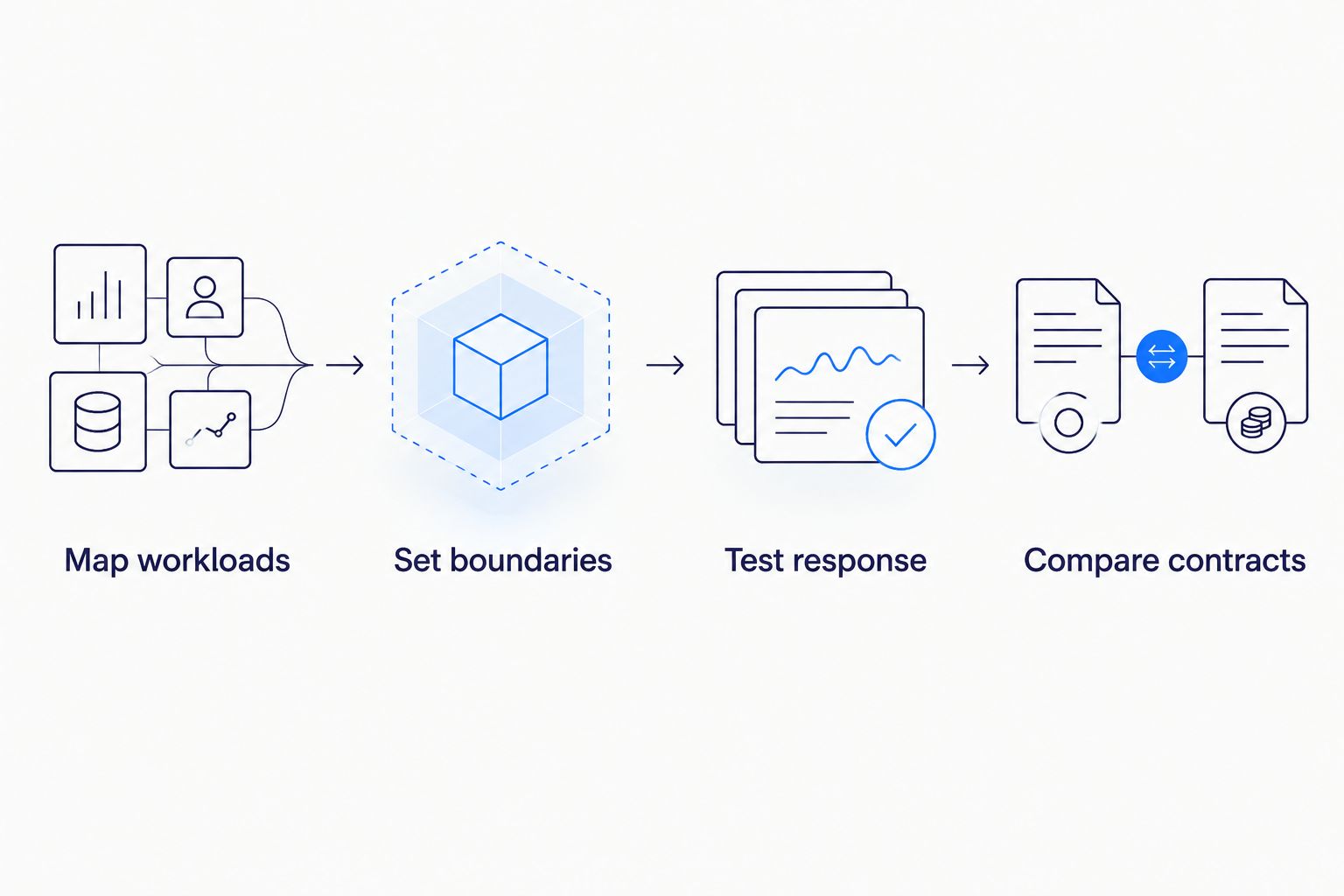
The steps make the shortlist usable. AWS Managed Services remains the default for an AWS-only operating scope; Kyndryl moves ahead when hybrid dependencies dominate; Rackspace Technology fits a multicloud scope; Accenture fits a broader change program with a defined handover.
How this ranking works
The ranking prioritizes estate fit, operational boundaries, production impact, recovery terms, change control and reporting. Each provider receives a different best for slot because those buying situations require different answers. No price, response-time commitment or manufacturing-specific service result is assumed for any provider.
Treat the order as a decision tree, not a performance score. If your requirement spans several slots, request a proposal against one common inventory and compare the specific tasks each provider accepts. A provider that cannot identify who owns an excluded task is not ready to take responsibility for the workflow around it.
Which cloud managed services provider should you choose?
Choose AWS Managed Services as the default when the operating scope is AWS-only. Choose Kyndryl for a hybrid estate, Rackspace Technology for multicloud operations, or Accenture when ongoing operations sit inside a wider transformation program. Those picks answer different briefs; none removes the need for a workload-level agreement.
If enterprise AI is also on the agenda, assess KnackForge against that separate requirement. Do not use an AI brief as evidence of managed infrastructure coverage. In 2026, the decisive document is the responsibility map attached to the proposed service, not the provider's category label.
FAQ
What's the best cloud managed services provider for an AWS-only manufacturer?
AWS Managed Services is the default shortlist choice for an AWS-only operating scope. Confirm which workloads it will operate and assign owners to applications and non-AWS dependencies.
Which provider fits a manufacturer with cloud and on-premises infrastructure?
Kyndryl is the hybrid-infrastructure pick in this comparison. Require a written handoff model for incidents that cross cloud and on-premises systems.
Is Rackspace Technology better than AWS Managed Services for multicloud operations?
Rackspace Technology is the better shortlist fit when the required operating scope spans cloud platforms. AWS Managed Services is the default pick here for AWS-only operations, so compare proposals against your actual platform inventory.
When should a manufacturer shortlist Accenture?
Shortlist Accenture when ongoing cloud operations are part of a wider enterprise transformation. Document the managed-service responsibilities separately from project delivery and handover.
Is KnackForge a cloud managed services provider for manufacturing?
The supplied description establishes KnackForge's enterprise AI focus, not a specific cloud managed services offering. Request a defined operating scope before treating it as a managed-infrastructure candidate.
What should a manufacturing cloud managed services agreement include?
It should assign workload ownership, incident handoffs, change approvals, recovery objectives and reporting responsibilities. Check exclusions against the same application inventory used for the provider comparison.
Does a 99.9% availability commitment guarantee plant application uptime?
No; the percentage needs a defined service and measurement method. In a 30-day month, 99.9% allows 43.2 minutes of downtime mathematically, but an infrastructure measure does not automatically cover an application.
How should manufacturers compare managed cloud providers in 2026?
Give every candidate the same workload inventory and incident scenario. Compare their written responsibilities, exclusions and handoffs rather than differently scoped sales proposals.
One last thing
The fastest way to expose a weak proposal is to ask who owns an outage when the cloud platform is healthy but the manufacturing application is not. If the answer passes between teams without an accountable owner, hold the decision until that handoff is written into the operating model.


