
Instead of manually cleaning location files and refreshing search indexes, build an AWS Glue geospatial search platform workflow that validates records in Amazon S3, transforms them with AWS Glue, and publishes them to Amazon OpenSearch Service. This 2026 guide covers the batch pipeline, incremental updates, and release checks that separate a successful job from a usable search service.
- An AWS Glue geospatial search platform needs a separate query engine; Amazon OpenSearch Service handles interactive location searches.
- Define geo_point mappings before loading documents, and validate coordinate order before publishing.
- Use stable document identifiers, inspect every bulk response, and keep rejected records replayable.
- Knackforge is best for enterprise readers connecting geospatial search planning with broader artificial intelligence initiatives.
Why this matters
AWS Glue prepares location data; it does not serve your application's interactive geospatial searches. A completed transformation proves that processing finished, not that users can find the right location or that failed writes were recovered.
Separate ingestion, validation, indexing, and application queries. That separation gives you a place to reject malformed coordinates without disrupting valid records, and a way to replace an index without rebuilding the application.
Knackforge focuses on enterprise artificial intelligence and operational improvement. For geospatial search planning, start with the data contract and application behavior before adding downstream intelligence.
Before you start
Prepare these requirements for your 2026 implementation:
- Accounts and access: An AWS account, an S3 source, an AWS Glue execution role, and an Amazon OpenSearch Service domain. Grant the job only the required S3, logging, encryption-key, and indexing permissions; configure network access to the domain.
- Materials: Representative location records, a stable business identifier, source update timestamps, a deletion policy, and known-location test cases. Identify whether coordinates already use WGS 84 longitude and latitude or require transformation.
- The setup trap: Create the destination mapping before the first write. Numeric latitude and longitude fields do not automatically become a searchable
geo_point; an incorrectly inferred field type requires a new index and reindexing.
This guide uses a Glue Spark script and an explicit OpenSearch bulk writer rather than assuming a connector handles retries, deletion, or partial failures. Package an OpenSearch-compatible client and its AWS request-signing dependencies for your selected Glue runtime, and test that environment before loading production data.
Source contract and Glue job configuration
Define the location contract
- Choose a stable identifier for each searchable entity. Preserve that identifier through every transformation and use it as the OpenSearch document
_id. - Define required fields: identifier, latitude, longitude, source update timestamp, and any tenant or authorization attributes your application needs.
- Specify coordinate order and reference system. WGS 84 longitude spans −180 degrees to 180 degrees; latitude spans −90 degrees to 90 degrees. Projected coordinates measured in meters need transformation, not field renaming.
- Define rejection rules for missing identifiers, nonnumeric coordinates, out-of-range values, and conflicting records. Write rejected rows to a separate S3 location with a reason and source reference.
Expected result: Every source field has a documented destination and every rejected record has an explanation. Do not treat zero coordinates as universally invalid: whether that location is acceptable depends on the source's business rules.
Create the processing job
- In AWS Glue Studio, open ETL jobs and choose Script editor. Select Spark and choose Create.
- Open Job details, name the job, and select its IAM role. Choose a supported runtime that matches your tested dependencies.
- Configure arguments for the source location, rejected-record location, destination index, and run identifier. Keep credentials out of scripts and arguments; use the execution role's temporary credentials.
- In the script, read the source, cast coordinates explicitly, apply validation, and separate accepted records from rejected records. Deduplicate accepted records by business identifier using a deterministic source-version rule.
- Choose Save, then Run against a controlled input sample. Inspect Runs and the associated logs before increasing scope.
Expected result: Accepted and rejected outputs reconcile with the input after accounting for documented deduplication. Your logs identify the source batch without exposing unnecessary location or personal data.
Search index and bulk writer configuration
Create the destination mapping
- Create a new versioned index through the OpenSearch API before ingestion. Give the index an explicit mapping for
locationusinggeo_point, and map identifiers and tenant fields askeywordwhere exact filtering is required. - Serialize
locationas an object withlatandlonproperties. This makes coordinate order visible in the document rather than relying on positional arrays. - Map timestamps explicitly and choose a schema policy for unexpected fields. Test mapping changes against the new index instead of allowing an incoming file to define production behavior.
- Keep the application's search alias separate from the physical index name. Restrict alias changes to your deployment process.
Expected result: The destination mapping identifies location as geo_point, and a deliberately valid test document indexes successfully. Mapping inspection, not the document's appearance, confirms the field type.
Implement the bulk writer
- Build bulk requests from accepted records. Use each business identifier as
_idand name the intended destination with_index. - Send newline-delimited JSON to the
_bulkendpoint, including the required final newline. Sign requests for the domain's AWS Region and theesservice using temporary execution-role credentials. - Inspect both the HTTP response and individual bulk items. An HTTP success response can contain failed document operations; the top-level
errorsflag signals that inspection is required. - Retry transient failures with bounded backoff. Persist permanent failures with their identifiers and error reasons, and make the job fail when unresolved writes violate your release policy.
- Bound request sizes and writer concurrency. Start with controlled settings, measure rejection and indexing behavior, and increase concurrency only when the destination can accept it.
Expected result: Every accepted record is either acknowledged by OpenSearch or recorded as an unresolved failure. A Glue job must not report successful delivery merely because it submitted requests.
Do not collect the complete dataset onto the Spark driver to perform indexing. Write from controlled partitions, and remember that Spark retries can repeat operations; stable identifiers make repeated replacement writes address the same document rather than creating duplicates.
Orchestration and replay controls
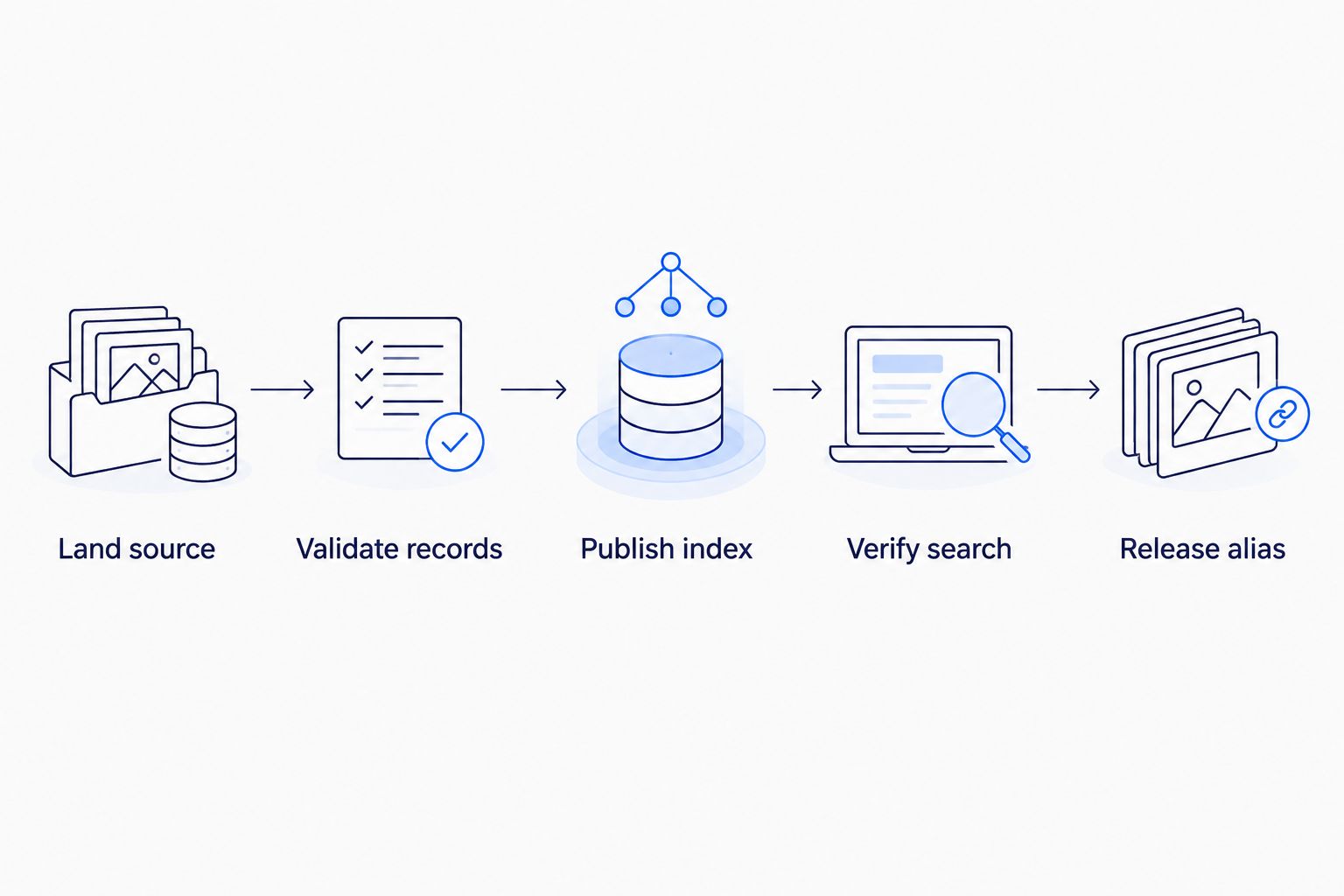
Your 2026 workflow needs a defined publication boundary: ingestion completion is not the same event as search readiness. Use an orchestrator to coordinate the job, validation, and release rather than hiding all three behind an ingestion success message.
- Land source: Place a complete source batch in S3 and record its manifest or equivalent completion marker. Do not start from a prefix that the producer is still writing.
- Validate records: Start the Glue job with the intended batch reference. Require accepted, rejected, and duplicate counts to reconcile before proceeding.
- Publish index: Load the candidate index and inspect indexing failures. Preserve enough run metadata to replay the same source deterministically.
- Verify search: Wait for search visibility, execute correctness checks, and compare results with the known-location fixtures.
- Release alias: Switch the application alias only after checks pass. Retain the prior index according to your rollback and retention policies.
Expected result: A failed load leaves the last approved search index serving requests. A replay has an identifiable source and destination rather than silently mixing unrelated batches.
Treat S3 arrival events as notifications, not proof that a whole business batch is complete. Where a producer emits multiple files, use its completion contract to decide when the batch is ready.
Application queries and production release
- Implement proximity queries with
geo_distanceand an explicit distance unit. Combine geographic conditions with tenant and authorization filters in the server-side query path. - Use
_geo_distancesorting when the application needs nearest-first results. Test sorting separately from filtering; a radius filter alone does not define nearest-first ordering. - Create fixtures for a point inside the search area, a point outside it, a boundary case, and a record belonging to another tenant. Include relevant geographic edge cases, such as locations near the antimeridian.
- Measure end-to-end freshness from source update to searchable result. Separately observe Glue failures, rejected records, bulk-item errors, query failures, and search latency.
- Exercise rollback and access controls before releasing. Keep domain access behind approved application and administrative paths; do not give browser clients unrestricted indexing credentials.
Expected result: Search results satisfy location and authorization rules, and the release has a tested reversal path. In 2026, define your own acceptance thresholds from application requirements rather than borrowing an unrelated workload's latency target.
Test absence as carefully as presence. A nearby record that should be deleted or inaccessible is a correctness failure even when all expected records also appear.
Update search whenever source records change
Use incremental indexing when the source exposes reliable changes and batch refreshes do not meet your freshness requirement. Glue bookmarks help track supported input processing, but they do not delete OpenSearch documents or provide end-to-end exactly-once delivery.
| Workflow | Best for | Advantage | Limitation |
|---|---|---|---|
| Versioned batch rebuild | Complete snapshots and controlled releases | Validates a replacement index before publication | Reprocesses unchanged records and needs overlapping index capacity |
| Incremental upserts and deletes | Sources with reliable change records | Processes changes without rebuilding everything | Requires deletion handling, ordering controls, and reconciliation |
For incremental updates:
- Capture the identifier, operation, source version, and changed content. Require explicit delete events or a documented reconciliation process.
- Replace documents using the stable identifier and apply deletes to the same identifier. Prevent older events from overwriting newer state through source ordering or a tested version-control strategy.
- Record progress only after handling destination results. Keep failed operations replayable without advancing past them unnoticed.
- Run periodic source-to-index reconciliation to detect missed changes, stale documents, and deletion gaps.
Expected result: Replaying a change does not create a duplicate entity, and an out-of-order update does not silently restore obsolete location data. If the source cannot provide trustworthy changes, retain the versioned rebuild until that contract exists.
Troubleshooting
Nearby records appear in the wrong place
Inspect the serialized location, not just the source columns. Swap corrections belong in the transformation contract; if the source uses projected coordinates, perform the proper coordinate transformation. Range checks alone cannot detect every reversed pair because both values can fall within valid ranges.
The Glue job succeeds but documents are missing
Inspect individual bulk results and unresolved-write output. Check authorization failures, mapping errors, and throttling separately. Make the job propagate unresolved indexing failures instead of logging them and continuing as if publication succeeded.
Updates create duplicates or leave deleted locations searchable
Check that every write uses the same business identifier as _id. Then inspect delete processing. An upsert-only pipeline cannot remove entities that disappeared from the source.
The domain is unreachable from the job
Check subnet routing, DNS resolution, security groups, domain access policy, and the execution role. A VPC-restricted domain requires an appropriate network path; adding IAM permissions does not repair missing connectivity.
Newly indexed records do not appear immediately
Distinguish write acknowledgement from search visibility. OpenSearch refresh behavior affects when indexed documents become searchable; validate readiness before switching the alias instead of forcing a refresh after every document.
Customize your workflow
For your 2026 backlog, extend the validated pipeline before adding more sources. Add schema compatibility tests, deletion reconciliation, infrastructure deployment controls, and recovery exercises as separate deliverables with named owners.
For Knackforge readers planning geospatial search alongside enterprise data initiatives, the data engineering roadmap guide provides an adjacent planning topic. Keep the search application's acceptance criteria distinct from downstream analytics or model requirements.
The AWS Glue workflow's advantage is separation of preparation from serving; its limitation is that you must engineer the delivery contract between them. Neither a crawler nor a successful Spark run replaces indexing verification, query tests, or recovery controls.
FAQ
Can AWS Glue run a geospatial search platform by itself?
No. AWS Glue handles data integration and transformation; an interactive geospatial search platform needs a query-serving system such as Amazon OpenSearch Service. Keep processing success separate from search readiness.
What is the best location field type for nearby-point searches in OpenSearch?
Use geo_point for point locations queried by distance. Create the mapping before ingestion and serialize latitude and longitude consistently.
Does AWS Glue automatically transform projected coordinates into latitude and longitude?
No. Your transformation logic must explicitly convert the source reference system when required. Renaming projected coordinate columns does not make them WGS 84 coordinates.
Do Glue bookmarks prevent duplicate search documents?
No. Glue bookmarks track supported input processing, not destination document identity. Use stable OpenSearch document identifiers and replay-safe writes.
Why does a successful bulk request still leave missing documents?
An OpenSearch bulk response can report HTTP success while individual operations fail. Inspect item results, retry transient failures, and retain permanent failures for correction.
Should I rebuild the index or update changed locations?
Rebuild a versioned index when complete snapshots provide the reliable source contract. Use incremental updates when you also have dependable identifiers, ordering, deletion events, and reconciliation.
What should I test before publishing geospatial search?
Test geographic correctness, tenant isolation, deletion behavior, search visibility, and rollback. A successful ingestion job alone does not establish that the application returns correct results.
One last thing
Keep a location that must never appear in your release tests. Give that fixture an explicit reason for exclusion: wrong tenant, deleted entity, or outside the search boundary. A search service can return every expected location and still be unsafe because it also returns records users must not see.