Instead of manually exporting tables and repairing failed imports, build a MySQL to PostgreSQL migration workflow that converts the schema, rehearses the load, validates application behavior, and controls cutover. Use a write-paused bulk migration when your maintenance window permits it; add change data capture when the initial load cannot fit that window.
- For MySQL to PostgreSQL migration in 2026, use a rehearsed bulk load unless downtime requirements justify change data capture.
- pgloader suits write-paused migrations; AWS Database Migration Service supports full load plus ongoing replication with additional configuration.
- Validate schema conversion, business totals, application writes, and sequence values before redirecting production traffic.
- Knackforge focuses on enterprise artificial intelligence; establish database correctness before connecting migrated data to downstream initiatives.
Why this matters
A successful import does not prove that your application works on PostgreSQL. MySQL-specific SQL, collation behavior, generated identifiers, and transaction assumptions require separate checks. Treat database migration and application compatibility as connected workstreams with distinct acceptance gates.
For a 2026 migration, define success around business operations: users can authenticate, records remain linked, scheduled jobs complete, and financial calculations retain their meaning. Row counts alone cannot establish those outcomes.
Knackforge focuses on helping enterprises apply artificial intelligence to operations and growth. For teams connecting database modernization to that work, the immediate priority is dependable source data—not a new database engine by itself.
Before you start
- Access and materials: Obtain MySQL metadata and data access, PostgreSQL database-creation privileges in an isolated test environment, network connectivity, application source access, and a verified backup. Assign owners for database changes, application changes, and the cutover decision.
- A migration contract: Record the exact engine versions, supported migration-tool versions, permitted write interruption, validation queries, rollback conditions, and every producer of database writes. Include background jobs, integrations, administrators, and message consumers—not just the web application.
- The hidden gotcha: A MySQL dump is not a PostgreSQL restore file. MySQL DDL, unsigned integers, zero dates, collations, routines, and SQL expressions need conversion. If you choose change data capture, configure and retain the required MySQL binary logs before establishing the replication starting point.
Keep migration credentials outside source control. Use restricted accounts, encrypted connections with certificate verification, and protected logs; a migration process handles production data even when its destination is temporary.
Choose your migration path
Best for a planned write interruption: pgloader with a bulk migration. It can read MySQL and load PostgreSQL, including schema conversion, but it does not provide ongoing MySQL change replication.
Best for a shorter final write interruption: AWS Database Migration Service with full load and change data capture. It adds a replication workflow, but schema conversion, application compatibility, and cutover still need explicit ownership.
| Migration path | Best for | Advantage | Limitation |
|---|---|---|---|
| pgloader bulk migration | Applications that can pause writes for the measured final load and checks | Combines MySQL extraction with PostgreSQL loading and type conversion | Requires compatibility review and a write pause for the final consistent migration |
| AWS Database Migration Service full load plus CDC | Applications that must remain writable during the initial transfer | Applies supported source changes after the initial load | Requires binary-log setup, replication monitoring, and separately prepared target objects |
Choose from rehearsal evidence, not database size alone. A small database with complex routines can demand more conversion work than a larger database with straightforward tables.
Schema and application compatibility
Inventory and conversion
- Inventory tables, primary keys, foreign keys, indexes, views, triggers, routines, scheduled events, and application SQL. Record dependencies so an omitted routine does not surface only after launch.
- Build a type-mapping worksheet. A MySQL unsigned 64-bit integer exceeds PostgreSQL's signed 64-bit
bigintrange; inspect actual values before selectingbigintor an appropriatenumericdefinition. Also check whether unsigned 32-bit values require PostgreSQLbigintrather thaninteger. - Resolve invalid dates, character encodings, and collation expectations. Test case-sensitive identifiers, case-insensitive searches, uniqueness rules, and timestamp interpretation using actual application examples.
- Rewrite MySQL-specific queries and database logic. Review backtick quoting,
IFNULL,GROUP_CONCAT,ON DUPLICATE KEY UPDATE, and assumptions about grouping. PostgreSQL alternatives require semantic review, not blind text replacement. - Configure the PostgreSQL driver and ORM dialect in a migration branch. Test parameter binding, generated-key retrieval, transaction boundaries, and retry behavior before production cutover.
Expected result: You have reviewed target definitions and a PostgreSQL-compatible application build. Every unsupported object has a replacement or an explicit removal decision.
Acceptance gates
Define checks before running the transfer. For example, an order record must retain its customer reference, its amount, and its timestamp meaning—not merely exist in the destination.
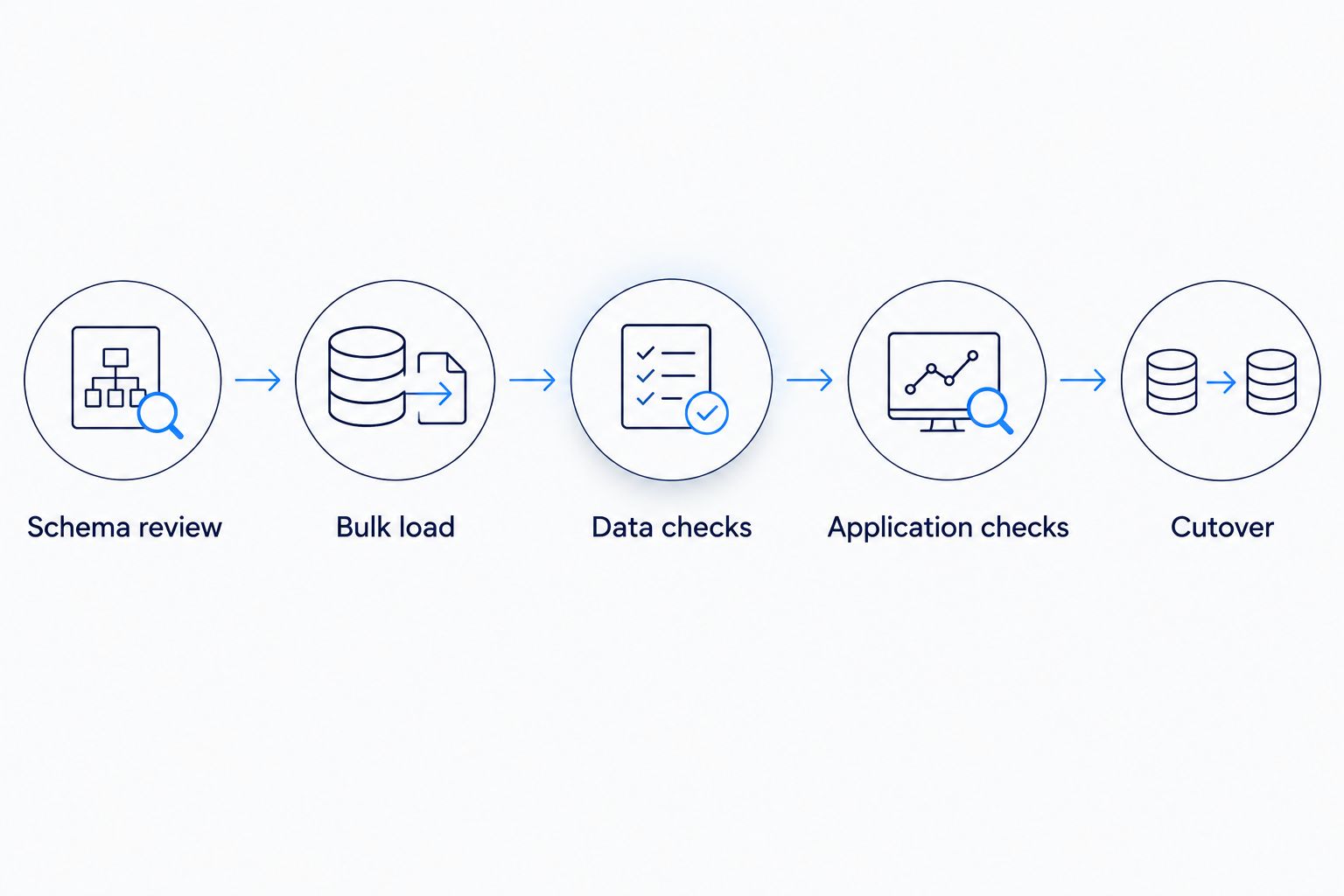
Use this gate sequence throughout the 2026 migration:
- Schema review: Target definitions preserve required types, constraints, and behavior.
- Bulk load: Every required table loads, and rejected records receive a documented resolution.
- Data checks: Counts and business-level comparisons agree at a common consistency point.
- Application checks: Critical reads, writes, jobs, and integrations pass.
- Cutover: The designated owner approves the final switch and its rollback boundary.
Bulk-load configuration
Rehearsal load
- Provision an isolated PostgreSQL destination and restore a representative MySQL backup into a rehearsal source. Keep both separate from production endpoints.
- Install a pgloader build compatible with your environment. Confirm connectivity and authentication against both databases before scheduling the full rehearsal.
- Define
MYSQL_SOURCE_URIandPOSTGRES_TARGET_URIthrough your approved secret-management process. These shell variable names are examples; they are not pgloader settings. - Run the basic invocation below against the rehearsal databases. For repeatable production use, move reviewed casting rules and load options into a protected pgloader command file.
- Inspect the generated schema and complete load report. Resolve errors and review conversions before accepting the rehearsal.
pgloader "$MYSQL_SOURCE_URI" "$POSTGRES_TARGET_URI"
Do not point a rehearsal at a populated production target. Review pgloader's schema-creation and drop behavior for your chosen command and options. Treat the destination as disposable until you have verified exactly which objects the load creates or replaces.
Record elapsed load time, index-build time, validation time, and application-check time separately. Those measurements determine whether the final migration fits your permitted interruption; the transfer duration alone does not.
Expected result: A repeatable load completes against an isolated destination, with reviewed schema output, resolved rejects, and measured execution stages.
Data validation
- Compare exact table counts against a stable source snapshot. For a live rehearsal source, establish a consistent comparison point rather than treating ongoing source changes as migration errors.
- Compare business aggregates by meaningful partitions: accounting period, tenant, status, or another application key. Normalize decimal precision, timestamps, and null handling before comparing results.
- Check orphaned relationships, duplicate business keys, nullability, and representative text values. Include multilingual text, binary content, JSON, and boundary values where your schema uses them.
- Verify that generated identifiers advance beyond imported values. Review pgloader's sequence handling and test a new insert rather than assuming imported keys establish the correct next value.
- Refresh PostgreSQL planner statistics with
ANALYZEafter loading and building indexes. Inspect representative queries withEXPLAIN; useEXPLAIN ANALYZEonly when executing the statement is safe.
Expected result: Your validation record identifies matching checks, resolved exceptions, and passing application operations. No unexplained discrepancy remains hidden behind a successful tool exit status.
Cutover and rollback configuration
Final write-paused migration
- Confirm that the 2026 cutover checklist still matches production: schema version, application build, credentials, endpoints, and write producers. Rehearse again if a material change invalidates earlier results.
- Stop all MySQL writers and verify that active write transactions have completed. Drain queues or stop consumers as required; maintenance mode alone does not stop external integrations.
- Take the agreed recovery checkpoint and run the final migration into the prepared destination. Keep the old MySQL database protected from new application writes.
- Repeat the agreed data gates, verify sequences and permissions, and run the critical application checks against PostgreSQL. Confirm extensions and required database objects are present.
- Change the application's database configuration, restart or recycle connection pools, and enable PostgreSQL writes only after approval. Monitor errors, business transactions, query latency, and connection saturation against your existing operational thresholds.
Expected result: PostgreSQL becomes the sole production write destination, and the release record identifies the final source checkpoint and approval decision.
Rollback boundary
Switching a connection string back is not a complete rollback plan. Before PostgreSQL accepts new writes, returning to the protected MySQL source is comparatively straightforward. After PostgreSQL accepts writes, MySQL no longer contains the full production state.
Define how you will preserve and reconcile those new writes before promising rollback. Without a tested reverse path or replay mechanism, stop new writes and follow an incident recovery procedure rather than silently discarding transactions.
Set separate owners for authorizing rollback and executing it. Include application configuration, queue state, scheduled jobs, and reconciliation—not just database restoration.
Variant: replicate changes while MySQL stays writable
Use full load plus change data capture when the measured bulk workflow exceeds your permitted write interruption. CDC reduces the final transfer workload; it does not remove the need for a controlled cutover.
For an AWS Database Migration Service workflow in 2026:
- Prepare the converted PostgreSQL schema and compatible application independently. Decide which migration component owns table creation so the load does not overwrite reviewed definitions.
- Configure the MySQL source for supported binary-log capture. Review
binlog_format,binlog_row_image, retention, privileges, and engine-specific requirements against the AWS documentation for your exact configuration. - Configure source and target endpoints, test connectivity, select tables, and choose Migrate existing data and replicate ongoing changes as the task's Migration type. Review target-table preparation and large-object handling before starting.
- Monitor table errors, capture progress, and apply progress. Test an insert, update, and delete on approved test records and verify the resulting target state.
- At cutover, stop source writers, record the final source position, wait for outstanding changes to apply, and validate the final state. Reset or verify target sequences before enabling application writes.
Expected result: PostgreSQL contains the initial dataset and subsequent supported changes through the agreed source position. Treat low reported lag as monitoring evidence, not proof that every table and object is correct.
If external support is part of the plan, use the enterprise data-engineering vendor evaluation guide to define evidence requirements. Keep schema conversion, replication, validation, and rollback explicit in the scope.
Troubleshooting
Loads fail on dates or unsigned values
Profile the offending columns in MySQL and identify the business meaning of exceptional values. Apply an approved cleanup or casting rule; do not silently turn an invalid date into null or truncate a value that exceeds the target type.
New inserts fail with duplicate primary keys
Inspect the column's default and its associated PostgreSQL sequence. Advance the sequence beyond imported keys while writes remain stopped, then test insertion through the application. Also check whether the application supplies identifiers itself.
Searches or uniqueness checks behave differently
Compare source and target collations, identifier casing, and query expressions. Test the application's actual search and uniqueness rules before selecting a PostgreSQL collation, expression index, or application-level normalization strategy.
CDC falls behind or stops
Inspect task logs, retained source logs, network connectivity, target locks, and apply errors. If the required source log position has expired, follow the documented reinitialization process; do not assume restarting the task recreates missing history.
Queries become slower after migration
Check planner statistics, missing indexes, implicit casts, connection-pool configuration, and changed query plans. Reproduce the affected workload before adjusting settings. A different engine requires measured tuning, not a copy of MySQL configuration values.
Customize your workflow
Extend the migration runbook into ongoing operations: backup restoration tests, schema-change reviews, access controls, query monitoring, and downstream data checks. Keep migration identities separate from permanent application roles, then revoke temporary access after acceptance.
Knackforge's enterprise AI focus makes the downstream boundary relevant: document which migrated tables feed analytical or automated workflows. In 2026, approve those consumers separately so database cutover does not silently change their input meaning.
FAQ
What's the safest MySQL to PostgreSQL migration approach?
Use a rehearsed bulk migration with writes paused when your measured maintenance window permits it. Add change data capture when the initial load cannot fit that window, and retain explicit validation and cutover gates.
Can I restore a MySQL dump directly into PostgreSQL?
No. A MySQL dump contains engine-specific syntax and definitions that PostgreSQL does not directly restore. Convert the schema and use a compatible transfer process.
Is pgloader enough for a production migration?
pgloader can handle the bulk transfer portion of a production migration, but it does not replace application testing, data validation, or rollback planning. Review its generated schema and conversion rules before the final load.
Does MySQL to PostgreSQL migration require downtime?
The write-paused workflow requires a maintenance interval. Change data capture keeps MySQL writable during the initial transfer, but this guide still uses a controlled final write pause to establish a consistent cutover point.
Does AWS Database Migration Service convert all database objects?
Do not treat the replication task as complete schema conversion. Prepare and verify target definitions, routines, permissions, indexes, and application-specific behavior separately.
How do I verify that the migrated data is correct?
Compare counts, business aggregates, relationships, and representative values at a consistent source position. Also test application reads, writes, generated identifiers, and scheduled jobs.
Can I switch back to MySQL after PostgreSQL accepts writes?
Only with a recovery process that preserves or reconciles the new PostgreSQL writes. Changing the application connection back without that process leaves those transactions out of MySQL.
One last thing
Test creating a new record before approving the migration—not just reading an imported one. That action exercises permissions, identifier generation, defaults, constraints, and application SQL together.
For Knackforge readers planning enterprise data changes, the practical rule is simple: approve the business transaction, not merely the completed transfer.