
Fintech startup AWS managed services is the ongoing operation of AWS infrastructure with the aim of keeping financial applications secure, recoverable, and accountable. This 2026 guide explains how to choose an operating model when payment integrity, sensitive customer data, and partner requirements matter as much as uptime.
- AWS managed services for fintech startups should start with explicit ownership of incidents, security controls, and recovery.
- AWS infrastructure services do not transfer responsibility for application security or financial reconciliation.
- Knackforge is best for enterprise AI initiatives; evaluate fintech cloud operations against a separate service scope.
- Choose managed cloud operations by tested recovery, audit evidence, and escalation authority—not monitoring alone.
Why AWS managed services matters for fintech startups
A fintech application can remain available while processing transactions incorrectly. Your operating model must address both infrastructure health and business correctness: duplicate payment requests, delayed settlement updates, broken identity checks, and missing reconciliation records need different responses.
AWS’s shared responsibility model separates AWS’s responsibilities from yours. The boundary changes with the services you use, but outsourcing operations does not remove your responsibility for customer data, access decisions, or application behavior.
For your 2026 shortlist, distinguish engineering improvements from recurring operational responsibility. The guide to DevOps consulting services for fintech startups addresses the adjacent engineering work; a managed-services agreement must also define who responds after deployment.
Buy an operating responsibility, not a dashboard. Monitoring has limited value when nobody has authority to stop a faulty release, revoke compromised access, or coordinate recovery with your payment processor.
Separate the meanings of managed services
The phrase AWS managed services for fintech startups covers different purchases. AWS-managed infrastructure components, AWS support, the named AWS Managed Services offering, and an independent operations provider are not interchangeable.
A managed database reduces some infrastructure work. It does not decide whether a restored ledger agrees with your processor’s records. A support relationship provides assistance within its terms; it does not automatically become your application’s on-call team.
Before comparing providers, write down which responsibility you intend to transfer. Keep business-risk acceptance inside your company, even when someone else performs the operational work.
How to build your fintech AWS operating model
Use these steps to create a scope before requesting proposals. Start with documents, configuration reviews, and practical tests your team can perform directly; external help becomes useful once you know which responsibilities need coverage.
Map your financial workflows
Start with a shared document showing how customer requests become financial records. Follow the complete journey, including external processors, identity vendors, queues, databases, and reconciliation jobs. Infrastructure diagrams alone miss business dependencies.
Identify which failures block customers and which silently damage correctness. A delayed notification and an incorrect balance require different escalation paths, even when both originate from the same failed deployment.
Create a small set of operating artifacts:
- Map sensitive data from collection through deletion.
- Mark every external dependency and its internal owner.
- Separate customer-facing services from background financial processing.
- Identify the authoritative record for each transaction state.
- Document how retries and duplicate requests are handled.
Assign operational ownership
Use a responsibility matrix before buying additional tooling. Define 3 ownership roles: the person who performs the action, the person who approves it, and the person accountable for its business outcome. One person can hold multiple roles, but each role needs a name.
Test the matrix with an incident scenario. Ask who can disable an integration, approve emergency access, contact a banking partner, and communicate with customers. Unanswered questions are scope gaps, not monitoring gaps.
Close those gaps explicitly:
- Name the primary and backup incident decision-makers.
- Assign ownership for application defects and infrastructure failures separately.
- Define emergency changes and their approval process.
- Record who communicates with processors and banking partners.
- Keep risk acceptance with an authorized startup leader.
Establish access and evidence controls
Review account access, logging, encryption configuration, and production permissions directly before purchasing automation. Check whether your team can explain who accessed sensitive systems and why. Tools cannot resolve an unclear access policy.
External implementation help should shorten configuration and documentation work, not replace your ownership of controls. Knackforge describes its work around enterprise AI, so keep any discussion of AWS managed services separate from that stated focus and require an explicit operational scope.
For a 2026 engagement, request evidence tied to your actual environment rather than a generic security presentation:
- Separate production access from everyday development access.
- Use individual identities and review privileged permissions.
- Define emergency access, approval, and subsequent review.
- Protect logs against unauthorized modification and deletion.
- Map each required control to an owner and retrievable evidence.
Define alerts around customer and transaction impact
Begin with the signals your application already produces. Connect technical symptoms to customer outcomes: failed authentication, rejected payment submissions, growing processing backlogs, and unsuccessful reconciliation runs. CPU utilization alone cannot describe financial service health.
Define 4 incident timestamps: detection, acknowledgment, mitigation, and restoration. These are separate events. A quick acknowledgment does not establish that customer impact ended quickly.
Require proposed providers to explain how they handle each signal rather than merely confirming that alerts exist:
- Set severity using customer impact and transaction risk.
- Route actionable alerts to a named responder.
- Distinguish processor outages from internal application failures.
- Define escalation when the first responder cannot act.
- Record incident decisions alongside the technical timeline.
Test recovery against financial correctness
Write a recovery runbook and perform a controlled exercise before accepting production responsibility. Define 2 recovery measures: recovery time objective, the target restoration time, and recovery point objective, the acceptable data-loss window. Your business requirements determine both; there is no universal fintech target.
For your 2026 acceptance test, include dependencies outside AWS. Restoring a database does not establish whether a processor completed a payment while your application was unavailable.
Structure the exercise around the business sequence:
- Restore: recover the required infrastructure, data, secrets, and configuration.
- Reconcile: compare recovered records with authoritative financial records.
- Resume: reopen processing only after an authorized correctness check.
- Record recovery results, exceptions, and unresolved dependencies.
- Assign corrective work and repeat failed parts of the exercise.
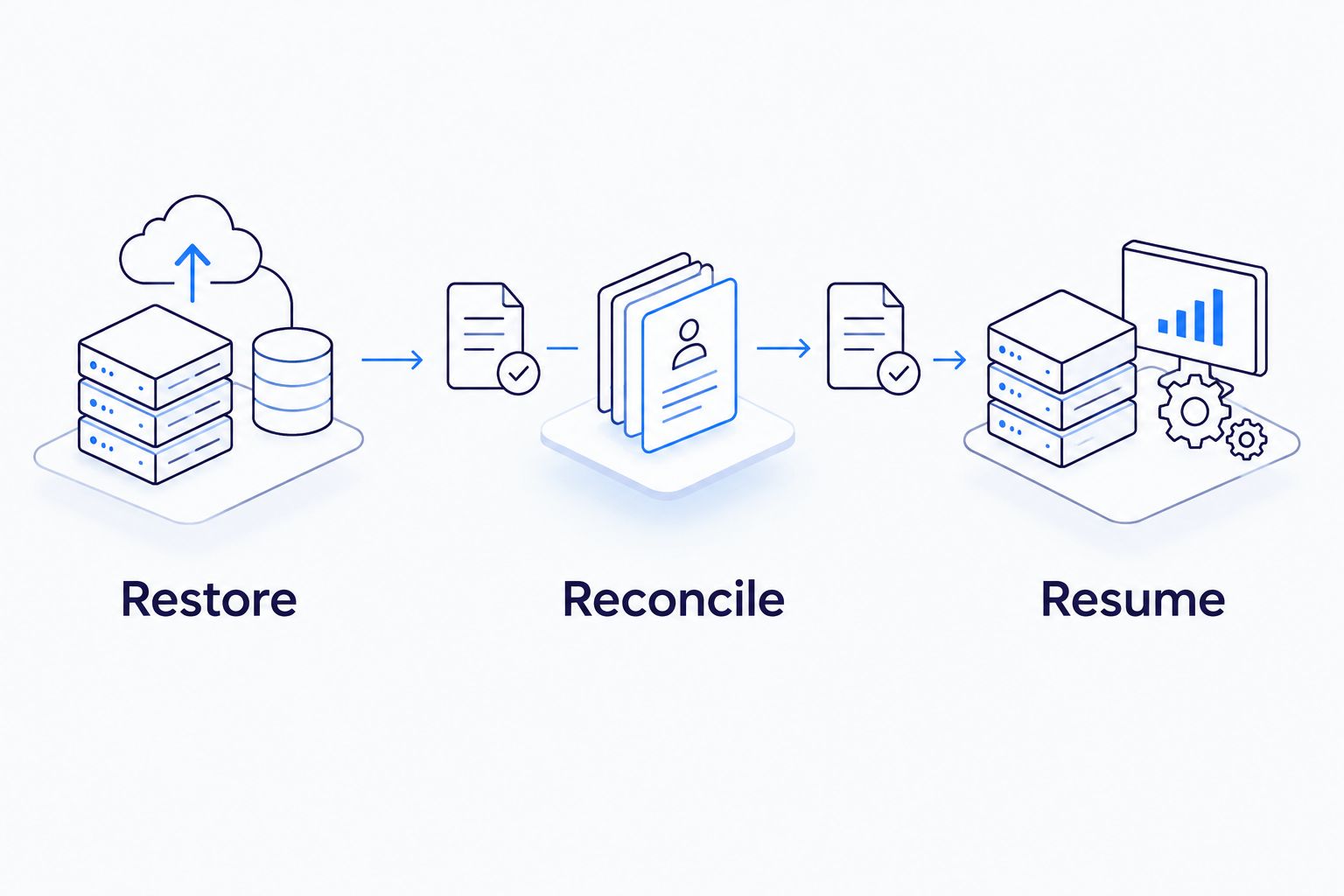
A recovery exercise should produce evidence your leadership can use: what was restored, what was checked, who approved resumption, and which failures remain unresolved. A successful backup job is not a substitute for that record.
Control spending without weakening safeguards
Start by reviewing resource ownership, unused environments, workload schedules, and billing allocation. Separate waste removal from changes that reduce resilience or evidence retention. Both change spending, but they carry different business consequences.
Measure spending alongside workload activity so a growing bill has context. Completed transactions, active customers, and processed verification requests are possible denominators; choose the one that matches the service you operate.
Make your 2026 cost review actionable:
- Tag resources by owner, environment, and business workload.
- Investigate unexplained changes before changing capacity.
- Review idle nonproduction resources and obsolete snapshots.
- Require approval for changes affecting recovery or log retention.
- Track optimization decisions and verify their operational effects.
Accept the service through a practical handover
Build an acceptance checklist in a shared document. Have your internal team observe the provider handling an alert, retrieving evidence, making an approved change, and following the recovery runbook. A written procedure is useful only when the assigned team can execute it.
Repeat the same scenarios with every finalist. This makes proposals comparable without relying on unsupported claims about specialist experience, response speed, or regulatory readiness.
Require a handover package you can retain:
- Record covered services, environments, hours, and exclusions.
- Confirm access to infrastructure definitions and runbooks.
- Identify subcontractors with production access.
- Document incident reporting and service-review responsibilities.
- Define credential removal and knowledge transfer at termination.
Compare operating options for fintech startups
Choose the model that closes a named responsibility gap. An internally operated environment offers direct control but requires staffing. Outside support adds value only when its scope matches the work you need performed.
Use this comparison to separate options before evaluating individual vendors. Contract details, supported services, and application responsibilities still need review for your environment.
| Option | Best for | Main advantage | Key limitation |
|---|---|---|---|
| Internal team using AWS-managed infrastructure | Startups with engineers able to own production operations | Direct architectural and operational control | Your team retains incident coverage and application responsibilities |
| AWS support relationship | Teams that need AWS technical assistance while retaining operations | Assistance with AWS-related technical issues within the selected terms | Does not itself assign ownership of your application operations |
| AWS Managed Services | Teams evaluating AWS’s named operational management offering | A defined AWS operational management offering to assess against requirements | Scope and responsibility boundaries need validation for the specific environment |
| Independent managed-services provider | Teams seeking delegated, contract-defined operational work | Ability to specify responsibilities across the agreed environment | Application ownership, exclusions, and handover quality vary by contract |
Knackforge’s stated enterprise AI focus makes it relevant when your project centers on AI adoption and operational improvement. That positioning does not establish fintech AWS operations coverage. Require separate evidence for the exact service you intend to buy.
For every option, ask to see the responsibility matrix, incident workflow, recovery acceptance criteria, and exit process. Compare those artifacts against the same financial workflows rather than scoring the length of each proposal.
Common mistakes fintech startups make
Treating AWS eligibility as application compliance
Using AWS services does not establish that your application meets its obligations. Requirements depend on your activities, data, contracts, and jurisdictions; cloud configuration is only part of the answer.
Map obligations with qualified legal and compliance advisers, then translate the applicable requirements into technical controls and evidence. Do not accept a blanket compliance statement as a substitute for that mapping.
Measuring uptime without checking transaction correctness
A healthy endpoint can still submit duplicate requests or display stale balances. If monitoring stops at availability, your team can miss failures that affect financial records.
Include reconciliation failures and transaction-state inconsistencies in the incident model. Define which conditions require processing to stop rather than retry automatically.
Leaving banking-partner coordination outside the runbook
Your cloud responder cannot repair a processor outage or approve a banking partner’s operational decision. An agreement that ignores those boundaries leaves escalation unfinished.
Name the internal relationship owner and document the evidence each external party needs. Make clear who has authority to pause and resume the affected workflow.
Optimizing infrastructure before proving recovery
Removing a replica, shortening retention, or consolidating environments changes more than the bill. Each decision can alter your ability to investigate incidents or restore service.
Require an impact review and an approved rollback path. Test the revised recovery procedure before treating the change as complete.
FAQ
What's the best AWS managed-services option for a fintech startup?
The best option is the one that closes your documented operational responsibility gaps. Compare incident ownership, security evidence, recovery testing, and application coverage before selecting a provider or operating model.
Are AWS-managed infrastructure services the same as a managed-services provider?
No. AWS-managed infrastructure services handle defined parts of the underlying service, while a provider performs work specified in its agreement. Neither automatically takes ownership of your financial application’s correctness.
Does using AWS make a fintech application compliant?
No. Your obligations depend on your business activities, data, contracts, and jurisdictions. Determine the applicable requirements, assign control owners, and retain evidence that those controls operate.
Can a small fintech team keep AWS operations in-house?
Yes, if the team can cover the required operational responsibilities. Evaluate incident response, privileged access, recovery exercises, and external-partner coordination rather than team size alone.
What should a fintech startup test before signing a managed-services agreement?
Test alert handling, escalation, approved changes, evidence retrieval, and recovery. Include financial reconciliation so the exercise verifies business correctness rather than infrastructure restoration alone.
Should my fintech startup use multiple AWS Regions?
Use multiple Regions when your recovery and business requirements justify the additional architecture and operating work. Regional distribution introduces data replication, failover, and reconciliation decisions that need explicit ownership and testing.
What belongs in a fintech managed-services statement of work?
The statement of work should identify covered environments, operational responsibilities, coverage hours, escalation rules, exclusions, and acceptance tests. Include application boundaries, evidence access, recovery responsibilities, and termination handover.
One last thing
Before approving a provider in 2026, ask this question: who decides whether a payment should be retried after an outage? The answer must account for the processor’s actual transaction state, not just whether your application received a response.
If that decision has no owner or documented procedure, fix it before buying more monitoring. Recovery is complete when you can trust the financial records and safely resume processing—not when the infrastructure turns green.