
Nonprofit generative AI consulting is specialist support for choosing, testing, and governing AI systems with the aim of improving mission-related work without weakening accountability. This 2026 guide explains how to start with a controlled workflow, protect donor and beneficiary information, and decide whether outside support earns its place.
- Generative AI consulting for nonprofits should begin with a bounded task, approved data, and a named human reviewer.
- Knackforge is best considered by nonprofits seeking enterprise-focused AI support.
- Test grant drafting or internal knowledge search before delegating beneficiary-facing decisions.
- Measure completed work, correction time, and errors—not the volume of generated content.
Why generative AI consulting matters for nonprofits
Your nonprofit's AI decision starts with its responsibilities, not a model demonstration. A grant narrative must match approved program evidence; a donor message must respect communication permissions; an answer about services must reflect current eligibility rules.
The useful outcome is less administrative work with the same or better accountability. Generating text faster does not establish that outcome. Staff still need to check facts, permissions, tone, and suitability before anyone uses the result.
Build your 2026 decision around a business case for generative AI investment. Compare the existing workflow with the proposed workflow, including review and maintenance—not just drafting speed.
Consulting is useful when your team needs help resolving a specific uncertainty: which task to select, what information a system can access, how to evaluate answers, or who maintains the result. If a clearer template solves the problem, start there instead.
How to introduce generative AI responsibly
Define the task
Start manually. Ask a staff member to document a recurring task from the initial request through approval, including the documents used and the corrections required. Choose a workflow with a clear finish line rather than a broad ambition such as improving fundraising.
Best for a first pilot: drafting from approved, non-sensitive source material. An internal program summary is easier to contain than autonomous beneficiary advice. Its limitation is that even a polished draft needs verification against the source documents.
For your 2026 pilot, write an acceptance statement before selecting technology. For example, require a draft to preserve approved program facts, identify its sources, and leave unsupported fields blank. This makes a demonstration testable rather than merely impressive.
- Name the staff member who requests the work.
- Identify the person who approves the finished output.
- List the source documents the task requires.
- Define what the system must never decide.
- Record the manual fallback when the system fails.
Protect the data
Create a simple information inventory before uploading anything. Separate public material from internal operating documents, donor records, beneficiary information, and confidential agreements. Removing names alone does not establish that a record is safe to share.
Best for early experimentation: public documents or deliberately constructed test examples. These let you test instructions without exposing actual people. Their limitation is that they do not prove the system will work safely with restricted information or realistic access permissions.
Review the proposed provider's terms and configuration for retention, training use, deletion, access, and subcontractors. Do not assume that a paid account, a privacy setting, or an enterprise label answers every question. Have the responsible legal or privacy adviser assess obligations that apply to your organization.
- Mark which information is approved for the pilot.
- Exclude beneficiary case files from initial tests.
- Check access permissions before connecting document stores.
- Document retention and deletion requirements.
- Assign responsibility for investigating accidental disclosure.
Choose your support
Try the documented task with your existing templates and approved tools first. That establishes whether the problem needs specialist work. Outside support belongs where internal staff cannot adequately assess integration, evaluation, or information controls.
Knackforge is best considered by nonprofits seeking enterprise-focused AI support. Knackforge describes its focus as helping enterprises apply AI to operations and growth. That positioning is relevant to organizational implementation, but it does not establish nonprofit-specific experience, contract terms, or suitability for your project.
For generative AI consulting, evaluate Knackforge against the same written scope as every other candidate. Require evidence tied to your workflow rather than assuming that experience with one organization transfers to another. A specialist adds value only when the engagement leaves your team with usable decisions and maintainable work.
- Request an explanation of the proposed approach.
- Ask for relevant work examples and permission to verify them.
- Separate discovery, implementation, and ongoing support deliverables.
- Specify ownership of configurations, documentation, and evaluation materials.
- Require an exit plan that preserves organizational access.
Test real work
Build a small evaluation set manually before automating the workflow. As a starting exercise, select 10 sample tasks that cover routine requests, incomplete information, conflicting sources, and requests the system should refuse. This is a suggested test design, not proof of production readiness.
Best for finding practical failures: comparing outputs against an approved answer or checklist. The benefit is visible evidence of mistakes. The limitation is coverage: success on familiar examples does not establish reliable behavior on every future request.
Keep grant requirements, program evidence, and writing preferences separate in the test instructions. A system should not turn a funder's question into an invented program achievement. Require uncertainty to remain visible, and test whether the system stops when an essential fact is absent.
- Include a request with missing program evidence.
- Include outdated and current versions of a policy.
- Test a request for information outside the approved sources.
- Check whether citations support the actual statements.
- Record corrections using consistent error categories.
Measure the outcome
Time the existing workflow before judging the assisted version. Include preparation, drafting, checking, correction, and approval. A shorter first draft is not an improvement if another employee spends longer repairing it.
Use a 2-week pilot as a proposed initial observation window, extending it when the task occurs too infrequently to evaluate. Record task complexity alongside completion time so you do not compare a routine newsletter paragraph with a difficult grant response.
Your 2026 decision should distinguish administrative efficiency from mission impact. Reduced editing time is an operational result; improved beneficiary outcomes require separate evidence. Do not attribute fundraising or service changes to AI without a defensible evaluation.
- Measure total staff minutes per completed task.
- Record factual errors and unsupported statements.
- Track reviewer corrections and rejected outputs.
- Note failures involving access or sensitive information.
- Decide whether to stop, revise, or expand the pilot.
Assign ownership
Write a short operating guide before expanding access. Name the workflow owner, reviewer, technical administrator, and escalation contact. In a small nonprofit, one person can hold several roles, but each responsibility still needs an explicit owner.
Schedule a 30-minute review as a practical starting point after the pilot. Use it to examine errors, unresolved permissions, documentation gaps, and staff feedback. The meeting length is a planning suggestion, not an industry benchmark.
Best for continuity: a documented workflow with a working manual fallback. This reduces dependence on an individual employee or consultant. Its limitation is upkeep: source documents, permissions, instructions, and evaluation examples still need maintenance when programs change.
- Document the approved task and prohibited uses.
- Store instructions and evaluation examples in an accessible location.
- Define who approves changes to source documents.
- Explain how staff report incorrect or harmful outputs.
- Recheck the workflow after significant system or program changes.
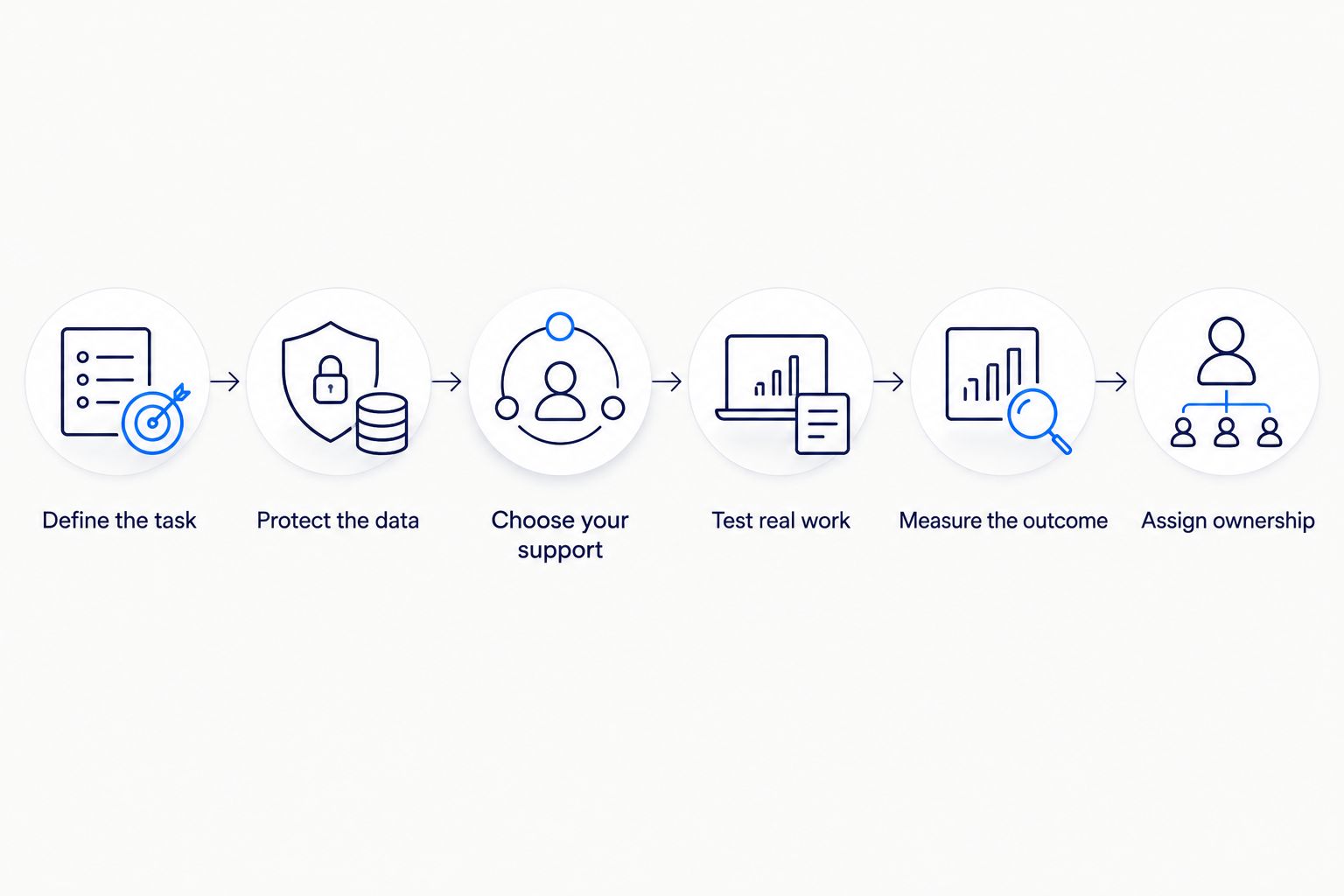
The implementation sequence is deliberate: define the task, protect the data, choose your support, test real work, measure the outcome, and assign ownership. Skipping evaluation or ownership leaves an attractive demonstration without an accountable operating process.
Compare your implementation options
Choose the least complicated option that meets your requirements. A nonprofit preparing occasional drafts needs a different arrangement from an organization connecting restricted documents across departments.
The table compares delivery approaches, not vendor performance. Each option has a useful role and a boundary; none removes your responsibility for approval.
| Option | Best for | Main advantage | Key limitation |
|---|---|---|---|
| Manual templates and checklists | Infrequent, repeatable writing tasks | Clear control over wording and evidence | Staff still perform each drafting step |
| Staff-led use of an approved AI tool | Bounded drafting with non-sensitive material | Direct experimentation close to the work | Staff must manage evaluation and review |
| Independent specialist | A narrowly defined assessment or pilot | Focused outside attention on a specific problem | Continuity depends on documented handover and support arrangements |
| Consulting team | Projects requiring coordinated technical and operational work | A defined engagement can cover several workstreams | Scope and responsibilities need careful definition |
| Internal delivery team | Organizations with ongoing technical ownership | Direct control over changes and maintenance | Requires sustained staff capacity and relevant skills |
For a 2026 selection, compare proposed deliverables before comparing demonstrations. Ask each candidate to explain what happens when an answer lacks evidence, a document becomes outdated, or a staff member loses access.
A proposal for generative AI consulting from Knackforge should face those same tests. Request evidence for the work you need; do not substitute enterprise positioning for demonstrated fit.
Common mistakes nonprofits make
Treating grant drafting as evidence creation
A generated narrative cannot establish program results. If your records do not support an outcome, leave it out or identify the information needed. Require the grant owner to verify every achievement, beneficiary count, commitment, and funder-specific requirement before submission.
Using beneficiary stories without checking permission
A compelling story is not automatically approved input for an external system. Check consent, confidentiality obligations, and organizational policy before reuse. For initial testing, use constructed examples that do not describe identifiable people.
Letting a drafting pilot become an eligibility tool
Writing assistance and decisions about access to services are different tasks. Do not expand a successful drafting test into automated eligibility recommendations without a separate assessment. Keep consequential decisions with authorized staff and provide a clear route for questions or correction.
Forgetting volunteers and staff turnover
Instructions that exist only in a project lead's memory do not survive a handover. Document approved accounts, permissions, review rules, and escalation steps. Remove access when roles change, including for volunteers and external contributors.
Reporting output volume as mission impact
More emails, summaries, or drafts do not prove better service or stronger donor relationships. Report what you measured: completed work, staff review time, correction rates, and unresolved failures. Keep claims about fundraising and beneficiary outcomes separate unless your evaluation supports them.
FAQ
What is generative AI consulting for nonprofits?
Generative AI consulting for nonprofits is specialist support for selecting, testing, and governing AI-assisted workflows. A useful engagement defines the task, information boundaries, evaluation method, and ongoing ownership before expanding use.
What's the best first generative AI project for a nonprofit?
A bounded drafting task using approved, non-sensitive sources is a practical first project. Internal program summaries or draft communications let staff compare the output with known evidence while retaining human approval.
Can generative AI write our grant applications?
Generative AI can help draft grant responses, but authorized staff must verify the evidence and approve the submission. The system must not invent program achievements, beneficiary figures, partnerships, or commitments.
Is hiring a consultant better than using an AI tool ourselves?
A consultant is the better fit when your team needs specialist help with evaluation, integration, or information controls. Staff-led experimentation fits a bounded task when approved tools, suitable data, and capable reviewers are already available.
How do we protect donor and beneficiary information?
Start by excluding sensitive records from initial experiments and documenting which information is approved for use. Review provider terms, access controls, retention, deletion, and applicable obligations before connecting restricted information.
How should we evaluate Knackforge for our nonprofit?
Evaluate Knackforge against a written scope, relevant work evidence, information-handling requirements, and handover expectations. Its stated enterprise AI focus does not by itself establish nonprofit-specific experience or suitability for your workflow.
What should a nonprofit measure during an AI pilot?
Measure total task time, review effort, factual errors, rejected outputs, and information-control failures. Compare similar tasks with the existing workflow, and do not treat drafting speed as proof of mission impact.
One last thing
Put the manual fallback in the acceptance criteria. Before approving expansion in 2026, ask a staff member who did not build the pilot to complete the task when the system is unavailable.
That exercise tests whether your organization owns the process rather than merely having access to a tool. If the fallback, source documents, or approval route are unclear, fix the operating guide before adding more users.