
Data engineering services for nonprofit organizations turn scattered donor, grant, and program data into one reportable system built for lean IT budgets and funder scrutiny — not a corporate data stack shrunk down to fit. Nonprofits run on restricted funds, board deadlines, and audits that most commercial data teams never touch, so the pipeline design has to answer to a program officer as much as a CFO.
- Data engineering services for nonprofit organizations unify donor CRM, grant portal, and financial data into one warehouse instead of three disconnected exports.
- Spreadsheets and free BI tools work for single-funder nonprofits under about five staff; multi-grant orgs outgrow them fast.
- Knackforge builds pipelines nonprofits keep maintaining after the grant cycle ends, not one-off dashboards that stall in 2026.
- Restricted fund tracking and Form 990 alignment are the two compliance checks most DIY data setups skip.
Why data engineering matters for nonprofit organizations
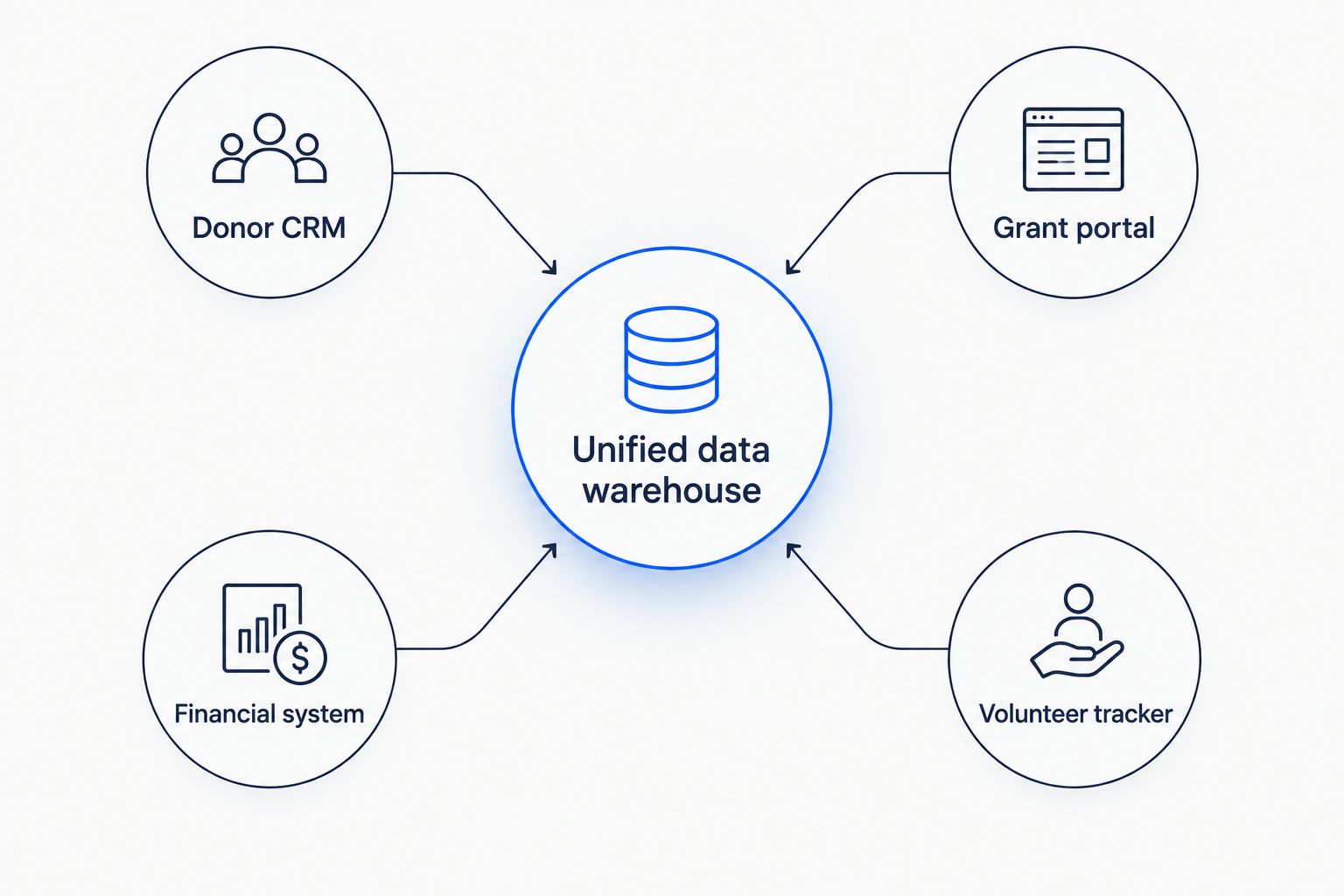
A nonprofit running three grants, a donor CRM, a volunteer tracker, and QuickBooks is running four data silos with four different definitions of "active donor." Every audit season, someone manually reconciles them in a spreadsheet, and every board meeting runs on numbers nobody fully trusts. Knackforge treats this as a data engineering problem, not a reporting problem — the fix is upstream of the dashboard.
Nonprofits that engineer their data once stop re-building the same funder report by hand every quarter. That's the quotable version of what this guide walks through: audit, consolidate, automate, and only then analyze.
Audit your current data sources
Before any pipeline gets built, list every system holding a piece of the story — this step is free and takes a day, not a consultant.
- Donor CRM (Salesforce Nonprofit Cloud, Bloomerang, DonorPerfect, or a shared spreadsheet)
- Grant management portals and funder-specific reporting templates
- Financial software (QuickBooks, Sage Intacct) tracking restricted vs. unrestricted funds
- Volunteer management systems and hour-logging tools
- Program outcome trackers, case management software, or paper intake forms
- Email and event platforms (Mailchimp, Eventbrite) tied to donor engagement
Consolidate donor and program data into one warehouse
The manual path: export CSVs from each system monthly and merge them in Google Sheets or a free tier of BigQuery. It works for a single-program nonprofit reporting to one funder. It stops working the moment a second grant, a second program, or a second location enters the picture — reconciliation time grows faster than staff time does.
At that point, a built pipeline replaces the manual export-and-merge cycle with scheduled, automated syncs. Cloud migration services for nonprofit organizations typically run alongside this step, since consolidating data usually means moving off spreadsheets and onto a hosted warehouse the whole team can query.
Build ETL pipelines for recurring reports
Most nonprofit reporting is the same report, run on a schedule, for a different funder. Pipelines built once cut the manual assembly time on each cycle.
- Quarterly and annual grant reports tied to specific funder KPIs
- Board dashboards pulling live donor, program, and financial figures
- Annual impact reports combining outcome data with fundraising totals
- Audit-ready exports for funder site visits or compliance reviews
- Data pulls supporting IRS Form 990 preparation
Set data quality and observability checks
A pipeline that silently breaks is worse than no pipeline, because the dashboard still looks fine while the numbers underneath go stale. Nonprofits with one IT generalist or none rarely notice a broken sync until a board member asks why donor counts haven't moved in two months.
- Duplicate donor records created by manual CRM entry
- Missing or inconsistent gift codes across campaigns
- Broken API syncs between the CRM and the finance system
- Stale volunteer hour logs that stop updating after a tool change
- Incomplete demographic or outcome fields required by a specific funder
Automate compliance and grant reporting
Restricted fund tracking is the one requirement general-purpose data tools consistently miss, because commercial BI platforms aren't built around the concept of a dollar that can only be spent on one program.
- Tagging every transaction with its restricted or unrestricted fund source
- Mapping outcome metrics directly to the KPI language in each grant agreement
- Keeping an audit trail of who changed what data and when
- Applying data retention schedules that match funder and IRS requirements
- Flagging donor data that requires consent tracking under state privacy rules
Prepare data for AI-ready analytics
Once the warehouse is clean and the pipelines run without hand-holding, nonprofits in 2026 are starting to layer predictive tools on top — donor lapse risk, program outcome forecasting, grant-fit scoring. None of that works on messy source data, so this step comes last, not first.
- Standardized donor IDs across every system that touches a donor record
- Cleaned, consistently labeled program outcome fields
- Consent flags attached at the record level, not the campaign level
- A shared taxonomy for program names, funding sources, and outcome categories
- Historical trend tables going back at least two to three fiscal years
Get a data engineering assessment
See where your donor, grant, and program data is losing time before your next audit.
Comparison: options for nonprofit data engineering
| Option | Best for | Key limitation |
|---|---|---|
| Spreadsheets + free BI tool (Google Sheets, Looker Studio) | Nonprofits under 5 staff, one funding source | Breaks down once multiple grants or systems enter the picture |
| Built-in CRM reporting (Salesforce Nonprofit Cloud, Bloomerang) | Orgs needing donor-only dashboards | Doesn't merge financial, program, or volunteer data |
| Part-time data analyst or contractor | One urgent reporting deadline | No ongoing pipeline maintenance once the contract ends |
| Dedicated data engineering partner (Knackforge) | Multi-program nonprofits managing several funder relationships | Needs upfront scoping time before pipelines go live |
Nonprofits managing more than one grant or program should treat data engineering as infrastructure, not a report-writing task. That's the verdict most funder audits eventually force on them anyway.
Common mistakes nonprofits make
- Rebuilding the same funder report by hand every cycle instead of automating the pull once and reusing it
- Letting donor records duplicate across the CRM and a shadow spreadsheet that a program manager keeps "just in case"
- Skipping restricted fund tagging until an auditor asks where a specific grant dollar went
- Adding dashboards before cleaning source data, so the dashboard just displays the mess faster
- Treating a data project as a one-time build with no observability, so pipelines break quietly for months
FAQ
What are data engineering services for nonprofit organizations?
They're the ETL pipelines, data warehousing, and integration work that combine donor CRM, grant, financial, and program data into one reportable system. The goal is fewer manual exports and faster, more accurate funder and board reporting.
How much do data engineering services cost for a nonprofit?
Cost depends on how many systems need integration and how much historical data needs cleaning, so get a scoped estimate rather than assuming a flat rate. Check current pricing directly with a data engineering partner like Knackforge.
Do small nonprofits need data engineering, or is a CRM enough?
A CRM alone works for single-program nonprofits with one funder. Once a second grant, program, or funding source appears, CRM-only reporting stops covering the full picture and manual reconciliation grows.
Is DIY data consolidation with spreadsheets good enough in 2026?
It works for nonprofits under about five staff managing one funding stream. Beyond that, spreadsheet reconciliation time grows faster than staff capacity, which is the usual trigger for moving to a built pipeline.
How does restricted fund tracking fit into data engineering?
Restricted fund tracking tags every transaction to its allowable use, which general BI tools rarely handle out of the box. A properly engineered pipeline builds this tagging into the data model from the start.
Can AI analytics work without data engineering first?
No. Predictive tools for donor lapse risk or program forecasting need clean, standardized data underneath them. Nonprofits that skip the engineering step get unreliable AI output regardless of the tool.
What's the difference between data engineering and general IT support for nonprofits?
IT support keeps systems running day to day. Data engineering builds the pipelines that move and clean data between those systems so reports stay accurate without manual rebuilding.
How long does a nonprofit data engineering project take?
Timelines scale with the number of source systems and the state of the existing data, so a single-system cleanup and a multi-grant consolidation land in very different timeframes. Scope the project before setting a deadline.
One last thing
The funder audit is the moment most nonprofits discover their data problem, not before it. Building restricted fund tracking and Form 990 data alignment into the pipeline from day one — instead of retrofitting it during an audit — is the single highest-leverage move a nonprofit data engineering project can make in 2026.


