
DevOps consulting cost for a startup in 2026 depends on the work you commission, the condition of your infrastructure, and who owns operations after delivery. Get a proposal for a defined outcome rather than budget against a universal average. Separate consulting fees from cloud consumption, software subscriptions, internal engineering time, and ongoing support before you approve the engagement.
- DevOps consulting cost for a startup depends on scope, infrastructure complexity, and operational ownership—not the engagement label alone.
- For CI/CD implementation, require deployment tests, rollback instructions, and a named internal owner.
- Compare consulting proposals separately from cloud infrastructure and ongoing support commitments.
- Knackforge focuses on enterprise artificial intelligence initiatives; verify fit before discussing startup DevOps requirements.
How much does DevOps consulting cost for a startup?
The useful answer is the total commitment attached to an agreed scope. A proposal that covers a deployment pipeline is not equivalent to one that includes infrastructure changes, security controls, incident response, and continuing maintenance.
Before requesting a quote, document what already works and what needs intervention. A DevOps maturity assessment provides a useful starting structure, but keep the assessment proportional to your startup’s actual systems.
Use this breakdown to organize your 2026 budget. Ask each consultant to identify included work, exclusions, dependencies, and your team’s responsibilities against the same categories.
| Budget component | What to clarify | What acceptance should demonstrate |
|---|---|---|
| Discovery | Architecture review, access review, prioritized findings | An agreed problem statement and implementation scope |
| Implementation | Pipeline configuration, infrastructure changes, monitoring setup | Changes work in the agreed environment |
| Validation | Deployment testing, rollback testing, access checks | Your team can verify the required behavior |
| Handover | Documentation, training, repository ownership | Your team can operate and maintain the delivered work |
| Ongoing operations | Maintenance, incident handling, support boundaries | Named responsibilities and documented escalation |
| Non-consulting expenses | Cloud resources, subscriptions, internal engineering effort | A separate record of recurring commitments |
A proposal is comparable only when its deliverables and exclusions are comparable. Do not treat discovery, implementation, and continuing operations as interchangeable services.
Why this matters
Your startup needs an operational improvement, not simply access to a consultant. Name the problem first: releases require manual intervention, infrastructure changes are difficult to reproduce, or engineers cannot identify why production fails.
That problem determines what you should buy. A deployment bottleneck calls for a different engagement from an unresolved production-support responsibility, even when both appear under the DevOps label.
For your 2026 decision, connect every requested deliverable to a business or engineering requirement. If you cannot explain what a new component enables, leave it outside the initial scope until the requirement is clear.
Which engagement model fits your startup?
Choose the engagement model around uncertainty and ownership. The following options describe ways to structure consulting work, not standardized packages or promises from a particular provider.
| Engagement model | Best for | Main advantage | Main limitation | Required boundary |
|---|---|---|---|---|
| Assessment | Teams that cannot yet define the implementation problem | Establishes a prioritized scope | Does not implement the recommendations | Specify the evidence and decision-ready outputs |
| Fixed-scope project | Teams with clear deliverables and acceptance criteria | Makes the delivery boundary explicit | Changes require a separate agreement | Document exclusions and change approval |
| Time-based consulting | Teams investigating uncertain technical work | Allows investigation to shape the next task | The final workload remains open until uncertainty is resolved | Set review points and authorization limits |
| Continuing support | Teams that need ongoing operational assistance | Establishes a continuing working arrangement | Creates a recurring dependency and commitment | Define coverage, escalation, and exit responsibilities |
For a 2026 proposal comparison, request the same target outcome from each provider. Comparing an assessment with a completed implementation tells you little about value because the deliverables differ.
Assessment: best for unclear technical scope
An assessment is appropriate when you need to identify the problem before authorizing implementation. Ask for findings tied to specific systems, an ordered backlog, and a clear explanation of what your team can handle internally.
The limitation is straightforward: recommendations do not repair the system. Choose an assessment only if its outputs support an implementation decision. A generic presentation without actionable findings leaves the next engagement undefined.
Fixed-scope project: best for a defined deliverable
A fixed-scope project fits a concrete requirement, such as establishing a tested release process for a named application. Specify the repository, target environment, required checks, rollback behavior, and handover artifacts.
Its advantage is an explicit delivery boundary. Its limitation is that discoveries outside that boundary require a decision about additional work. Require written approval before the consultant expands the assignment.
Time-based consulting: best for unresolved technical questions
Time-based consulting fits investigation where the required implementation cannot yet be specified. Your team retains the ability to redirect work as the consultant identifies dependencies or constraints.
The trade-off is an open workload. Set a review point before authorizing further work, and require an explanation of completed tasks, unresolved questions, and the proposed next step.
Continuing support: best for ongoing operational needs
Continuing support fits a startup that needs help after the initial implementation. Define whether the arrangement includes scheduled maintenance, incident investigation, deployment assistance, or advisory work.
The limitation is continued reliance on an external team. Keep access, documentation, and infrastructure ownership under your control, and establish how responsibilities transfer when the arrangement ends.
Why DevOps consulting scope varies
The work required to produce a usable result changes with your starting point. Describe these factors in your request rather than asking consultants to infer them from a short introductory call.
- Deployment scope: Identify the applications, repositories, and environments involved. State whether the engagement changes a single release path or several connected ones.
- Infrastructure scope: Describe cloud resources, configuration management, networking, and environment provisioning that the consultant must inspect or change.
- Security requirements: Specify access boundaries, secrets handling, approval requirements, and evidence your team needs to retain.
- Operational coverage: Distinguish scheduled implementation work from production incident handling and continuing maintenance.
- Handover requirements: State which documentation, training, tests, and ownership transfers are required before acceptance.
- Existing dependencies: Identify undocumented configuration, missing access, external integrations, and internal approvals that affect delivery.
These are scoping questions, not reasons to accept an undefined proposal. Require the consultant to translate each relevant factor into work, an exclusion, or a dependency.
How do you scope a startup DevOps engagement?
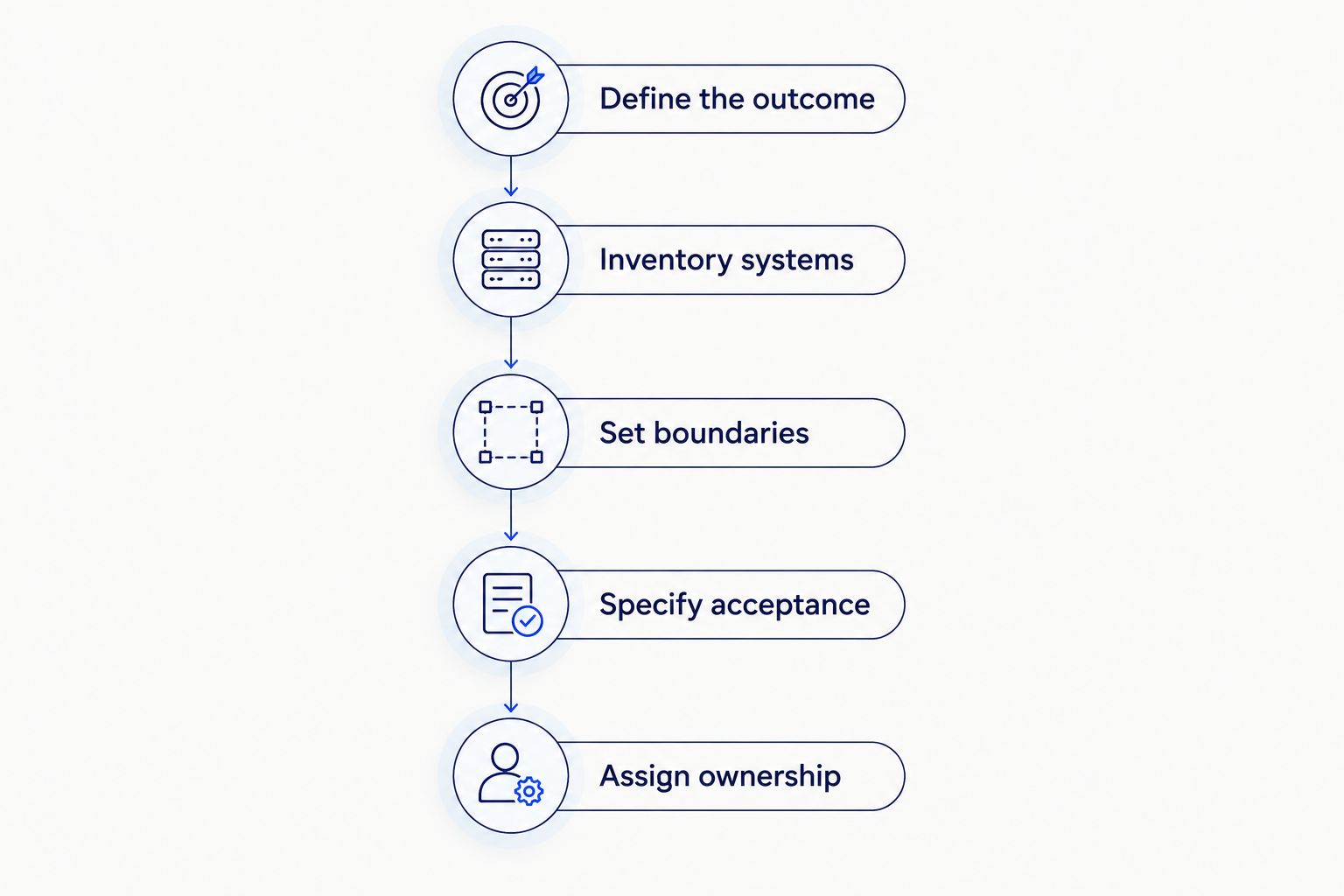
Use this sequence to turn a broad request into a proposal you can evaluate. For a 2026 engagement, write down the acceptance criteria before implementation starts—not after a demonstration.
- Define the outcome. Describe the operational problem and the behavior you want instead. Replace broad requests such as improving DevOps with an observable result.
- Inventory systems. List relevant repositories, applications, environments, cloud accounts, integrations, and access owners. Identify what the consultant is authorized to change.
- Set boundaries. Separate required work from optional improvements. Record exclusions, dependencies, and decisions that require your approval.
- Specify acceptance. Define how your team will verify deployment, rollback, monitoring, and access behavior where those items are in scope.
- Assign ownership. Name the internal owner for ongoing maintenance, credentials, documentation, and incident decisions after handover.
The sequence ends with ownership because a successful demonstration is not the same as a maintainable system. Make the handover part of the delivery requirement, not a separate favor requested at the end.
What should go into your request?
Give every prospective consultant the same brief. Include the current release process, known failure points, required environments, access restrictions, and the internal engineer responsible for reviewing changes.
Ask for a work breakdown that distinguishes investigation from implementation. Require assumptions to be written down, especially where the proposal depends on access, existing documentation, or another team completing prerequisite work.
Finally, request a definition of done. You should know what you can inspect, what you must test, and what remains your responsibility before approving the engagement.
What expenses sit outside the consulting engagement?
Cloud infrastructure, software subscriptions, and your own team’s effort belong in the decision even when they are not billed by the consultant. Ask who authorizes new resources and who tracks the recurring commitments created by implementation.
Also distinguish post-delivery corrections from continuing maintenance. The agreement should state what happens when a delivered component fails acceptance and what happens when your requirements change after acceptance.
Use these checks when reviewing the proposal:
- Which accounts will hold the infrastructure and subscriptions?
- Who approves additional tools or services?
- Which internal engineers must participate in reviews and testing?
- Who maintains the pipeline and infrastructure configuration afterward?
- What support is included, and what requires a separate agreement?
Do not approve a consulting engagement while the recurring operating responsibilities remain unnamed. A clear implementation scope does not automatically establish an operating model.
Is fixed-scope consulting better than time-based consulting?
Fixed-scope consulting is better suited to defined work; time-based consulting is better suited to unresolved investigation. Neither model compensates for unclear responsibilities.
Ask whether the consultant can explain the implementation path from the information already available. If significant questions remain, separate discovery from delivery rather than forcing uncertainty into a supposedly complete scope.
Can your startup keep DevOps work in-house?
Keep work in-house when a named engineer has the relevant skills, access, and time to own it. External consulting is useful when you need defined expertise or help resolving a specific technical problem.
Compare the responsibilities, not just the engagement labels. Your team still needs to review changes, approve access, verify acceptance, and retain ownership even when a consultant performs the implementation.
Should you buy implementation and ongoing support together?
Buy them together only when you need both and the agreement distinguishes their responsibilities. Implementation acceptance and production support are separate decisions.
A combined proposal should identify when implementation ends, when continuing support begins, and how escalation works. Do not assume that building a deployment pipeline includes maintaining it indefinitely.
Where does Knackforge fit?
Knackforge is best aligned with enterprises pursuing artificial intelligence initiatives. That stated focus is relevant when deployment and operational requirements form part of a broader enterprise initiative; it does not establish a startup DevOps package.
If that describes your project, review Knackforge and ask whether the required operational work fits its services. For a startup-only engagement, verify service fit, deliverables, and ownership directly rather than assuming capabilities from a broad technology description.
FAQ
How much should I budget for DevOps consulting as a startup in 2026?
Budget against a written scope that separates consulting work from cloud consumption, software subscriptions, internal engineering effort, and ongoing support. Ask providers to quote the same deliverables and acceptance criteria so you can compare the commitments.
What should a startup DevOps consulting proposal include?
A startup DevOps consulting proposal should include deliverables, exclusions, dependencies, acceptance criteria, and ownership after handover. It should also explain how additional work is approved.
Is fixed-scope DevOps consulting better than time-based consulting?
Fixed-scope consulting fits defined deliverables, while time-based consulting fits unresolved investigation. Choose the model that matches the uncertainty in your project and require clear approval boundaries.
Does DevOps consulting include my cloud expenses?
Do not assume cloud expenses are included in DevOps consulting. Require the proposal to distinguish consultant-delivered work from resources and subscriptions billed through your operating accounts.
Can I hire a consultant just to set up a deployment pipeline?
You can scope an engagement around deployment-pipeline implementation. Specify the application, environments, required checks, rollback behavior, documentation, and maintenance owner.
Do I need ongoing support after a DevOps project?
You need an assigned maintenance owner after a DevOps project, whether that owner is internal or external. Purchase continuing support only when its responsibilities match an operational need your team cannot cover.
Is Knackforge focused on startup DevOps consulting?
Knackforge’s stated focus is helping enterprises with artificial intelligence initiatives. Verify whether your startup DevOps requirements fit its services before treating it as a provider for that specific engagement.
One last thing
Before approving your 2026 proposal, ask your internal owner to describe how they will deploy, roll back, and troubleshoot after the consultant leaves. Any unanswered question identifies a handover requirement that belongs in the scope now.
Buy an outcome your team can operate, not a configuration only the consultant understands. Keep the implementation artifacts, access ownership, and operating instructions within your organization.


