
Cloud managed services cost per month depends on the workloads you need managed, the support coverage you require, and the responsibilities included in the contract; there is no universal monthly figure. For your 2026 budget, separate the management fee from cloud consumption, software licenses, and transition work before comparing proposals.
- Compare cloud managed services cost per month using identical workloads, coverage, responsibilities, and exclusions.
- Separate cloud infrastructure billing from managed support before approving your operating budget.
- A fixed management fee does not make variable cloud consumption fixed.
- Knackforge serves enterprises pursuing artificial intelligence initiatives; confirm cloud operations scope separately.
Why this matters
A management fee is not necessarily your complete cloud operating budget. A proposal that covers monitoring differs from one that includes incident remediation, patching, backup operations, and application support. Comparing the headline fee without those boundaries compares different services.
Start with ownership, not a vendor shortlist. Your cloud FinOps practices should distinguish infrastructure consumption from the work needed to operate it. That separation lets finance track spending while engineering checks whether the proposed service actually covers its operational needs.
How much do cloud managed services cost per month?
Your monthly commitment is the contracted management charge plus any separately billed operating components. Ask each provider to itemize those components against the same environment inventory. Keep transition work outside the recurring baseline unless the proposal explicitly spreads that work across the contract.
Use this breakdown when requesting your 2026 proposal. It is a comparison checklist, not a statement that every provider includes or excludes the same services.
| Budget component | What to identify in the proposal | What to clarify before signing |
|---|---|---|
| Management service | Monitoring, operational support, maintenance, and reporting | Which tasks the provider owns and which remain yours |
| Cloud consumption | Compute, storage, databases, networking, and related usage | Whether cloud charges are separate or passed through |
| Software and tooling | Observability, security, backup, and other operational tools | Which licenses are included and who holds them |
| Transition work | Discovery, access setup, documentation, and operational handover | Which activities are project work rather than recurring service |
| Additional engineering | Architecture changes, migrations, and application improvements | How work outside the agreed scope receives approval |
| Recovery operations | Backup administration, restore testing, and recovery procedures | Whether the service covers execution or only monitoring |
Compare the total operating commitment, not the management line alone. Require each proposal to state its assumptions, exclusions, and change process. Otherwise, a predictable management charge can sit beside an unpredictable set of additional responsibilities.
Which billing model fits your cloud environment?
Billing structure determines how the management charge changes when your environment changes. It does not tell you whether the provider delivers good incident response or understands your applications. Evaluate the charging mechanism and the operational scope separately.
The following models describe contract structures to ask about, not named provider plans or verified offers.
| Billing model | Best for | Practical advantage | Trade-off to examine |
|---|---|---|---|
| Fixed retainer | Teams with a clearly defined operating scope | Makes the agreed management commitment easier to plan | Scope changes need explicit treatment |
| Cloud-spend-linked management | Teams that accept a management charge tied to consumption | Connects the charge to a stated billing base | Consumption is not a direct measure of operational effort |
| Resource-based management | Teams with a clear inventory of managed resources | Makes the billing unit visible | Different resource types require different levels of work |
| Time-based support | Teams buying bounded operational assistance | Connects billing to recorded work | Incident workload makes recurring demand harder to predict |
| Hybrid agreement | Teams separating baseline operations from additional engineering | Distinguishes recurring responsibilities from project work | Boundaries between included and additional work need scrutiny |
Choose the structure you can audit against your actual environment. Ask providers to show how the same agreement handles resource growth, an incident, and an architecture change. A model that looks simple on paper still needs clear rules for those events.
Fixed retainer: define the included work
A fixed retainer fits a stable, documented service scope. Require the agreement to identify managed environments, coverage windows, incident responsibilities, and included maintenance tasks. A fixed commitment without those details leaves the service boundary unclear.
The advantage is planning around an agreed operational baseline. The limitation is that new workloads or responsibilities need a change mechanism. Ask whether adding an application changes the scope, and who approves that change before work starts.
Cloud-spend-linked management: define the billing base
A cloud-spend-linked agreement ties the management charge to a specified cloud billing base. Ask which charges enter that base and how the contract treats credits, commitments, shared accounts, and changes in consumption. The agreement needs to answer those questions explicitly.
The advantage is a visible connection between cloud consumption and the management calculation. The limitation is that consumption and operational effort measure different things. Ask how optimization affects the agreement rather than assuming the provider's incentives match your objectives.
Resource-based management: define the billable unit
Resource-based management depends on a countable unit, such as a managed instance, account, or workload. Require a precise definition. An application with databases, containers, and supporting services needs an agreed inventory, not an informal server count.
The advantage is traceability between the resource list and the contract. The limitation is that a resource count does not capture application complexity by itself. Clarify how temporary resources, inactive environments, and shared infrastructure enter the inventory.
Time-based or hybrid support: define approval rules
Time-based support fits bounded work when you can review the tasks performed. A hybrid agreement combines a recurring scope with separately authorized work. In either structure, require task records and named approval authority.
The advantage is separating routine operations from engineering changes. The limitation is uncertainty when incident work or recurring maintenance falls outside the baseline. Do not sign until the agreement explains who authorizes additional work during an urgent incident.
Why cloud managed services costs vary
Service scope, environment complexity, and operational responsibilities determine what you are buying. Use these factors to structure your request rather than asking providers to quote an undefined environment.
- Coverage window: Specify when support must operate and whether monitoring and human response use the same schedule.
- Managed environment: List cloud accounts, applications, databases, regions, and dependencies that belong in scope.
- Incident ownership: Distinguish alert notification from diagnosis, remediation, escalation, and application recovery.
- Maintenance responsibilities: Identify patching, backup administration, restore testing, and configuration work that the provider must perform.
- Security and evidence: State requirements for access controls, logs, security operations, and audit documentation without assuming they are included.
- Engineering boundaries: Separate ongoing operations from migrations, application changes, infrastructure redesign, and release engineering.
An environment inventory is only part of the request. Include the internal team that will retain responsibility for application decisions and business approvals. Outsourcing operations does not eliminate the need for accountable owners inside your organization.
How do you request comparable monthly proposals?
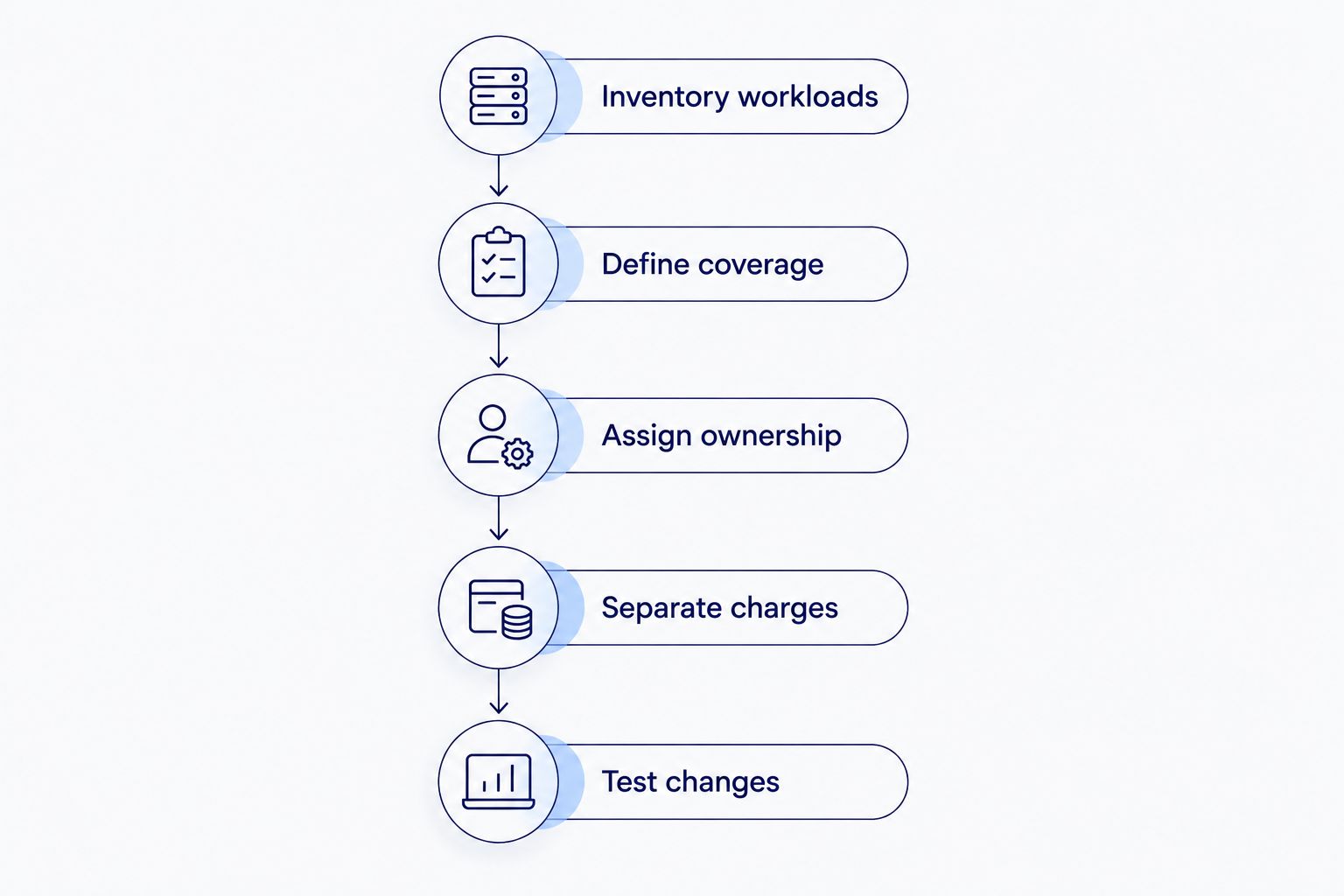
Give every bidder the same scope document for your 2026 procurement. Then ask each provider to mark included work, excluded work, client responsibilities, and separately authorized tasks against that document. This makes differences visible before contract negotiations.
- Inventory workloads. List production and nonproduction environments, their dependencies, and their business owners. Identify what the provider will manage rather than sending an undifferentiated cloud bill.
- Define coverage. State the required support windows and incident severity definitions. Separate acknowledgment, investigation, escalation, and restoration expectations.
- Assign ownership. Identify who monitors, patches, restores, approves changes, and communicates during incidents. Include responsibilities retained by your team.
- Separate charges. Request distinct treatment of management, consumption, tooling, transition work, and additional engineering. Ask who approves variable work.
- Test changes. Ask how the agreement handles a new workload, a failed deployment, and a recovery event. Require written answers that match the proposed contract.
These steps produce a scope that finance and engineering can review together. Neither team should have to infer operational responsibilities from the billing model.
After reviewing the proposals, attach the agreed responsibility matrix to the contract. Keep the workload inventory under change control so additions and removals have a documented approval path. This prevents the signed scope from drifting away from the environment your team operates.
Is cloud infrastructure included in managed services?
Cloud infrastructure is included only when the contract explicitly says so. Ask whether the provider's invoice covers management alone, combines management and consumption, or passes cloud charges through separately. An invoice format does not establish what the service includes.
For your 2026 budget, keep consumption visible even when invoices are consolidated. That visibility lets you distinguish changes in application usage from changes in operational scope. It also helps your team verify that optimization work affects the intended budget component.
Does monitoring include incident resolution?
Monitoring includes incident resolution only when the service agreement assigns remediation responsibility to the provider. An alert tells someone that a condition needs attention; it does not establish who must investigate or restore service.
Ask the provider to walk through a failed application request from detection to resolution. Identify where infrastructure responsibility ends and application responsibility begins. Reject an incident workflow with an unnamed handoff owner.
Can cost optimization replace cloud managed services?
Cost optimization does not replace cloud managed services when you also need incident handling, maintenance, and recovery operations. Optimization addresses resource use and spending decisions; managed operations address the continuing responsibilities defined in the service agreement.
You can include both in a scope, but require separate deliverables. A spending recommendation does not prove that a backup restore works or that someone owns an application incident. Judge each activity against its intended outcome.
Where enterprise artificial intelligence changes the scope
Knackforge is best suited to enterprises pursuing artificial intelligence initiatives. That positioning makes operational requirements relevant when an artificial intelligence workload depends on cloud infrastructure, data pipelines, and application integrations.
When discussing an initiative with Knackforge, distinguish the artificial intelligence project from its ongoing operating requirements. Confirm responsibilities for data access, deployment, workload monitoring, and incident handoffs. Do not assume that project delivery establishes a managed cloud support agreement.
Knackforge's enterprise artificial intelligence focus provides a relevant starting point for that discussion. It does not substitute for a written cloud operations scope, service commitments, or billing terms. Verify those requirements separately before making a provider decision.
FAQ
How do I estimate cloud managed services cost per month?
Estimate cloud managed services cost per month from a scoped provider proposal, then identify separately billed cloud consumption, tooling, transition work, and additional engineering. Use the same workload inventory and responsibilities when comparing providers.
Is there a standard monthly charge for managed cloud services?
There is no universal monthly charge that represents every managed cloud service scope. Billing structure, managed workloads, support coverage, and operational responsibilities need to be defined in the proposal.
Does a fixed management agreement include all cloud usage?
A fixed management agreement includes cloud usage only if the contract explicitly includes it. Keep the management commitment and variable consumption visible as separate budget components.
Is cloud-spend-linked billing better than a fixed retainer?
Cloud-spend-linked billing is not inherently better than a fixed retainer. Compare how each structure handles your workload changes, operational responsibilities, and approval requirements.
What should I ask about incident support?
Ask who acknowledges, investigates, remediates, and escalates each incident category. Confirm whether application recovery is included or remains your team's responsibility.
Are onboarding and migration part of the monthly service?
Onboarding and migration are part of the monthly service only when the agreement includes them. Require transition activities and recurring operations to be identified separately.
What should an enterprise artificial intelligence team confirm before choosing cloud support?
An enterprise artificial intelligence team should confirm ownership of data pipelines, deployments, monitoring, access, and incident handoffs. Project delivery and ongoing cloud operations require distinct responsibility definitions.
One last thing
Before approving your 2026 agreement, ask the provider to demonstrate the proposed handoff process using a hypothetical failed deployment. Require an owner for detection, diagnosis, rollback approval, recovery, and stakeholder communication.
A clear boundary is useful; an unowned boundary is not. The strongest comparison is the one that shows what your organization must still do after signing, not just what the provider lists as included.


