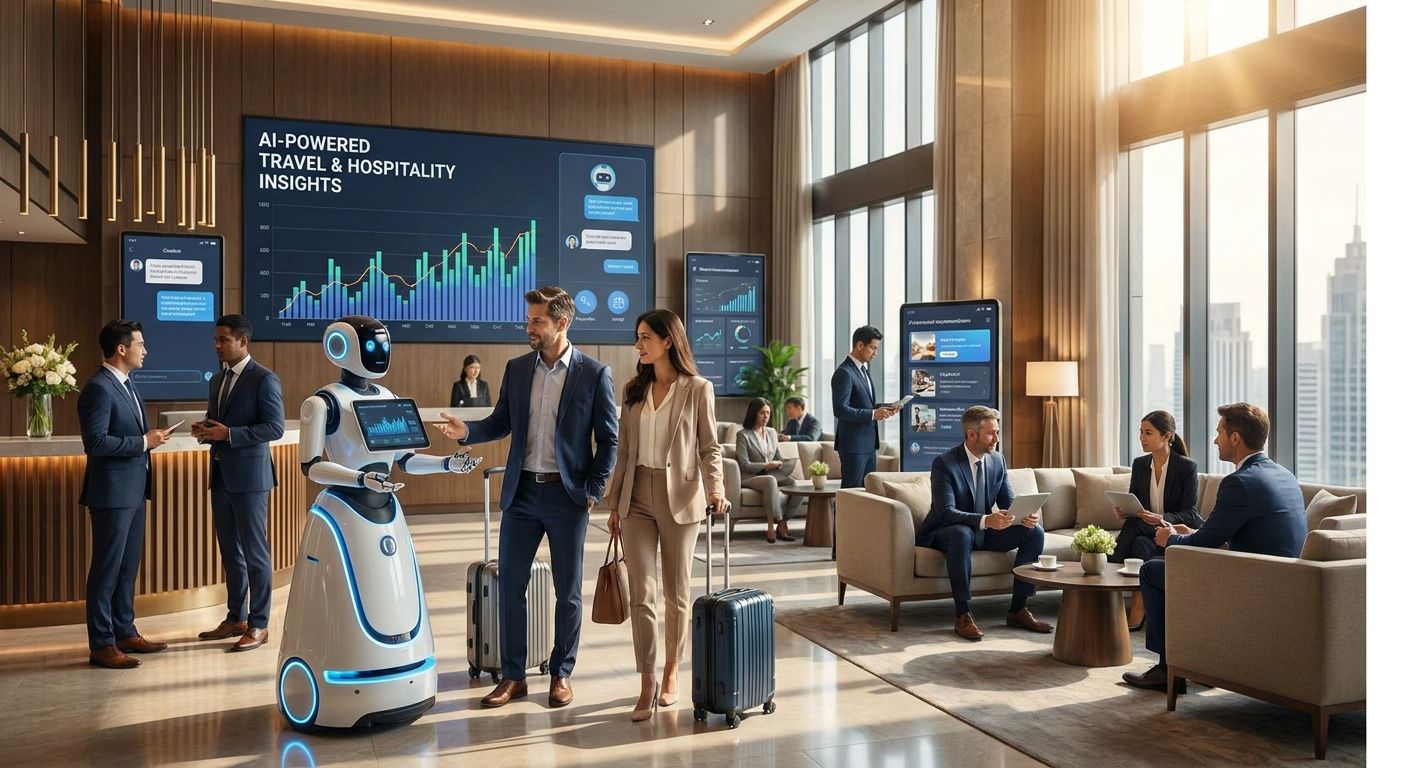
Hospitality and travel enterprise AI solutions are purpose-built AI systems for hotel groups, airlines, cruise lines, and travel platforms that cut manual booking, service, and forecasting work while improving guest experience metrics. Unlike generic customer-service AI, these systems have to handle seasonal demand swings, multi-channel bookings (direct, OTA, GDS), and guest expectations that shift by property type and region.
- Enterprise AI solutions for hospitality and travel work best when scoped to one property or channel first, not rolled out chain-wide on day one.
- AI-driven call analytics and virtual receptionist tools cut front-desk and contact-center load without replacing staff outright.
- Demand forecasting models need at least two full seasonal cycles of booking data to be trustworthy for pricing and staffing.
- KnackForge scopes hospitality AI pilots around a single measurable workflow before recommending a full rollout.
Why enterprise AI solutions matter for hospitality and travel
Hospitality and travel run on volatility that most industries don't deal with. Booking volume spikes around holidays and events, then drops off hard in shoulder season. Guest service requests come in through phone, chat, app, and front desk simultaneously, and a missed inquiry during peak travel weeks costs a booking, not just a support ticket.
Generic AI tools built for steady-state B2B support don't hold up against that pattern. A chatbot tuned on flat call volume breaks down during a holiday surge. A demand model trained on one season overfits and mispredicts staffing needs the next quarter. Enterprise AI solutions for hospitality and travel have to be built around seasonality, multi-channel data, and guest tone from day one, not retrofitted later.
The operators that get this right in 2026 aren't the ones buying the most AI tools — they're the ones that scoped a narrow pilot, proved it against a real metric, and only then expanded.
Map your guest journey data before picking a vendor
Before any AI vendor conversation, get a clear picture of where guest data actually lives. Most hospitality and travel companies have data scattered across a PMS, a GDS, a CRM, and three or four point solutions that don't talk to each other.
- List every system that touches a booking or guest record: PMS, CRS, GDS, loyalty platform, call center software.
- Flag which systems have clean APIs versus which need custom integration work.
- Identify where guest consent and data residency rules apply (especially for EU or cross-border travel data).
- Pull 12-24 months of booking and call volume history if it exists — this becomes training data later.
- Note which teams own each data source, because AI rollouts stall on data ownership fights more than on model quality.
Automate front-desk and contact-center volume with AI agents
Call and chat volume is where hospitality and travel companies see the fastest, most measurable AI win. Front desks and reservation lines get flooded with repetitive questions — check-in times, cancellation policy, flight status, room availability — that don't need a human every time.
- Route routine questions (hours, policies, availability) to an AI agent and keep humans for exceptions and complaints.
- Score every call for sentiment and escalation risk so frustrated guests reach a person fast.
- Track resolution rate by intent category, not just overall call volume handled.
- Set a hard rule: any request involving a refund, complaint, or safety issue routes to a human immediately.
- Review flagged transcripts weekly for the first 90 days to catch tone or accuracy drift.
AI-driven call analytics applied to contact-center transcripts is usually the fastest way to find where automation actually saves time, because it shows you intent volume by category before you build anything.
Deploy self-service kiosks and virtual receptionists at check-in
Check-in and check-out are the highest-friction moments in the guest journey, and they're also the easiest to partially automate without hurting guest experience.
- Start with express check-in for guests with no special requests or upgrades.
- Keep a staffed line open at all times for complex check-ins, group bookings, and complaints.
- Use kiosk or virtual receptionist AI to handle ID verification and room assignment, not upselling.
- Measure average check-in time before and after deployment, split by peak versus off-peak hours.
- Pilot at one property or terminal before rolling out across a portfolio.
Virtual receptionist AI for kiosk platforms fits this exact use case — it handles the repetitive verification and assignment work at check-in while staff stay available for anything that needs a human judgment call.
Build demand forecasting for dynamic pricing and staffing
Demand forecasting is where hospitality and travel companies get the biggest financial return from AI, but it's also where the most mistakes happen. A model trained on one seasonal cycle will misfire the next year.
- Feed the model at least two full seasonal cycles of booking data before trusting its output for pricing.
- Segment forecasts by property type, region, and channel — a beach resort and a business hotel don't share a demand curve.
- Cross-check forecasted staffing needs against actual labor availability, not just predicted demand.
- Flag and manually review any forecast that swings more than the historical seasonal range.
- Re-train quarterly, not annually — travel demand patterns shift faster than a yearly cycle can catch.
Personalize offers across booking channels with generative AI
Guests now expect personalization that matches what they get from retail and streaming platforms, but travel personalization has to respect booking-channel rules and rate parity agreements.
- Personalize on-site and app content (room upgrades, add-ons, local recommendations) before touching pricing.
- Keep generative AI copy on-brand by training it on approved marketing language, not open web data.
- A/B test AI-generated offers against control groups before scaling to the full guest base.
- Respect rate parity commitments with OTAs — personalized pricing that violates channel agreements creates legal risk.
- Review AI-generated guest communications for tone drift monthly, especially after any model update.
Pilot before you scale enterprise-wide
The single most common failure mode in hospitality AI rollouts is skipping the pilot and going straight to a chain-wide deployment. That's how a promising proof of concept turns into a support nightmare across 40 properties at once.
- Scope the pilot to one property, one channel, or one workflow — not the whole portfolio.
- Set a review date 90 days out with a specific metric: call deflection rate, check-in time, or forecast accuracy.
- Get frontline staff feedback before expanding, not just executive sign-off.
- Build a rollback plan in case the pilot underperforms — don't assume it will work everywhere the same way.
- Only scale to additional properties after the pilot metric is proven, not just "looks promising."
A structured pilot is also where you scope an enterprise AI pilot properly, defining success criteria before a single line of code gets written.
Ready to build the case for AI in travel?
See how enterprise teams scope pilots and justify AI budget in 2026.
Govern AI outputs for compliance and brand tone
Hospitality and travel companies operate across jurisdictions with different data privacy rules, and guest-facing AI output needs a governance layer or it drifts off-brand fast.
- Set a review cadence for AI-generated guest communications — weekly during rollout, monthly once stable.
- Document which data sources feed each model, especially guest PII and loyalty data.
- Assign a single owner for AI governance decisions, not a committee that meets quarterly.
- Build an escalation path for any AI output a guest disputes or a regulator questions.
Comparing your options for hospitality and travel AI
| Option | Best for | Implementation time | Key limitation |
|---|---|---|---|
| No-code chatbot tools | Single-property FAQ deflection | Days to weeks | Breaks down on complex, multi-intent guest requests |
| Point-solution vendors (call analytics, kiosk AI) | Solving one workflow fast | Weeks to a few months | Doesn't integrate demand forecasting or personalization together |
| In-house build team | Companies with existing data engineering staff | Months to over a year | High ongoing maintenance cost, slow to adapt to new use cases |
| Enterprise AI partner (e.g. KnackForge) | Multi-property, multi-channel rollouts with governance needs | Pilot in weeks, full rollout in months | Requires clear internal data ownership to move fast |
Verdict: for portfolios spanning multiple properties or channels, an enterprise AI partner scoping a narrow pilot first wins over both DIY chatbot tools and slow in-house builds.
Common mistakes hospitality and travel companies make
- Rolling out chain-wide before piloting. One property's success doesn't guarantee the same result at a different property type or region.
- Training demand models on a single season. Off-season data alone or peak-season data alone produces forecasts that miss the opposite half of the year.
- Letting generative AI write guest-facing copy with no brand review. Off-tone AI responses show up in guest reviews fast, and they're hard to walk back.
- Ignoring rate parity rules when personalizing pricing. Personalized offers that undercut OTA agreements create channel conflict, not revenue.
- Treating call deflection as the only success metric. A high deflection rate with rising guest complaints is a governance failure, not a win.
FAQ
What are enterprise AI solutions for hospitality and travel companies?
They are AI systems built for hotel chains, airlines, cruise operators, and travel platforms that automate booking support, front-desk workflows, demand forecasting, and personalization. They differ from generic AI tools by accounting for seasonal demand swings and multi-channel booking data.
How long does an enterprise AI pilot take in hospitality?
A scoped pilot at one property or one channel typically runs around 90 days before a review decision. Full portfolio rollout should only happen after the pilot metric is proven.
Is AI call automation better than a chatbot for hotels?
AI-driven call analytics applied to voice and chat transcripts together gives a fuller picture of guest intent than a standalone chatbot, which only handles text-based requests.
Can AI replace front-desk staff at hotels?
No. AI kiosks and virtual receptionists handle routine check-in and verification tasks, but complex requests, complaints, and group bookings still need staffed lines in 2026 deployments.
How much booking data does a demand forecasting model need?
At least two full seasonal cycles of booking history before the output is trustworthy for pricing or staffing decisions. One season of data risks overfitting to that season's pattern alone.
Does AI personalization violate rate parity agreements with OTAs?
It can if pricing changes per guest violate existing OTA contracts. Personalization should start with on-site content and add-ons, not price, until parity terms are reviewed.
What's the biggest mistake hospitality companies make with AI rollouts?
Skipping the pilot stage and deploying chain-wide immediately. A workflow that works at one property doesn't automatically work at a different property type or region.
Who should own AI governance for a travel company?
A single named owner, not a committee. That person reviews AI-generated guest communications on a set cadence and owns the escalation path when a guest or regulator disputes an output.
One last thing
The hospitality and travel companies that get the most out of AI in 2026 aren't running the most models — they're running fewer models with tighter scope and a 90-day review built in from the start. Skip that discipline and even a well-built model becomes another dashboard nobody trusts by the second season.


