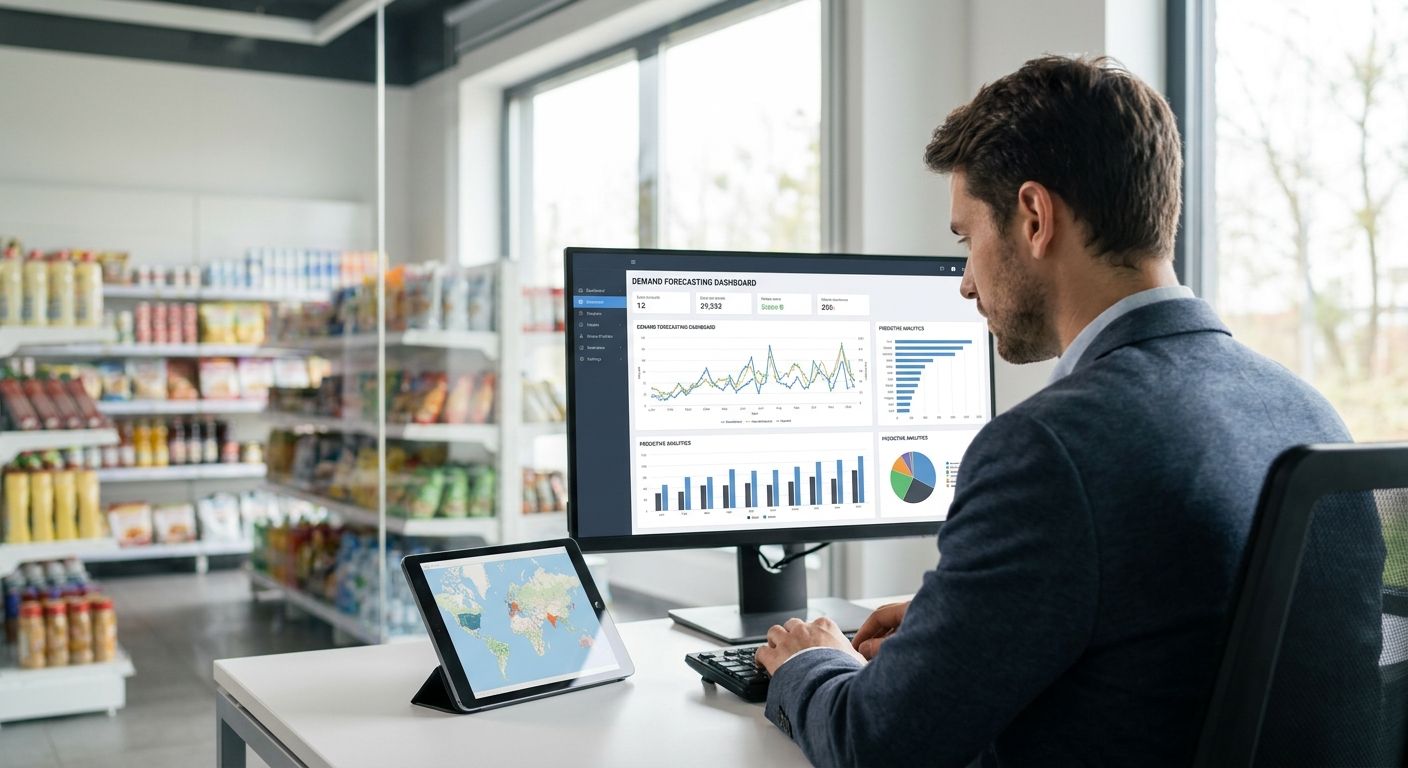
Retail demand forecasting in 2026 runs on far more data than the statistical models built for it a decade ago — daily SKU-level sales, location-level inventory, weather feeds, promotional calendars, and web traffic all updating in real time. This guide breaks down what actually separates a working predictive analytics solution for retail demand forecasting from a vendor demo that looks impressive and then drifts within two quarters.
- Predictive analytics solutions for retail demand forecasting fail most often on data quality, not model choice — fix the platform first.
- Generative AI-augmented demand sensing catches promotional and weather-driven spikes that standard time-series models miss in 2026.
- MLOps discipline keeps forecasting models from silently degrading after the first two fiscal quarters — treat retraining as mandatory.
- Skip vendors quoting accuracy numbers without disclosing SKU count and data history behind them.
Why this matters
Most retail teams don't fail at demand forecasting because the algorithm is wrong. They fail because point-of-sale, inventory, and e-commerce data live in three or more disconnected systems, and the forecasting model gets fed a partial, stale picture. If you're evaluating data integration for retail enterprises before you evaluate forecasting software, you're already ahead of most buyers in 2026.
The stakes are direct: overforecast and you sit on markdown inventory; underforecast and you're out of stock on the SKUs driving margin. Predictive analytics solutions for retail demand forecasting exist to shrink that gap, but only when the underlying data and operating model support them.
Who this is for
This guide is for retail operators, supply chain leaders, and IT decision-makers evaluating predictive analytics for demand forecasting across multiple stores, channels, or regions — not single-location shops running spreadsheet forecasts. If you're managing SKU counts in the thousands, seasonal demand swings, and at least one legacy ERP or planning system you can't rip out overnight, the criteria below apply directly to you.
What to look for in predictive analytics solutions for retail demand forecasting
A data foundation that doesn't need rebuilding every quarter
Models retrained on incomplete or duplicated data produce forecasts that look confident and drift wrong. A solution worth buying in 2026 assumes your POS, inventory, and web data need consolidation first, not as an afterthought six months into the project.
SKU- and location-level granularity, not category averages
A forecast accurate at the category level can still be wrong at the store shelf. Retailers running multi-region operations need models that account for local demand patterns, not a national average smoothed across every location.
Explainability planners can act on
A forecast a planner can't interrogate gets ignored the first time it's wrong. Look for solutions that show which signals drove a given number — a promotion, a weather pattern, a competitor stockout — not a black-box score.
A retraining cadence built in, not bolted on
Demand patterns shift with every fiscal quarter, new product launch, and macro shock. Models that aren't retrained on a defined schedule degrade quietly, and by the time the error shows up in inventory numbers, the damage is already done.
Native fit with existing ERP and planning tools
A forecasting engine that can't feed directly into your existing replenishment and planning workflow becomes a second system planners have to manually reconcile against. That reconciliation gap is where forecasts stop getting trusted.
Top approaches for 2026
The foundation play — data platform consolidation. The unglamorous one that actually works. Before any forecasting model gets deployed, POS, inventory, and e-commerce data get unified into a single AI-ready data platform, replacing the three-to-five disconnected systems most retail enterprises are still running forecasts against. This is the step that determines whether every model built after it holds up past the first fiscal quarter. Verdict: Buy — see how to prepare a data platform for AI-ready analytics.
The demand-sensing play — generative AI-augmented forecasting. The one that catches what pure statistics miss. Traditional time-series models handle steady-state demand well but struggle with promotional spikes, weather-driven surges, and new-product launches with no sales history. Generative AI models layered on top of demand data pick up these signals and shift forecasts from a weekly cycle to something closer to daily. Verdict: Consider for a 2026 pilot before full rollout — see generative AI development for retail personalization for the adjacent capability set.
The risk-monitoring play — supply chain risk agents. The one planners actually check every morning. AI agents that monitor supplier, logistics, and inventory signals flag disruption risk before it turns into a stockout, feeding directly into the demand forecast so planners adjust orders before the shelf goes empty rather than after. Verdict: Consider for retailers running multi-supplier categories with volatile lead times.
The model-ops play — MLOps discipline for forecasting models. The one nobody budgets for and everyone needs by month six. Forecasting models deployed without a retraining pipeline degrade the moment demand patterns shift — a new competitor, a pricing change, a supply shock. Building retraining and monitoring into the deployment from day one is what separates a forecast that stays accurate through 2026 from one that quietly stops being trusted by planners. Verdict: Buy for any team running models past the first year of production.
Talk through your forecasting gap
Get a straight read on where your retail data blocks accurate demand forecasting.
What to avoid
- Off-the-shelf forecasting templates that ignore your promotional calendar. A model tuned on generic retail seasonality without your actual promotion and markdown schedule will consistently miss the weeks that matter most.
- Vendors quoting accuracy percentages without showing SKU count or data history. An accuracy number without context on how many SKUs, how many locations, and how much historical data it was measured against is a marketing figure, not a benchmark.
- One-time forecasting projects with no retraining plan. A model handed off at go-live with no defined retraining cadence is a model that starts degrading the day the project team leaves.
Verdict comparison
| Approach | Data foundation required | Time to see signal | Best for | Verdict |
|---|---|---|---|---|
| Data platform consolidation | This is the foundation | Ongoing, unlocks everything else | Any retailer with 3+ disconnected data systems | Buy |
| Generative AI demand sensing | Clean, unified demand data | Weeks to first pilot results | Promotion-heavy categories, new-product launches | Consider |
| Supply chain risk agents | Supplier and logistics data feeds | Immediate on deployment | Multi-supplier categories with volatile lead times | Consider |
| MLOps for forecasting models | Existing forecasting model in production | Pays off after month six | Teams running models past year one | Buy |
FAQ
What is predictive analytics in retail demand forecasting?
Predictive analytics for retail demand forecasting uses historical sales, inventory, and external signals like weather or promotions to project future demand at the SKU and location level. In 2026, the strongest implementations combine unified data platforms with models that retrain on a defined schedule rather than running static.
How accurate is AI-based demand forecasting in 2026?
Accuracy depends entirely on data quality and granularity, not just the model — a model fed fragmented POS and inventory data will underperform regardless of how advanced it is. Retailers that consolidate their data platform before deploying forecasting models see far more stable results than those that don't.
Do we need a data platform before adding demand forecasting models?
Yes, in most cases. Forecasting models trained on incomplete or duplicated data across disconnected POS, inventory, and e-commerce systems produce confident-looking forecasts that are frequently wrong at the SKU level.
What's the difference between demand forecasting and demand sensing?
Demand forecasting projects future demand from historical patterns over weeks or months, while demand sensing adjusts those projections in near-real time using current signals like promotions, weather, or competitor stockouts. Retailers running both together catch spikes that pure forecasting misses.
How often should forecasting models be retrained?
Forecasting models need a defined retraining cadence tied to your fiscal calendar, not an ad-hoc schedule. Models left untouched after go-live degrade quietly as demand patterns shift with new products, pricing changes, or competitor moves.
Can predictive analytics handle promotions and weather events?
Standard time-series models struggle with one-off events like promotions and weather spikes because they lack sales history for those conditions. Generative AI-augmented models layered on top of demand data are built specifically to pick up these irregular signals.
Is generative AI different from traditional forecasting models?
Yes. Traditional forecasting models rely on historical time-series patterns, while generative AI models can incorporate unstructured signals and adapt faster to new scenarios with limited sales history, like new product launches.
What should a retail enterprise budget for a demand forecasting pilot in 2026?
Scope and cost vary by data readiness and the number of SKUs and locations involved, so get a specific quote based on your current systems rather than a generic industry number. Retailers with a consolidated data platform already in place typically move to pilot faster than those starting from fragmented systems.
One last thing
The forecasting model is rarely what fails first — the data feed is. Retail teams that invest in a clean, unified data platform before chasing the newest generative AI forecasting feature consistently get more mileage out of both, because the model finally has something reliable to learn from. Going into 2026 planning cycles, that ordering — platform first, model second — is the single biggest predictor of whether a predictive analytics rollout sticks past its first fiscal quarter.


