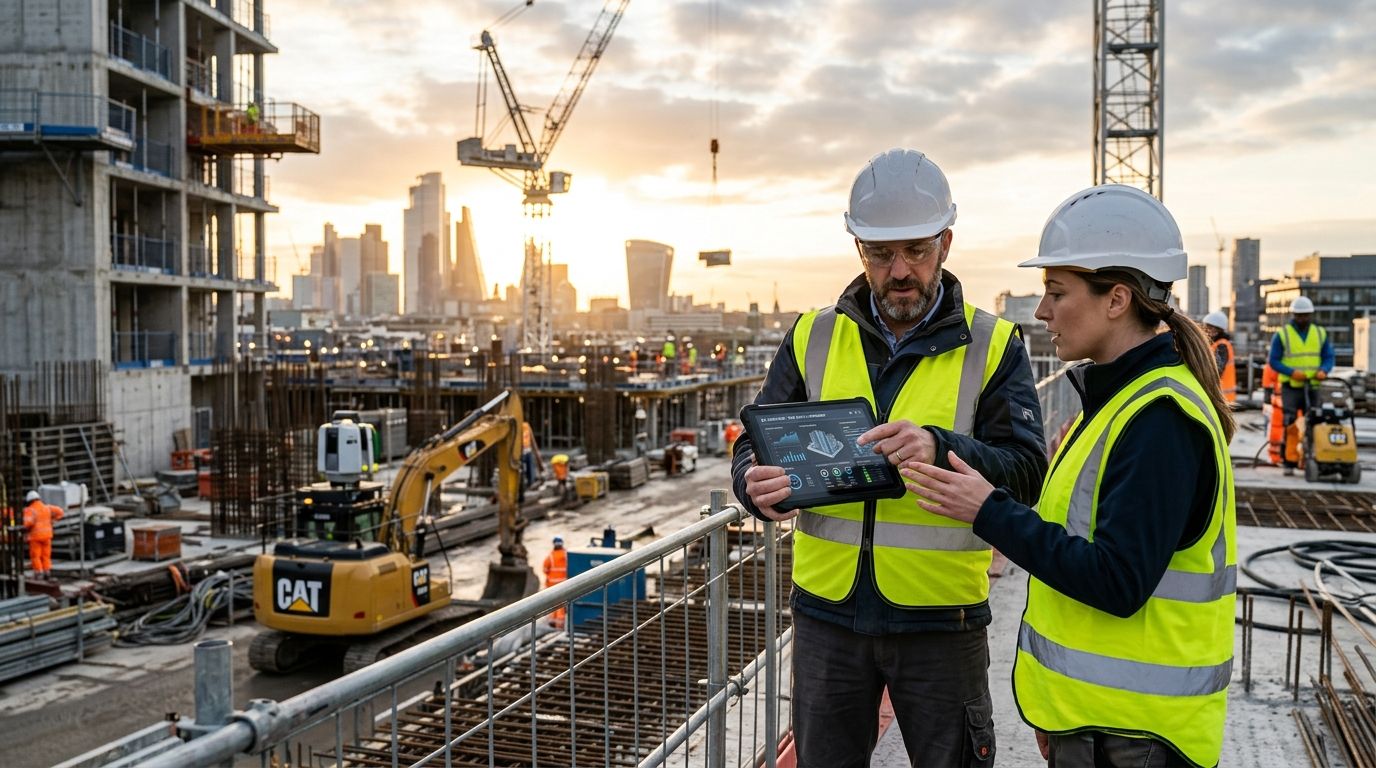
Enterprise AI for construction companies means applying machine learning, computer vision, and generative AI to the parts of a build that eat the most hours and money: safety monitoring, RFIs, submittals, scheduling, and supply chain risk. Construction runs on paper-heavy workflows and fragmented job-site data, so the AI use cases that win here look different from a retail or SaaS deployment.
- Enterprise AI for construction companies works best scoped to one workflow first, not a platform-wide rollout.
- Computer vision catches PPE violations and progress gaps that manual walkthroughs miss on multi-site jobs.
- Document AI for RFIs and submittals pays back fastest because it needs no new hardware.
- KnackForge scopes enterprise AI pilots against margin impact, not feature lists, before recommending a build.
- Governance must exist before AI touches subcontractor data or safety records.
Why enterprise AI matters for construction companies
Construction margins run thin, and most of the waste sits in rework, delayed RFIs, and material overordering rather than labor rates. Enterprise AI for construction companies targets those leaks directly: a submittal review that took a project engineer days can run through a document AI pipeline in hours, and a camera feed at a site entry point flags a missing hard hat before an inspection does.
The reason this differs from a typical enterprise AI rollout is data quality. Job-site data lives in scanned drawings, jobsite photos, subcontractor emails, and disconnected ERP modules. Any construction AI plan that assumes clean, structured data from day one will stall in month two. Scoping the pilot project around one messy, high-volume data source separates a 2026 pilot that ships from one that dies in committee.
Update your project data intake
Before any model touches a workflow, get the inputs into a state a model can actually read.
- Centralize RFIs, submittals, and change orders into one document repository instead of email threads
- Standardize photo capture from field teams: timestamp, GPS tag, and project phase metadata
- Tag historical project data by trade, phase, and outcome so models have labeled examples
- Audit which subcontractors still submit paper-only documentation and plan a digitization path
Start with a scoped pilot, not a platform buy
A six-figure platform license with no defined workflow is the fastest way to burn a construction AI budget with nothing to show a board in 2026.
- Pick one workflow with high volume and clear cost: RFI turnaround time, safety incident rate, or material waste percentage
- Set a measurable baseline before the pilot starts, because you cannot prove ROI against a number you never captured
- Run the pilot on one active job site or one region, not the whole portfolio
- Define kill criteria upfront: what result ends the pilot instead of extending it indefinitely
Deploy computer vision for site safety and progress tracking
Computer vision is the most mature enterprise AI use case in construction because the input already exists on most large jobs.
- PPE detection flags missing hard hats, harnesses, or high-vis vests in real time
- Progress-tracking models compare daily photo capture against the BIM model to flag schedule slippage
- Fall-hazard detection on scaffolding and open edges reduces reliance on manual daily walkthroughs
- Equipment utilization tracking identifies idle machinery drawing rental fees with no output
Vendor selection matters, because not every computer vision shop understands safety-relevant detection taxonomies. The comparison of computer vision firms serving manufacturing floors is a useful reference point, since the underlying detection models overlap heavily with construction site use cases.
Automate document-heavy processes
RFIs, submittals, and contract review are the biggest time sink for project engineers on large commercial jobs.
- Generative AI drafts first-pass RFI responses from historical answers to similar questions
- Document extraction pulls spec compliance data out of submittal PDFs instead of manual review
- Contract clause comparison flags deviations from standard terms across subcontractor agreements
- Automated routing sends documents to the right reviewer based on trade and urgency
Build a business case that ties AI to margin
Boards fund construction AI in 2026 when the pitch is dollars per job, not transformation language.
- Tie every use case to a line item: rework cost, RFI cycle time, safety incident cost, material waste percentage
- Model the pilot cost against the baseline captured before rollout
- Include ongoing model maintenance and data pipeline upkeep, not just the initial build
- Present a phased rollout of pilot, one region, then full portfolio instead of full-scale budget upfront
A structured framework for this step appears in building a business case for generative AI investment. The same margin-first logic applies whether the buyer sits in construction, manufacturing, or logistics.
Monitor supply chain and material risk
Material delays and price volatility hit construction harder than most sectors because change orders cascade through the whole schedule.
- Predictive models flag supplier delivery risk based on historical lead-time variance
- Price volatility alerts on lumber, steel, and copper let procurement lock contracts before spikes
- Cross-project material demand forecasting reduces overordering across simultaneous job sites
- Automated reorder triggers based on burn-rate data instead of manual inventory checks
Set governance before scaling across projects
Safety data, subcontractor records, and site imagery carry liability exposure that generic SaaS governance frameworks were never built for.
- Define who can access safety incident footage and how long it is retained
- Set model accuracy thresholds before any AI output triggers automatic action
- Document which decisions require human sign-off, since a flagged PPE violation is not the same risk tier as a mis-tagged RFI
- Audit vendor data-handling terms before subcontractor or worker data leaves your systems
“A construction AI pilot with no captured baseline is a demo, not a business case.”
Comparison: enterprise AI approaches for construction companies
| Approach | Best for | Key limitation |
|---|---|---|
| Off-the-shelf safety camera AI | Fast PPE and hazard detection on a single site | Rarely integrates with BIM or scheduling data |
| Custom computer vision plus progress tracking | Multi-site GCs needing schedule variance detection | Requires clean drone and photo capture pipelines |
| Document AI for RFIs and submittals | Firms drowning in paper-based review cycles | Needs historical labeled documents to train against |
| Full enterprise AI partner, pilot to scale | Portfolios tying AI to margin across multiple job types | Longer setup before the first measurable result |
Verdict: the fastest-paying construction AI use case in 2026 is document automation for RFIs and submittals, because it needs the least new hardware. Computer vision for safety pays off over a longer horizon but requires camera infrastructure many mid-size general contractors have not installed yet.
Scope your construction AI pilot
Get a workflow-first assessment before committing platform budget.
Common mistakes construction companies make with enterprise AI
- Buying a platform before defining the workflow. License fees with no scoped use case sit unused by month three.
- Skipping the baseline measurement. No captured pre-AI number means no defensible ROI story for the next budget cycle.
- Treating every job site the same. A model trained on one region's permitting, soil, and labor conditions underperforms elsewhere.
- Ignoring subcontractor data quality. The general contractor's records can be clean while much field documentation still arrives on paper.
- No governance until after an incident. Retrofitting access controls and audit trails after a safety data leak costs far more than setting them up first.
FAQ
What is enterprise AI for construction companies?
It is the application of machine learning, computer vision, and generative AI to construction workflows like RFIs, safety monitoring, scheduling, and material forecasting. In 2026, the highest-return use cases are document automation and site safety detection, because both run on data most general contractors already capture.
Is computer vision or document AI the better first project?
Document AI for RFIs and submittals usually pays back faster because it needs no new hardware. Computer vision for safety monitoring requires camera infrastructure but pays off over a longer horizon on multi-site portfolios.
How long should a construction AI pilot run?
Long enough to measure against a captured baseline on one workflow at one job site or region. The exact length depends on that workflow's cycle time, not a fixed calendar window.
Does enterprise AI replace project engineers on RFIs?
No. It drafts first-pass responses and routes documents, but a human still reviews and signs off. The time savings come from cutting manual triage, not removing the reviewer.
What data does a construction company need before starting an AI pilot?
Centralized, tagged historical documents such as RFIs, submittals, and site photos, plus a captured baseline metric. Scanned paper and untagged email threads need digitizing first.
How does AI help with construction material costs?
Predictive models flag supplier delay risk and price volatility on materials like steel and lumber, letting procurement lock contracts before a spike instead of reacting after one hits the schedule.
Who handles governance for construction AI safety data?
Whoever owns the AI program defines access, retention, and human sign-off rules before deployment. Safety footage and worker data carry higher liability exposure than typical enterprise records.
One last thing
The construction firms getting real value from enterprise AI in 2026 are not the ones with the biggest budgets. They are the ones that measured a baseline before touching a model. Skip that step and every ROI claim afterward is a guess dressed up as a metric.


