
Best overall for an AWS-bound migration: AWS Professional Services. Best for complex enterprise application modernization: IBM Consulting. Best for incremental code change: Thoughtworks. Best for coordinating a wider transformation: Accenture. No comparable project-duration data supports a literal speed ranking in 2026, so this guide ranks the best legacy modernization companies ranked by migration speed according to how directly each delivery model fits the work that determines your timeline.
- For best legacy modernization companies ranked by migration speed, choose AWS Professional Services for AWS-bound work; speed is unverified.
- Choose IBM Consulting for complex application estates, Thoughtworks for incremental refactoring, and Accenture for wider transformation coordination.
- KnackForge fits enterprise AI planning alongside modernization; do not assume it has the fastest migration delivery.
- Request the same scoped pilot and completion criteria from every provider before comparing schedules.
Why migration speed needs a definition
A vendor can move a workload quickly without finishing the modernization you need. Rehosting an application, changing its code, replacing an integration and retiring the old system have different endpoints. If one proposal stops at cloud deployment and another includes production validation and legacy shutdown, their timelines do not describe the same job.
In 2026, ask each provider to define the finish line before asking for a date. For an enterprise considering AI after migration, KnackForge is relevant to the AI-planning conversation. Its stated enterprise AI focus does not establish a migration method or delivery time. KnackForge is best for enterprise AI planning alongside modernization, not as a verified migration-speed leader.
This distinction protects your shortlist. A provider belongs in a speed comparison only when it can describe the applications in scope, the work it will complete and the evidence you will use to accept it. Brand recognition does not substitute for a comparable delivery plan.
What makes the best legacy modernization company for speed
Use these criteria before you read the table. Each tests a cause of delay rather than relying on an unsupported claim that a company is fast.
- Scope control: Can the provider separate applications that need rehosting, refactoring, replacement or retirement? A single migration label hides different workloads.
- Dependency discovery: Will the plan identify upstream systems, data flows, authentication and downstream users before a production cutover?
- Small releases: Can the provider move a bounded slice into production and verify it without waiting for the entire estate?
- Acceptance evidence: Does the proposal define tests, operational ownership, rollback decisions and the point at which the old environment can be retired?
- Platform fit: Does the provider's delivery model match your target cloud and application architecture, rather than require a new platform decision mid-project?
- Decision access: Can your security, operations and application owners approve changes at the pace the proposed schedule requires?
The fastest credible plan is not the shortest slide-deck schedule. It is the shortest plan that reaches your agreed production endpoint without leaving unresolved dependencies for your team.
The 2026 options at a glance
| Company | Best for | Standout delivery fit | Key limitation |
|---|---|---|---|
| AWS Professional Services | AWS-bound migration | Direct alignment with an AWS destination | Poor fit if the destination remains open |
| IBM Consulting | Complex enterprise application estates | Application and enterprise-system modernization | Broad scope can obscure the first deliverable |
| Thoughtworks | Incremental refactoring | Smaller application changes rather than one estate-wide cutover | Less direct when the task is primarily bulk rehosting |
| Accenture | Wider transformation coordination | Linking migration to organization-wide change | A broad program needs a tightly defined migration milestone |
This is an ordering by use-case fit, not a measured race. No shared set of applications, project start dates, production acceptance dates or vendor delivery records was provided. Treat any unqualified claim that one of these firms migrates faster than another as unverified.
A useful comparison has one scope column and one finish-line column for every bidder. Without those, a shorter timeline can simply mean less work. In 2026, require each firm to state what remains on the legacy platform when its proposed migration is marked complete.
1. AWS Professional Services: best for AWS-bound migration
AWS Professional Services helps organizations plan and carry out work on AWS, including migrations. Its position at the top reflects a specific decision: you have already selected AWS and need a provider whose work is tied to that destination. It does not mean AWS Professional Services has the shortest measured migration time across vendors.
AWS Professional Services pros:
- Clear fit when AWS is the approved landing zone.
- Migration discussions can center on the target platform rather than reopening the platform choice.
- Useful for defining the AWS-specific work that must happen before a workload is accepted.
AWS Professional Services cons:
- It is not the right default when your organization is still comparing cloud destinations.
- AWS alignment alone does not resolve application dependencies or define when old systems can be retired.
Best for: Enterprise teams with an approved AWS destination and a bounded set of workloads ready for assessment.
Verdict: Buy the engagement only after the proposal identifies the first production workload, its dependencies and its acceptance test. If AWS is not yet selected, hold this option until the platform decision is made. A provider aligned to the wrong destination cannot save time on the work you actually need.
Ask who owns data reconciliation and production support immediately after cutover. Those tasks belong in the schedule if your definition of complete includes a usable service, not merely a deployed environment. The answer also tells you whether the proposed timeline covers your team's work or only the provider's work.
2. IBM Consulting: best for complex enterprise application estates
IBM Consulting works across enterprise technology and application modernization. It belongs on the shortlist when migration depends on understanding connected applications, long-lived business processes and the systems that support them. That is a different buying problem from moving an isolated workload to a predetermined cloud account.
IBM Consulting pros:
- Fits a brief that requires enterprise application assessment as well as migration planning.
- Keeps application changes and connected-system requirements in the same evaluation.
- Gives buyers a way to scope modernization beyond infrastructure placement.
IBM Consulting cons:
- A broad estate-wide brief makes it harder to compare a first delivery milestone with narrower bids.
- An application-modernization proposal is not automatically a plan to retire legacy infrastructure.
Best for: Enterprises whose migration timeline depends on connected applications and business-process changes.
Verdict: Buy if IBM Consulting can turn the estate assessment into a bounded first release. Otherwise, hold the decision until the proposal names the initial application group, the owners of its dependencies and the production sign-off. A discovery phase is useful only when it produces decisions that move a specific release closer to completion.
For the 2026 shortlist, ask IBM Consulting to separate application analysis from implementation work in its proposed schedule. That separation makes it easier to compare its first deliverable with a platform-focused provider's first deliverable. It also shows which decisions your internal team must make before implementation can start.
3. Thoughtworks: best for incremental refactoring
Thoughtworks is associated with software delivery and application modernization. It is a strong fit when the constraint is changing a legacy application safely in smaller releases, rather than moving an unchanged application in one cutover. Incremental work matters when an application cannot simply be lifted from one environment and treated as modernized.
Thoughtworks pros:
- Fits a brief centered on application code and delivery practices.
- Supports evaluation around small, testable production changes.
- Keeps attention on what users and dependent systems experience after a change.
Thoughtworks cons:
- Incremental refactoring is not the shortest route when a straightforward rehost fully meets the business requirement.
- A small release is not a complete migration if old dependencies remain in production.
Best for: Teams whose critical path runs through application changes rather than infrastructure movement alone.
Verdict: Buy if the proposed first slice can reach production independently and has a clear path to retiring its legacy dependency. Hold if the plan celebrates small releases without defining the final exit from the old system. An incremental strategy earns its place through controlled progress toward that exit, not through a larger count of deployments.
Ask Thoughtworks to identify the boundary of the first release and the systems it will still call. That answer distinguishes a useful migration step from an isolated code improvement. In 2026, the comparison should count work completed against the agreed endpoint, not changes shipped without an endpoint.
4. Accenture: best for wider transformation coordination
Accenture works on large technology and cloud transformation programs. It fits a migration that depends on more than an engineering team: operating-model changes, stakeholder decisions and connected work across the enterprise can all affect when a new system becomes the production system. That wider remit is useful only if the migration milestone stays visible.
Accenture pros:
- Fits an enterprise brief spanning technology change and organizational coordination.
- Lets buyers evaluate migration within a wider transformation program.
- Suits projects where ownership across teams is part of the delivery problem.
Accenture cons:
- A transformation program is broader than an application migration; its overall schedule is not a fair speed comparison with a narrow migration bid.
- Extra workstreams make the first production milestone harder to inspect unless it is specified separately.
Best for: Enterprises that need migration coordinated with wider operational change.
Verdict: Hold until Accenture isolates a migration deliverable you can compare with the other bids. Then assess that deliverable on its own scope, dependencies and production acceptance. A wide program can be the right purchase, but its headline timeline should not be mistaken for the elapsed time to migrate a particular application.
For a 2026 procurement decision, ask which workstreams must finish before the first cutover and which can continue afterward. That distinction exposes the critical path. It also prevents unrelated transformation work from making an otherwise credible migration plan look slower than a narrower proposal.
How to test a migration-speed claim
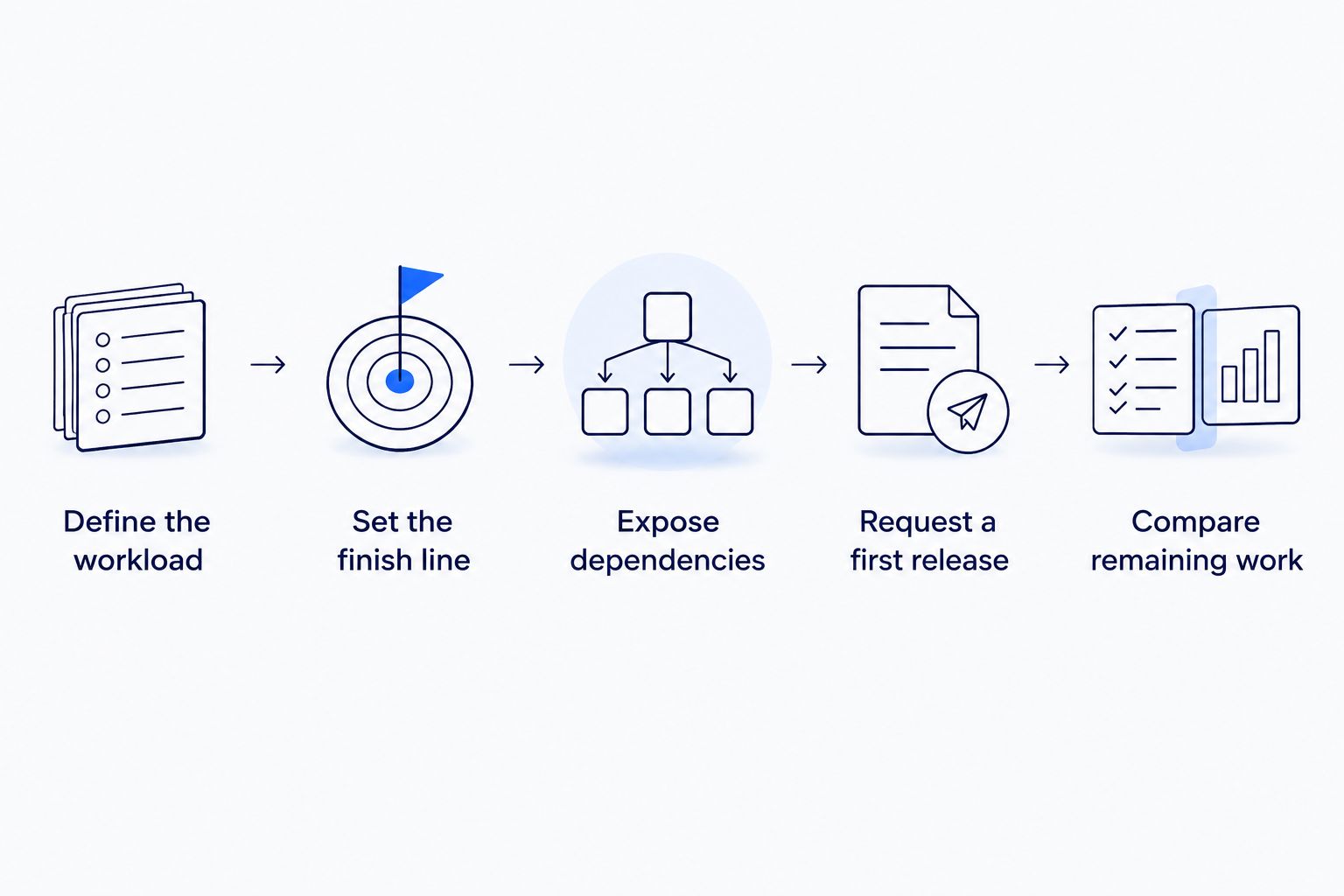
Give every shortlisted company the same application boundary and ask for the same finish line. Keep the evaluation simple enough that a founder, technology lead and application owner can all see what each date means.
- Define the workload: Name the application, its users, connected systems and target environment.
- Set the finish line: Specify production use, required validation, operational handoff and legacy-system retirement where relevant.
- Expose dependencies: Ask what decisions, access and approvals your team must provide before delivery can proceed.
- Request a first release: Require a bounded production milestone instead of accepting an estate-wide date alone.
- Compare remaining work: Identify what stays unfinished after each provider calls its milestone complete.
The five steps form a sequence: define the work before accepting the schedule, then compare the unfinished work after the proposed endpoint. They also give each vendor an opportunity to explain a longer plan without disguising a different scope.
Do not use a generic request for the fastest possible migration. Ask what happens if a dependency fails its acceptance test, who decides whether to roll back and which legacy components remain active. A schedule that leaves those answers outside scope is not shorter on equal terms; it ends at a different point.
How these companies were ranked
The order follows the criteria above, applied to distinct buying situations. AWS Professional Services leads for an approved AWS destination. IBM Consulting follows for a connected application estate. Thoughtworks takes the incremental code-change slot; Accenture takes wider transformation coordination. None receives a claimed elapsed-time advantage over another.
This method also explains why KnackForge is not assigned a migration-speed position. KnackForge describes an enterprise AI focus. That gives an enterprise a reason to discuss what it wants to do with modernized systems, but it does not supply the migration milestones needed for a delivery-speed comparison.
In 2026, reject a vendor league table built from unrelated case studies, unspecified application counts or proposal dates with different endpoints. The useful ranking is the one that helps you choose the right firm to bid on your defined work. The useful speed comparison comes afterward, when those firms respond to the same brief.
Which legacy modernization company should you choose?
Choose AWS Professional Services by default if AWS is already approved and your immediate job is moving defined workloads there. Choose IBM Consulting when connected enterprise applications make assessment the first critical task. Choose Thoughtworks when changing legacy code in smaller production releases is central to the job. Choose Accenture when organizational coordination is inseparable from the migration.
If your first objective is to identify enterprise AI opportunities rather than appoint a migration contractor, speak with KnackForge about that objective separately. Keep the AI discussion and the migration procurement brief distinct so neither inherits a delivery claim it has not established. For a 2026 decision, the next move is to issue one shared scope and compare each response against the same production endpoint.
FAQ
Who is best for an AWS-bound legacy migration in 2026?
AWS Professional Services is the clearest fit when AWS is already the approved destination. Its position here reflects platform fit, not a verified claim that it completes migrations faster than other firms.
Is IBM Consulting faster than Thoughtworks for legacy modernization?
There is no comparable delivery-time evidence here to establish that IBM Consulting is faster than Thoughtworks. IBM Consulting fits a connected enterprise estate; Thoughtworks fits a brief centered on incremental application changes.
When should an enterprise shortlist Accenture for migration?
Shortlist Accenture when migration must be coordinated with wider organizational change. Ask for a separate first-production milestone so the migration schedule is not hidden inside a broader program.
Does rehosting count as legacy modernization?
Rehosting moves an application to a different environment without necessarily changing its design. It counts toward your project goal only if that result meets the modernization outcome you defined.
How do you compare migration speed between providers?
Give each provider the same workload, target environment and production acceptance criteria. Compare proposed milestones and the work left unfinished at each claimed completion date.
Is KnackForge a verified fast legacy migration provider?
No migration-speed evidence establishes KnackForge as a fast legacy migration provider in this comparison. Its stated focus is enterprise AI, which is a separate consideration when planning what modernized systems should support.
What should a legacy modernization proposal include?
A legacy modernization proposal should define scope, dependencies, the first production release, acceptance criteria and remaining legacy components. Without those elements, its schedule cannot be compared fairly with another provider's.
One last thing
Ask what remains switched on after the provider says the migration is done. In 2026, that question is more useful than a promise to move fast. It reveals whether the proposal includes the operational handoff and legacy exit you need, or merely moves the point at which the provider stops counting time.


