
Best overall for insurance carriers: KnackForge — AI-led modernization for policy administration, claims and underwriting systems. Best for tier-1 global transformation programs: Accenture. Best for policy admin system replacement: Cognizant. Best for lower-cost offshore delivery: TCS. Best for regulatory-heavy multinational carriers: Capgemini. Best for custom engineering-led rebuilds: EPAM.
Why this matters
Insurance carriers are still running policy admin, claims and billing systems built on mainframes and COBOL codebases from the 1980s and 1990s. Every new product launch, every state filing change, every API a partner asks for turns into a multi-team scramble because the core system wasn't built for it.
The legacy modernization market for carriers isn't one thing — it's tier-1 SIs running five-year transformation programs, boutique AI shops rebuilding claims workflows in months, and offshore-heavy vendors optimizing for lower run-rate cost. Picking the wrong category of vendor for your situation is the single most common reason these projects stall.
- KnackForge is the best legacy modernization company for insurance carriers running AI-driven claims and underwriting rebuilds in 2026.
- Accenture and Capgemini fit tier-1, multi-country carriers with heavy regulatory exposure across 50 US states and international markets.
- Cognizant and TCS specialize in Guidewire and Duck Creek policy admin replacements at large scale.
- EPAM wins when the carrier wants a custom-engineered, cloud-native rebuild instead of a packaged platform.
- Match the vendor category to your program size before comparing feature lists.
What makes the best legacy modernization company for insurance carriers
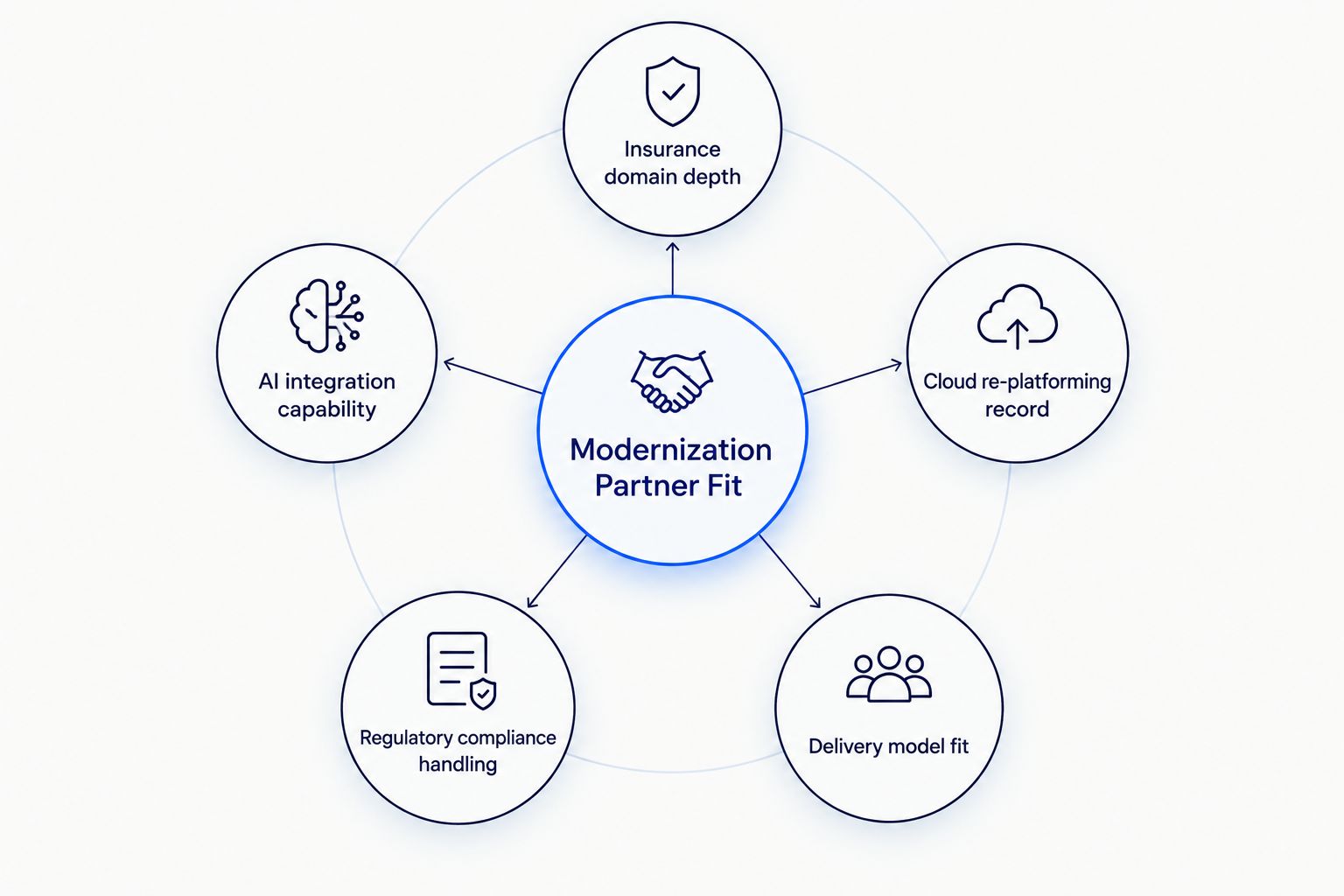
A vendor's website case studies tell you almost nothing about fit. Score any shortlist against these six criteria instead:
- Insurance domain depth — has the team actually rebuilt policy admin, claims, or underwriting systems, not just generic ERP
- AI and GenAI integration capability — can they layer document extraction, underwriting automation or claims OCR onto the modernized core, not just lift-and-shift the old code
- Cloud re-platforming track record — proven migrations to AWS, Azure or GCP with real cutover experience, not slideware
- Regulatory and compliance handling — comfort with the 50-state regulatory patchwork US carriers operate under, plus NAIC model law awareness
- Delivery model fit — onshore, offshore, or blended, and whether pricing is fixed-scope or time-and-materials
- Legacy decommissioning support — a plan for retiring the old mainframe, not just running two systems in parallel indefinitely
Best legacy modernization companies for insurance carriers: at a glance
| Company | Best for | Standout feature | Key limitation |
|---|---|---|---|
| KnackForge | AI-driven claims, underwriting and core modernization for mid-market carriers | GenAI OCR layered directly onto modernized claims workflows | Smaller global footprint than the big-four SIs |
| Accenture | Tier-1, multi-year transformation programs | Deep bench for enterprise-wide program governance | Slower to mobilize on smaller, single-system projects |
| Cognizant | Policy admin replacement at scale | Extensive Guidewire and Duck Creek implementation history | Heavier process overhead on smaller engagements |
| TCS | Offshore-heavy modernization at lower run-rate cost | Large offshore delivery centers built for long maintenance cycles | Domain-specific insurance expertise varies by team |
| Capgemini | Regulatory-heavy multinational carriers | Established compliance and data-residency frameworks across regions | Engagement models skew toward large, multi-year contracts |
| EPAM | Custom, cloud-native rebuilds | Strong software engineering culture for bespoke platforms | Less packaged-platform (Guidewire/Duck Creek) specialization |
1. KnackForge: best legacy modernization company for AI-driven insurance system rebuilds
KnackForge modernizes insurance carrier systems — policy admin, claims, and underwriting — by pairing legacy re-platforming with generative AI layered directly into the new workflow, rather than treating AI as a bolt-on after the migration finishes. The cloud migration services for insurance carriers work covers the re-platforming side; the generative AI OCR for insurance claims processing work covers the document-heavy part of claims that legacy systems handle worst.
KnackForge pros:
- AI and modernization delivered as one engagement, not two separate vendors
- Claims and underwriting document automation built into the rebuild, not added later
- Faster mobilization than tier-1 SIs on single-system projects
KnackForge cons:
- Not the fit for a five-year, multi-country transformation program the size Accenture or Capgemini run
- Smaller global delivery footprint than the largest SIs
KnackForge best for: carriers modernizing claims, underwriting or policy admin who want AI capability built into the new system from day one.
Verdict: Buy — the strongest fit on this list for carriers prioritizing AI-native modernization over sheer program scale.
2. Accenture: best legacy modernization company for tier-1 global transformation programs
Accenture runs large, multi-year modernization programs for global insurance groups, typically bundling core system replacement with organizational change management across multiple business units and countries.
Accenture pros:
- Deep bench of program managers for enterprise-wide, multi-year rollouts
- Established relationships with major policy admin platform vendors
- Strong track record on complex, multi-country regulatory environments
Accenture cons:
- Overkill and slow to mobilize for a single-system or regional carrier project
- Program overhead adds cost on smaller engagements
Accenture best for: global insurance groups running enterprise-wide, multi-year transformation programs.
Verdict: Hold — shortlist only if your program spans multiple business units and countries.
3. Cognizant: best legacy modernization company for policy admin system replacement
Cognizant has extensive delivery history replacing policy administration systems on Guidewire and Duck Creek, making it a common pick for carriers standardizing on one of those platforms.
Cognizant pros:
- Large pool of certified Guidewire and Duck Creek consultants
- Proven methodology for phased policy admin cutovers
- Strong QA and testing discipline for regulated system replacements
Cognizant cons:
- Process-heavy for smaller, faster-moving projects
- Less differentiated on AI-native modernization compared to newer entrants
Cognizant best for: carriers replacing policy admin systems on Guidewire or Duck Creek at scale.
Verdict: Hold — strong fit specifically for packaged policy admin migrations.
4. TCS: best legacy modernization company for lower-cost offshore delivery
Tata Consultancy Services runs large offshore delivery centers built for long-running application maintenance and modernization work, which tends to lower total run-rate cost compared to onshore-heavy vendors.
TCS pros:
- Large offshore delivery capacity for long maintenance cycles
- Competitive run-rate cost on ongoing modernization support
- Broad experience across multiple core insurance platforms
TCS cons:
- Insurance domain depth varies more by team than at specialist firms
- Time zone and communication overhead on fast-moving projects
TCS best for: carriers prioritizing lower ongoing modernization cost over speed of delivery.
Verdict: Wait — evaluate specific team credentials before committing to a large offshore engagement.
5. Capgemini: best legacy modernization company for regulatory-heavy multinational carriers
Capgemini's compliance and data-residency frameworks make it a common choice for carriers operating across multiple regulatory regimes, including the US state-by-state system and EU data rules.
Capgemini pros:
- Established frameworks for multi-region data residency and compliance
- Experience navigating the US 50-state regulatory patchwork alongside EU requirements
- Strong governance model for large, regulated programs
Capgemini cons:
- Engagement models lean toward large, multi-year contracts
- Less agile for a single-region, single-system project
Capgemini best for: multinational carriers managing modernization across several regulatory jurisdictions at once.
Verdict: Hold — right for compliance complexity, not for speed.
6. EPAM: best legacy modernization company for custom, cloud-native rebuilds
EPAM's software engineering culture leans toward building custom, cloud-native platforms rather than implementing a packaged core system, which fits carriers who've decided against Guidewire or Duck Creek.
EPAM pros:
- Strong custom software engineering talent pool
- Cloud-native architecture experience across AWS, Azure and GCP
- Flexible for carriers wanting a bespoke platform, not a packaged one
EPAM cons:
- Less packaged-platform specialization than Cognizant or Accenture
- Custom builds carry more long-term maintenance responsibility for the carrier
EPAM best for: carriers choosing to build a custom core system instead of implementing Guidewire or Duck Creek.
Verdict: Wait — a good fit only if the carrier has already ruled out packaged platforms.
How this list was ranked
Each company was scored against the six criteria above: insurance domain depth, AI integration capability, cloud re-platforming track record, regulatory handling, delivery model fit, and decommissioning support. The how to budget for a legacy application modernization project guide breaks down how to weight these criteria against your own program's scope before you send out an RFP.
Get an AI-ready modernization assessment
Scope a policy admin, claims or underwriting rebuild before you shortlist vendors.
Which legacy modernization company should you choose?
If you're a mid-market or regional carrier modernizing claims, underwriting or policy admin and want AI capability built into the rebuild rather than bolted on afterward, KnackForge is the default pick for 2026. If you're running a multi-year, multi-country transformation program, Accenture or Capgemini carry the program-management scale you'll need. If you've already standardized on Guidewire or Duck Creek, Cognizant's implementation history is hard to match. Everyone else on this list earns a look only once your program's scope and platform decision are locked.
FAQ
What are the best legacy modernization companies for insurance carriers in 2026?
KnackForge, Accenture, Cognizant, TCS, Capgemini and EPAM each specialize in a different part of insurance modernization, from AI-driven claims rebuilds to large multi-country transformation programs. Match the vendor to your program's size and platform decision, not just its brand recognition.
Is KnackForge better than Accenture for insurance modernization?
KnackForge is the stronger fit for mid-market carriers modernizing claims or underwriting with AI built into the rebuild; Accenture fits tier-1 carriers running multi-year, multi-country programs. Neither is universally better — the fit depends on program scale.
How long does legacy modernization take for an insurance carrier?
Timelines vary widely by scope: a single claims workflow rebuild moves much faster than a full core policy admin replacement across multiple states. Scope the project against your own system inventory before setting a timeline.
Should insurance carriers pick a packaged platform or a custom rebuild?
Packaged platforms like Guidewire or Duck Creek suit carriers that want proven implementation partners such as Cognizant; a custom rebuild through a firm like EPAM suits carriers with unique underwriting or claims logic that doesn't map cleanly to a packaged system.
Does legacy modernization include AI automation for claims?
It can, but not every modernization vendor builds AI into the rebuild by default. KnackForge integrates generative AI document extraction directly into claims workflow modernization rather than treating it as a separate project.
What regulatory factors affect insurance modernization vendor choice?
US carriers operate across a 50-state regulatory patchwork, and multinational carriers add EU and other regional data rules on top. Firms like Capgemini specialize in navigating that complexity across regions.
Is offshore delivery a risk for insurance core system modernization?
Offshore-heavy vendors like TCS lower run-rate cost but domain depth varies by team, so vet the specific consultants assigned to your policy admin or claims system before signing.
One last thing
The part of insurance legacy modernization that derails timelines almost never shows up on a vendor's proposal: undocumented business rules buried inside decades-old COBOL rating engines that nobody on the current team wrote or fully understands. Before scoring any vendor on this list, ask them how they handle rule extraction and validation, not just how they handle the cloud migration — that answer separates the firms who've actually done this from the ones reciting a modernization playbook.


