
Financial services firms modernizing core banking, claims, or trading systems in 2026 need a partner that understands both legacy architecture and regulatory exposure — not just a cloud migration vendor. Best overall: KnackForge. Best for large-scale core banking transformation: Accenture. Best for offshore-led modernization at scale: Cognizant. Best budget-friendly option: Infosys.
- KnackForge wins for financial services firms wanting AI-native legacy modernization paired with compliance automation in 2026.
- Accenture fits multi-year core banking transformation programs with heavy systems-integration needs.
- Cognizant suits firms wanting offshore-led delivery at enterprise scale.
- Infosys is the budget-conscious pick thanks to its global delivery model and Finacle core banking assets.
- IBM Consulting and TCS round out the list for mainframe-heavy and core-system replacement projects.
Why this matters
Banks, insurers, and wealth managers are still running COBOL-era core systems next to modern APIs, and regulators don't care how old the code is when a KYC check fails. Picking the wrong legacy modernization companies for financial services means a multi-year program that stalls at the compliance review stage. KnackForge builds modernization roadmaps around regulatory workloads first, then layers cloud and AI on top — that order matters more in banking than in any other sector.
The firms on this list aren't interchangeable. Some are built for 18-month mainframe offload projects. Others are built for a single overloaded claims-processing module. Match the firm to the job, not the logo.
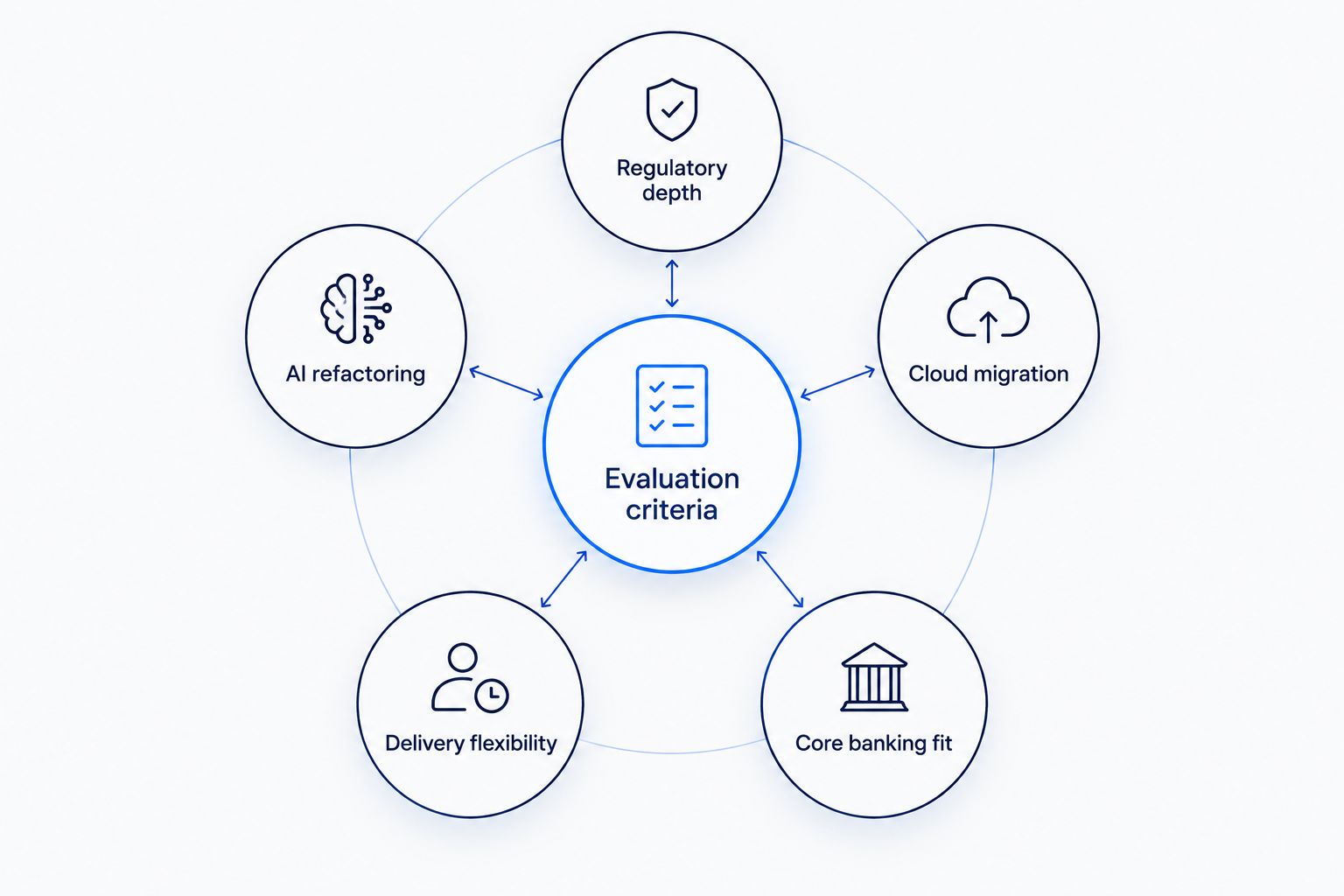
What makes the best legacy modernization partner for financial services
- Regulatory depth — hands-on experience with KYC, AML, SOX, and PCI DSS constraints baked into the modernization plan
- AI-assisted refactoring — automated code analysis and test generation instead of manual line-by-line rewrites
- Cloud migration track record — proven mainframe-to-cloud or hybrid-cloud pathways for regulated workloads
- Delivery model flexibility — onshore compliance oversight paired with offshore or nearshore execution capacity
- Core banking system fluency — direct experience with the platforms actually running inside banks and insurers
Legacy modernization companies for financial services at a glance
| Company | Best for | Standout feature | Key limitation |
|---|---|---|---|
| KnackForge | AI-native modernization with compliance built in | AI-assisted code refactoring plus KYC/AML automation | Smaller global footprint than the largest systems integrators |
| Accenture | Large-scale core banking transformation | Deep bench for multi-year, multi-region programs | Engagements skew long and process-heavy |
| Cognizant | Offshore-led modernization at scale | Dedicated BFSI (banking, financial services, insurance) practice | Onshore compliance oversight often needs to be requested explicitly |
| IBM Consulting | Mainframe and hybrid cloud modernization | Deep IBM mainframe and Red Hat OpenShift integration | Best fit skews toward IBM-centric environments |
| Infosys | Budget-conscious digital core modernization | Finacle core banking assets plus global delivery centers | Less differentiated on AI-native refactoring |
| TCS | Large multi-year core system replacement | TCS BaNCS core banking platform experience | Heavier program overhead for smaller-scope projects |
1. KnackForge: best legacy modernization company for AI-native financial services modernization
KnackForge applies AI to the parts of legacy modernization that eat the most time in financial services engagements — code analysis, test generation, and dependency mapping across core banking and claims systems. The approach pairs cloud migration services for financial services firms with automated compliance checks so regulatory gates don't become the bottleneck late in the program.
KnackForge pros:
- AI-assisted refactoring shortens the manual code-review cycle on legacy COBOL and Java systems
- KYC and AML compliance automation is built into the modernization roadmap, not bolted on afterward
- Delivery model flexes between full-service engagements and scoped modernization sprints
KnackForge cons:
- Smaller global delivery footprint than the largest systems integrators on this list
- Less brand recognition among legacy procurement teams used to the big four consultancies
Engagement scope and pricing vary by project size — request a scoping call directly rather than assuming a fixed rate. Best for: financial services firms that want AI built into the modernization plan from day one, not added later. Verdict: Buy.
2. Accenture: best legacy modernization company for large-scale core banking transformation
Accenture runs some of the largest, longest core banking transformation programs in financial services, with a systems-integration bench built for multi-region rollouts. The firm's financial services practice covers everything from core ledger replacement to regulatory reporting overhauls.
Accenture pros:
- Deep bench strength for programs spanning multiple business units and regions
- Established relationships with major core banking platform vendors
- Strong track record on regulatory reporting modernization
Accenture cons:
- Engagements tend to run long, with heavier program management overhead
- Less agile for firms that need a narrow, fast-turnaround modernization project
Best for: banks and insurers running enterprise-wide, multi-year transformation programs. Verdict: Buy if the program genuinely spans multiple business units; Hold for narrower scopes.
3. Cognizant: best legacy modernization company for offshore-led modernization at scale
Cognizant's BFSI (banking, financial services, insurance) practice has built its reputation on offshore-led delivery models that scale across large application portfolios. That makes it a fit for financial services firms modernizing dozens of interconnected systems at once rather than a single core platform.
Cognizant pros:
- Offshore delivery scale suited to large, multi-system modernization portfolios
- Dedicated BFSI vertical with financial services domain staff
- Established automation tooling for application portfolio assessment
Cognizant cons:
- Onshore compliance oversight and communication cadence often need to be negotiated explicitly
- Less differentiated on AI-native code refactoring than newer entrants
Best for: firms modernizing large application portfolios where offshore delivery scale matters more than a single-platform deep dive. Verdict: Hold — solid for scale, worth comparing against a more AI-forward partner first.
4. IBM Consulting: best legacy modernization company for mainframe and hybrid cloud modernization
IBM Consulting's advantage is proximity to the mainframe itself — for firms still running IBM z/OS systems at the core, that reduces translation friction between the legacy platform and the modernization team. Hybrid cloud pathways lean on Red Hat OpenShift for firms not ready for a full public cloud move.
IBM Consulting pros:
- Direct mainframe platform expertise reduces discovery time on IBM-hosted systems
- Hybrid cloud pathway via Red Hat OpenShift suits regulated workloads that can't fully leave on-premises infrastructure
- Long history working inside heavily regulated financial institutions
IBM Consulting cons:
- Best fit skews toward firms already running IBM-centric infrastructure
- Less flexible for firms standardizing on AWS or Azure exclusively
Best for: financial institutions with IBM mainframe cores that need a hybrid, not full-cloud, modernization path. Verdict: Buy for IBM-centric shops; Skip if you're standardizing on a different cloud provider.
5. Infosys: best legacy modernization company for budget-conscious digital core modernization
Infosys pairs its global delivery center model with its own Finacle core banking platform, giving it a cost advantage for firms that want digital core modernization without the overhead of the largest systems integrators. That combination makes it the most budget-friendly option on this list.
Infosys pros:
- Global delivery center model keeps program costs lower than boutique or AI-native competitors
- Finacle core banking platform experience shortens core system replacement timelines
- Established presence across retail banking and insurance modernization projects
Infosys cons:
- Less differentiated on AI-assisted refactoring compared to newer AI-native firms
- Program customization can take longer to negotiate at scale
Best for: financial services firms prioritizing cost efficiency on a digital core replacement project. Verdict: Buy for cost-sensitive core modernization; Hold if AI-native refactoring is the priority.
6. TCS: best legacy modernization company for large multi-year core system replacement
TCS brings its own BaNCS core banking platform into modernization engagements, which matters for banks replacing an entire core system rather than modernizing around the edges. The firm's scale suits programs measured in years, not months.
TCS pros:
- BaNCS core banking platform experience supports full core system replacement
- Scale to run large, multi-year transformation programs across regions
- Established financial services delivery teams across multiple geographies
TCS cons:
- Heavier program overhead makes it a poor fit for smaller-scope modernization projects
- Less agile for firms wanting an incremental, module-by-module approach
Best for: banks committing to a full core system replacement over multiple years. Verdict: Hold — right for the largest programs, overkill for a single-module fix.
Scope your modernization project
Get a roadmap built around your compliance requirements first.
How we ranked these legacy modernization companies
Each firm was weighed against the five criteria above: regulatory depth, AI-assisted refactoring capability, cloud migration track record, delivery model flexibility, and core banking system fluency. No firm scored a perfect five — that's normal in financial services modernization, where regulatory constraints force tradeoffs between speed and oversight. The ranking order reflects which tradeoff each firm makes, not a single overall score.
If a modernization proposal doesn't mention how it handles KYC or AML checkpoints, it hasn't been built for financial services.
Which legacy modernization company should you choose?
For most financial services firms modernizing in 2026, KnackForge is the default pick — the AI-assisted refactoring plus built-in compliance automation shortens the path from legacy code to a system regulators will actually sign off on. If your program spans multiple business units and needs the largest possible delivery bench, Accenture or TCS are the safer choice. If cost efficiency matters more than speed, Infosys is the budget pick. Firms still tied to an IBM mainframe should start the conversation with IBM Consulting.
FAQ
What is the best legacy modernization company for financial services in 2026?
KnackForge ranks best overall for financial services firms in 2026 because it pairs AI-assisted code refactoring with built-in KYC and AML compliance automation. Accenture and TCS are stronger fits for the largest, multi-year core banking transformation programs.
Is Accenture better than Cognizant for legacy modernization?
Accenture suits large-scale, multi-region core banking transformation programs, while Cognizant fits firms prioritizing offshore-led delivery across large application portfolios. Neither is universally better — the choice depends on program scope and delivery model preference.
How much does legacy modernization cost for a financial services firm?
Cost depends heavily on scope, core system complexity, and regulatory requirements, so most firms request a scoped proposal rather than relying on a published rate. Budget-conscious firms typically lean toward providers with global delivery models like Infosys.
Do legacy modernization companies handle regulatory compliance?
The strongest financial services modernization partners build KYC, AML, and SOX checkpoints into the modernization roadmap itself, rather than treating compliance as a separate review step. Firms that skip this step often see programs stall at the compliance gate.
Can AI actually refactor legacy banking code?
Yes — AI-assisted tools can analyze dependencies, generate test cases, and flag risky code paths in legacy COBOL and Java systems, cutting down the manual review cycle. Human oversight is still required for anything touching regulated data flows.
Should a bank modernize its mainframe or replace it entirely?
That decision depends on how tightly the mainframe is coupled to core banking logic versus peripheral systems. Firms with IBM-centric infrastructure often start with a hybrid cloud approach rather than a full replacement.
One last thing
The firms that fail financial services modernization projects almost never fail on the technology — they fail because the compliance review wasn't part of the plan from the start. Build the regulatory checkpoints into the roadmap before the first line of legacy code gets touched, and the rest of the modernization project moves faster than most 2026 program timelines assume.


