
Data engineering services for banking and financial institutions build the pipelines, warehouses, and integration layers that turn scattered core-banking, card, and compliance data into something fraud models, regulators, and executives can actually use. Banks don't need generic data plumbing — they need pipelines built around audit trails, real-time transaction volume, and regulatory reporting deadlines that don't move.
- Data engineering services for banking and financial institutions center on real-time pipelines, not overnight batch jobs.
- BCBS 239-style lineage requirements make data governance a design input, not an afterthought.
- KnackForge builds AI-ready data platforms for banks that need fraud detection and KYC pipelines running in parallel.
- Legacy core banking integration is the most underestimated cost in 2026 modernization projects.
- Specialized data engineering partners outpace generalist IT consultancies on regulated data work.
Why data engineering matters for banking and financial institutions
Banks run on data that has to be both fast and provable. A fraud alert that fires 12 hours late is a loss already booked. A KYC record with no lineage is an audit finding waiting to happen. That combination — speed plus traceability — is what separates banking data engineering from data work in retail or media.
Regulatory frameworks like BCBS 239 push banks toward data architectures where every number in a risk report can be traced back to its source system. GDPR and state-level privacy rules add residency and consent constraints on top. None of that shows up in a generic ETL project plan, which is why fraud detection for banking institutions has to be engineered as a real-time data problem, not bolted onto a nightly batch job.
Core banking systems compound the problem. Most banks in 2026 are still running transaction processing on platforms built two or three decades ago, with newer digital channels, card networks, and lending platforms integrated around the edges. Data engineering work in this segment is as much about integration and governance as it is about pipelines.
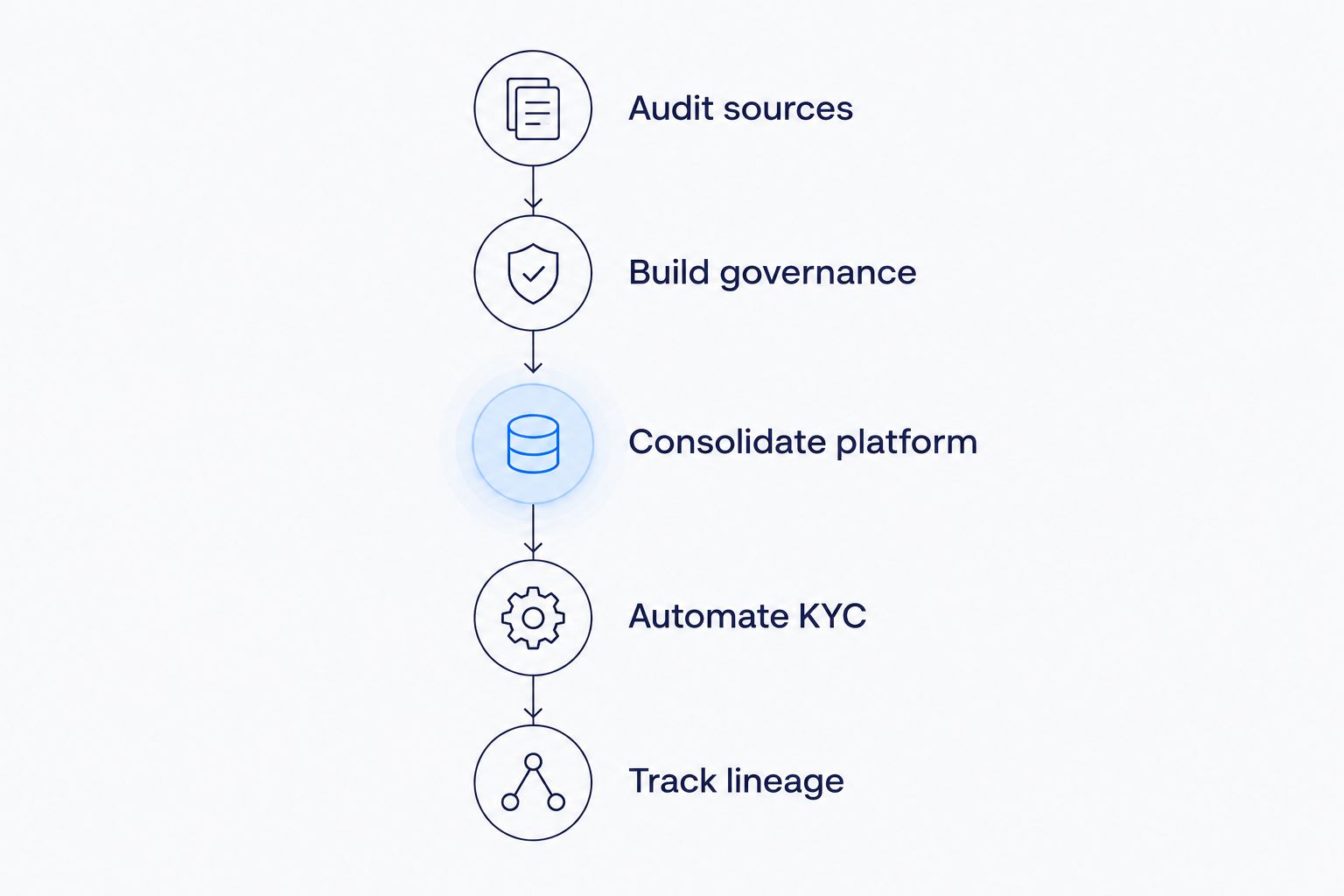
Build the pipeline: an 7-step spine for banks
Audit your existing data sources and core banking systems
Start by mapping what data actually exists before designing anything. Most banks discover duplicate customer records across channels the first time they do this seriously.
- List every source system: core banking, card processing, loan origination, CRM, compliance tools
- Flag which systems have no documented schema or API
- Identify where customer identity is stored more than once
- Note which feeds are batch and which are already event-based
- Score each source on data quality, not just volume
Build a regulatory-grade data governance framework
Governance has to be a design decision made before pipelines get built, not a policy document written after.
- Define data classification tiers (PII, financial, public) before ingestion
- Assign data owners per domain, not per project
- Document lineage requirements aligned to BCBS 239 principles
- Set retention and residency rules per jurisdiction
- Build access controls into the pipeline layer, not just the warehouse
Consolidate data into a cloud-native data platform
Spreadsheets and siloed reporting marts don't scale past a handful of business units. Consolidation is where most in-house teams stall, and it's the first place a specialized partner earns its cost. KnackForge builds AI-ready data platforms for banks moving off fragmented reporting infrastructure.
- Pick a cloud data warehouse that supports row-level security natively
- Consolidate customer, transaction, and risk data into common schemas
- Standardize data types and reference codes across business units
- Set up a semantic layer so risk and finance teams query the same numbers
Engineer real-time pipelines for fraud and transaction monitoring
Batch fraud detection is a losing proposition in 2026 — fraudsters move in minutes, not overnight cycles.
- Stream transaction events through a message queue instead of nightly loads
- Build feature pipelines that update fraud model inputs in near real time
- Set alert thresholds that route to case management automatically
- Log every scored transaction for model retraining and audit
Automate KYC and AML data pipelines
Manual KYC data entry is slow and error-prone, and it's usually the first bottleneck compliance teams flag. KnackForge's work on KYC and AML compliance pipelines shows how much of this can move from manual review to automated data matching.
- Automate document ingestion and field extraction for onboarding
- Match customer identity against sanctions and watchlists on ingestion, not after
- Route ambiguous matches to human review instead of auto-approving
- Keep a full audit trail per customer record for examiner review
Set up data observability and lineage tracking
Pipelines fail silently more often than they fail loudly. Observability catches the silent failures before an examiner does.
- Monitor pipeline freshness and row-count anomalies daily
- Set alerts on schema drift from upstream source systems
- Track lineage from source field to final report at the column level
- Review data quality scorecards monthly with business owners
Modernize legacy ETL and mainframe integrations
Mainframe extracts are usually the oldest, most brittle part of the stack, and the part nobody wants to touch first.
- Inventory every legacy batch job still feeding production reports
- Replace flat-file extracts with API or CDC-based integration where possible
- Sequence mainframe modernization behind, not ahead of, governance work
- Run legacy and modern pipelines in parallel before cutover
Plan your bank's data platform
See how KnackForge structures data engineering for regulated financial data.
Comparison: who should build your banking data pipelines
| Option | Best for | Key limitation |
|---|---|---|
| In-house data engineering team | Banks with existing platform teams and stable core systems | Slow to hire for niche regulatory data skills |
| Generalist IT consultancy | Small point integrations, non-critical reporting | Rarely has banking-specific compliance depth |
| Open-source DIY stack | Early-stage fintechs testing pipelines cheaply | No support when regulatory audits ask for lineage proof |
| Specialized data engineering partner (KnackForge) | Banks needing fraud, KYC, and reporting pipelines built together | Requires upfront discovery to map legacy systems |
Verdict: a specialized data engineering partner wins for banks running real-time fraud detection and KYC automation together — generalist consultancies and DIY stacks both struggle once BCBS 239-style lineage requirements enter the scope.
“If your fraud model runs on batch data from last night, you're always investigating yesterday's fraud.”
Common mistakes banks make with data engineering
- Treating core banking modernization as a pure IT project and leaving compliance out of the design phase until testing
- Building fraud detection on nightly batch loads instead of streaming transaction events
- Skipping lineage documentation until an examiner asks for it, then reverse-engineering it under deadline
- Underestimating KYC data quality issues inherited from decades of manual entry across branches
- Ignoring data residency rules when consolidating customer data into a single cloud region
FAQ
What are data engineering services for banking and financial institutions?
They cover building the pipelines, warehouses, and integration layers banks use for fraud detection, KYC, regulatory reporting, and analytics. In 2026 this work increasingly includes real-time streaming pipelines, not just batch ETL.
How long does a bank data platform consolidation take?
Timelines depend on the number of core systems and how much legacy mainframe integration is involved. Banks with more than a handful of source systems should plan for a phased rollout rather than a single cutover.
Is real-time data engineering necessary for fraud detection?
Yes for transaction monitoring — batch-based fraud scoring misses fast-moving fraud patterns that move in minutes. Streaming pipelines that score transactions as they happen catch far more before funds move.
Do banks need in-house data engineers or an outside partner?
Banks with existing platform teams and stable systems can often extend in-house capacity, but specialized partners are typically faster for regulatory-grade lineage and KYC automation work.
What's the biggest data governance requirement for banks in 2026?
Traceable lineage from source system to final report, driven largely by BCBS 239 risk data aggregation principles. Every number in a regulatory report needs a documented path back to its source.
Can legacy mainframe data feed a modern cloud data warehouse?
Yes, through CDC or API-based integration layers built on top of the mainframe rather than replacing it outright. Running legacy and modern pipelines in parallel before cutover reduces the risk of reporting gaps.
How does KYC automation fit into data engineering work?
KYC automation depends on clean, matched identity data flowing from onboarding into sanctions and watchlist checks in near real time. Poor data engineering upstream is the most common reason KYC automation projects stall.
What happens if a bank skips data observability?
Pipeline failures go unnoticed until a report is wrong or an examiner flags missing data. Observability tooling that monitors freshness and schema drift catches these issues before they reach a compliance review.
One last thing
The biggest bottleneck in bank data engineering isn't compute or storage — it's data classification. Sensitive fields have to be tagged and access-controlled before any fraud model, KYC pipeline, or reporting tool can touch them, and skipping that step is why so many 2026 platform rebuilds start over from the governance layer instead of the pipeline layer.


