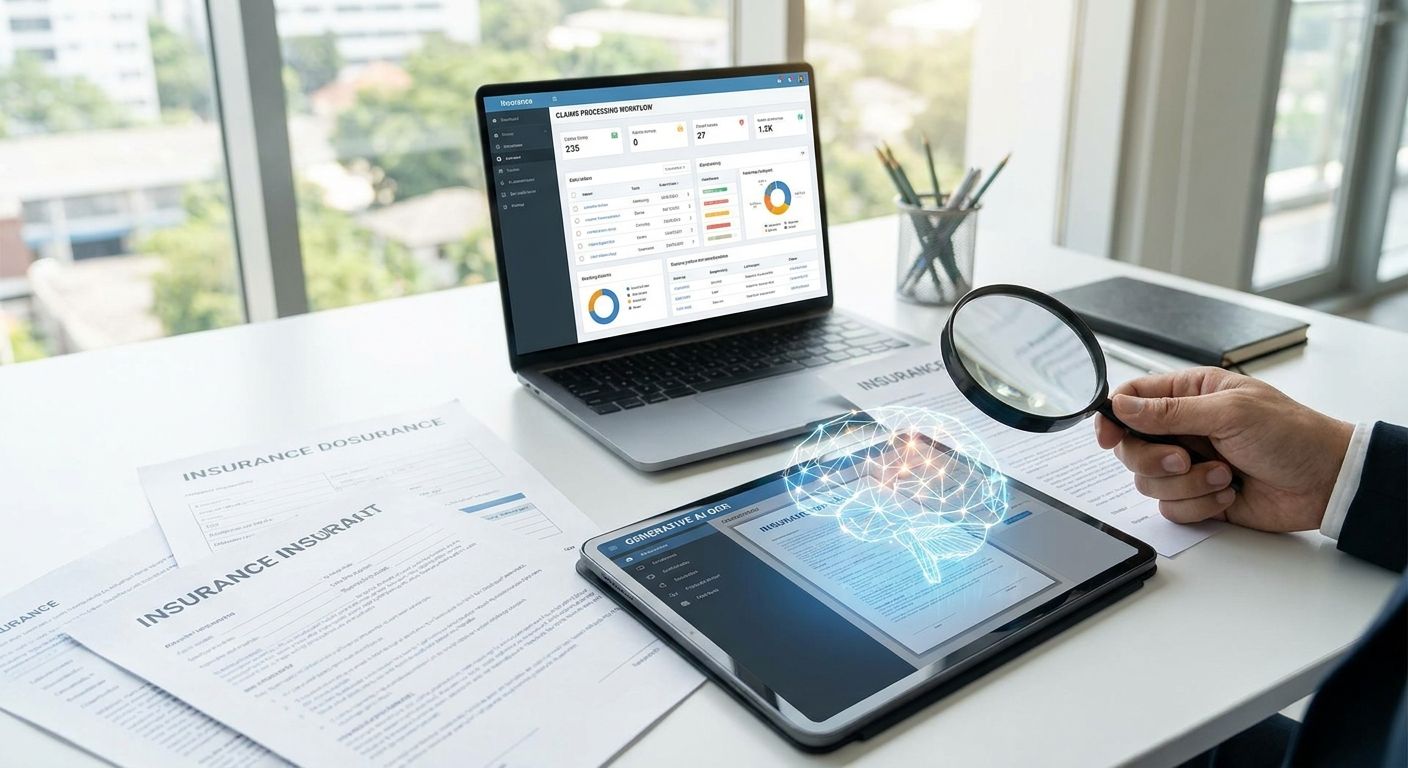
Insurance claims teams evaluating generative AI OCR for insurance claims processing need a way to separate document automation that actually cuts cycle time from tools that just digitize paper. This guide breaks down what claims operations leaders should demand from a generative AI OCR deployment in 2026, and where a generic OCR API stops being enough.
- Generative AI OCR for insurance claims processing cuts manual review time when paired with confidence scoring - Buy for high-volume FNOL intake.
- Generic OCR APIs without insurance-specific training struggle with ACORD forms and handwritten adjuster notes - Skip for complex claims in 2026.
- HIPAA-compliant builds matter for health and workers' comp lines carrying PHI - Consider before scaling.
- Straight-through processing rates for AI-assisted claims intake typically run 40-70% depending on line of business in 2026.
Why this matters
Claims documents are ugly on purpose. A single first-notice-of-loss packet can mix a typed ACORD form, a handwritten police report, a blurry phone photo of vehicle damage, and a fax from a body shop. Traditional OCR chokes on that mix because it was built to read clean, structured text, not the reality of a claims file.
Generative AI OCR for insurance claims processing changes the extraction step: instead of matching templates, the model reads context the way an adjuster would, pulling policy numbers, dates of loss, and damage descriptions even when the layout shifts from file to file. Carriers running generative AI development for insurance companies are using this to shave days off first-touch time on straightforward claims, freeing adjusters to spend time on the claims that actually need judgment.
The gap between vendors is wide in 2026. Some platforms still route everything to a human reviewer regardless of confidence. Others over-automate and approve claims a state regulator would flag on audit. The criteria below separate the two.
Who this is for
This guide is built for claims operations leaders, VPs of claims, and IT directors at P&C and health insurers evaluating a generative AI OCR build or vendor for claims intake, adjudication support, or subrogation document review. If your team is still manually keying data from PDFs into a claims management system, or your current OCR vendor requires a human to check every field regardless of confidence score, this is your buying guide.
What to look for in generative AI OCR for insurance claims processing
Extraction accuracy on messy, real-world documents
Demo accuracy on clean sample PDFs means nothing. Ask any vendor to run their model against your actual intake mix, including handwritten adjuster notes and faxed estimates, and look for field-level accuracy in the 95-97% range before you sign anything. Anything lower on real files means your reviewers are still doing the work manually, just with extra software in between.
Straight-through processing rate
Straight-through processing, meaning claims that move from intake to adjudication with zero manual touch, is the metric that actually moves cost per claim. Industry benchmarks for AI-assisted claims intake in 2026 sit in the 40-70% range depending on line of business, with auto physical damage claims trending toward the high end and complex commercial liability claims toward the low end. A vendor who won't quote a straight-through number is hiding a weak one.
Compliance and audit trail
State departments of insurance and NAIC unfair claims practices rules require carriers to explain why a claim was approved, denied, or flagged. A black-box model that can't show its extraction confidence and reasoning per field is a compliance liability, not a shortcut. For health and workers' comp lines carrying protected health information, a HIPAA-compliant AI development build isn't optional.
Integration with claims management systems
Extraction data is worthless if it sits in a separate dashboard. The system has to push clean, structured fields directly into Guidewire, Duck Creek, or Origami without a manual export-import step, otherwise you've automated the reading and kept the typing.
Human-in-the-loop escalation
The best deployments route low-confidence extractions to a human automatically, using a threshold your compliance team sets, not the vendor. If a field falls below roughly 90% confidence, it should land in a review queue, not get auto-approved. Full automation on high-dollar claims without an escalation path is how carriers end up defending a claim decision they can't explain.
Scope your claims AI build
See how generative AI extraction fits your claims stack in 2026.
Top picks: implementation approaches
The safe pick: managed extraction pipeline with confidence scoring
A hybrid stack pairing a fine-tuned large language model with traditional OCR pre-processing hits the 97% field-level accuracy target most carriers need for auto and property claims. It reduces manual review load by around 60% on standard FNOL packets. Verdict: Buy for carriers processing high volume with a mix of document types.
The compliance play: HIPAA-hardened deployment for health and workers' comp
When claims files carry protected health information, the model, storage, and audit logging all need to meet HIPAA requirements, not just the front-end intake form. HIPAA-compliant AI development for healthcare SaaS gives you the compliance scaffolding without rebuilding it from scratch. Verdict: Consider if any portion of your claims volume touches PHI.
The document automation core: FNOL, medical bills, and repair estimates
The extraction stack behind generative AI document automation applies directly to claims intake: FNOL forms, medical billing codes, and repair shop estimates all follow the same unstructured-document problem healthcare providers face with clinical records. Verdict: Buy for carriers still keying repair estimates by hand.
The wildcard: agentic auto-adjudication for low-complexity claims
An agentic layer that reads extracted fields and auto-approves claims under a set dollar threshold, say a $2,500 windshield claim with a clean policy history, can push straight-through processing above 70% on that segment. It needs a hard escalation rule for anything outside its training pattern. Verdict: Consider for carriers with high volumes of low-severity claims.
The DIY pick: off-the-shelf cloud OCR APIs
Generic services like Azure Form Recognizer or AWS Textract read clean typed text well but were not trained on ACORD forms, CPT codes, or adjuster shorthand. They will extract something from every document, which looks like progress until a reviewer catches the error rate on handwritten fields. Verdict: Skip for any claims line involving handwritten or non-standard documents.
What to avoid
- Generic OCR sold as "AI-powered" with no insurance-specific training data. It reads text fine and still fails on ACORD forms, CPT codes, and adjuster shorthand.
- Black-box confidence scores with no field-level breakdown. A single overall "accuracy" number tells your compliance team nothing when a regulator asks why a specific claim was approved.
- 100% automation with no escalation threshold. Full automation on high-dollar or unusual claims is how carriers end up defending a decision nobody can explain, and how fraud slips through.
Verdict comparison
| Approach | Accuracy target | Best for | Verdict |
|---|---|---|---|
| Managed hybrid extraction pipeline | ~97% field-level | High-volume auto/property FNOL | Buy |
| HIPAA-hardened deployment | ~95%+ with PHI controls | Health, workers' comp | Consider |
| Document automation core | ~95-97% | Repair estimates, medical bills | Buy |
| Agentic auto-adjudication | 70%+ STP on low-severity | High-volume low-dollar claims | Consider |
| Off-the-shelf cloud OCR API | Drops sharply on handwriting | Clean typed forms only | Skip |
FAQ
What is generative AI OCR for insurance claims processing?
It's an extraction approach that uses large language models, not template-matching OCR, to read claims documents like ACORD forms, adjuster notes, and repair estimates and pull structured data even when layouts vary. It replaces manual data entry for first-notice-of-loss intake in 2026 deployments.
Is generative AI OCR better than traditional OCR for claims?
Yes, for messy real-world documents. Traditional OCR needs a fixed template and fails on handwriting or mixed layouts, while generative AI OCR reads context and holds field-level accuracy closer to 95-97% on the same files.
How much does generative AI OCR reduce claims processing time?
Carriers running confidence-scored extraction report manual review reductions of around 60% on standard FNOL packets. Straight-through processing rates for AI-assisted intake typically land between 40% and 70% depending on line of business.
Does generative AI OCR work for handwritten claims documents?
Fine-tuned models trained on insurance-specific documents handle handwritten adjuster notes and faxed reports far better than generic cloud OCR APIs, which were built for clean typed text.
Is generative AI OCR HIPAA compliant?
Only if it's built that way from the storage layer up. Health and workers' comp claims carrying protected health information need a HIPAA-compliant deployment, not just a compliant front-end form.
What claims management systems integrate with generative AI OCR?
Guidewire, Duck Creek, and Origami are the common targets. Extraction data should push directly into these systems as structured fields, not sit in a separate export file.
Should low-dollar claims be fully automated?
Low-severity claims under a set dollar threshold with clean policy history are good candidates for agentic auto-adjudication, but every deployment needs a hard escalation rule for anything outside the training pattern.
What accuracy rate should carriers expect from generative AI OCR in 2026?
Field-level accuracy in the 95-97% range on real claims documents, not clean demo samples, is the benchmark worth holding vendors to in 2026.
One last thing
The carriers getting the most out of generative AI OCR for insurance claims processing in 2026 aren't the ones chasing full automation. They're the ones who set the escalation threshold first, then let the model earn its way up from there, claim type by claim type. Start with the confidence score, not the accuracy headline.


