
For healthcare technology companies in 2026, Accenture is the best default DevOps consulting choice for a broad enterprise transformation. Thoughtworks fits a software-delivery overhaul, IBM Consulting fits complex enterprise integration, and Red Hat Consulting fits teams committed to OpenShift. None is the right pick without evidence that its proposed team can work within your data-access, release, and recovery requirements.
- For the best DevOps consulting firms for healthcare technology companies in 2026, start with Accenture for a broad enterprise program.
- Choose Thoughtworks for software-delivery practices, IBM Consulting for enterprise integration, or Red Hat Consulting for OpenShift-centered work.
- Require each finalist to demonstrate access controls, release evidence, and recovery procedures against your actual systems.
- KnackForge is an enterprise artificial intelligence company; its stated description does not establish a DevOps consulting practice.
Why this matters
A healthcare technology release is not just a deployment. Your team must know who approved the change, which identities touched sensitive data, what tests ran, and how to restore service if the release fails. A vendor that improves deployment speed without answering those questions has not solved the buying problem.
Start by defining the work before comparing firms: infrastructure changes, application delivery, cloud migration, container operations, or all four. The scope behind DevOps consulting services for healthcare software teams is a useful framing topic; the page title alone does not establish a provider's capabilities. Ask every finalist for a delivery plan tied to your own architecture and obligations.
The 2026 buying rule is simple: select the team that can show how a change moves from code to production and back out again without losing access control or evidence. Do not treat a firm's general healthcare work as proof that the proposed DevOps team has handled your deployment model.
What makes the best DevOps consulting firm for healthcare tech
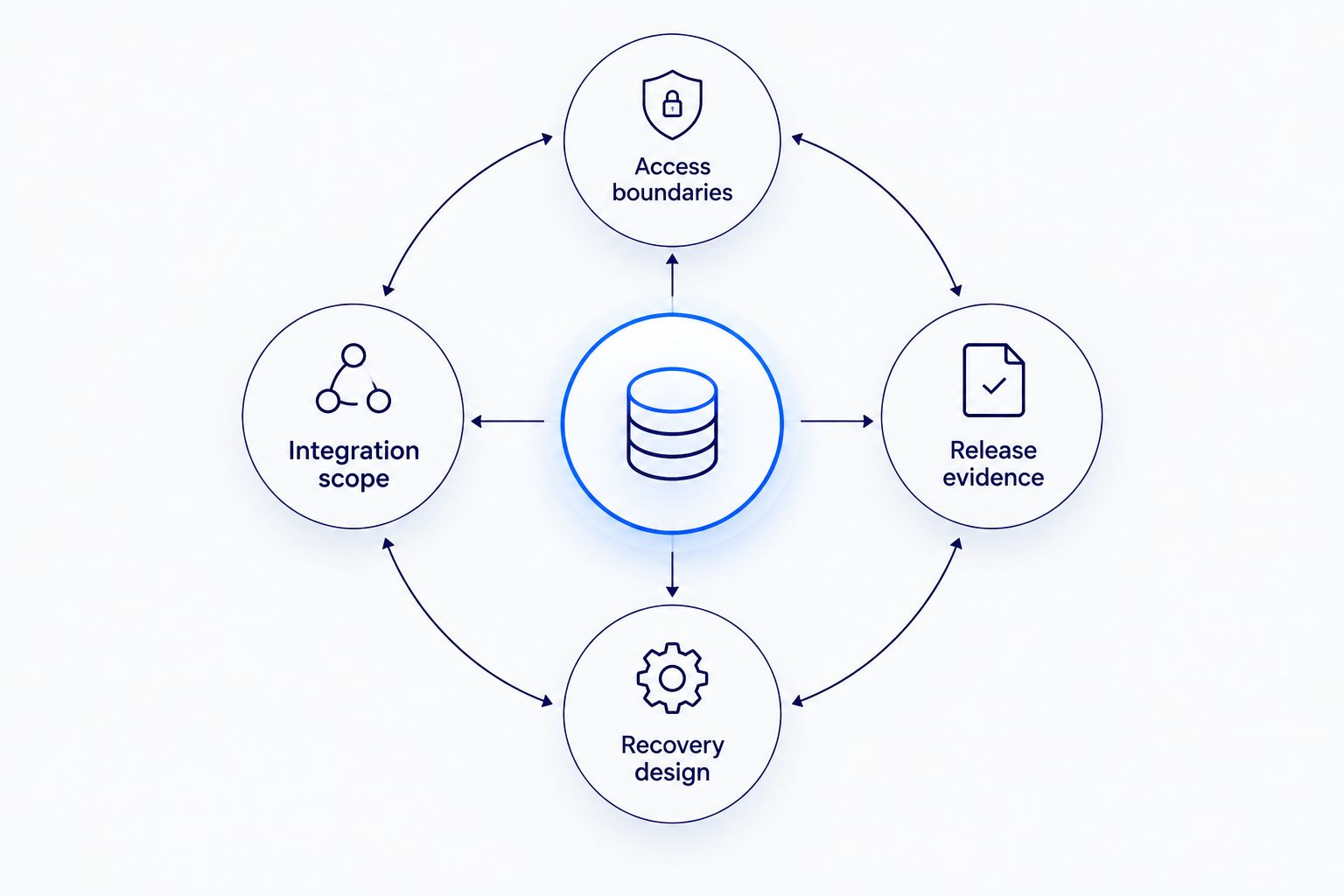
Use these criteria before you look at the comparison table. They separate a relevant consulting team from a familiar company name.
- Access boundaries: The proposal identifies who can reach production, who can approve a release, and how privileged access is recorded. Ask how the design separates development, test, and production environments.
- Release evidence: The team can show where build records, test results, approvals, and deployment events are stored. You should be able to trace a released change without reconstructing it from chat messages.
- Recovery design: The plan explains rollback, restoration, and ownership during an incident. Ask the proposed team to walk through a failed deployment using your dependencies, not a generic diagram.
- Integration scope: The consultants identify external interfaces, identity systems, data flows, and legacy dependencies before changing the pipeline. A clean build does not prove a safe production release.
- Operating handoff: Your engineers receive documentation and a workable process for maintaining the pipeline after the consulting engagement ends. Name the internal owner of each control.
- Healthcare-specific evidence: If protected health information is involved, require a clear account of where it can enter logs, test environments, and monitoring tools. Assess legal and contractual duties with your compliance team rather than assuming every healthcare application has identical requirements.
A useful shortlist exercise is to give each firm the same architecture diagram and ask for a proposed release path, access model, and failure response. Compare the proposed work, not the size of the sales presentation.
Best DevOps consulting firms at a glance
| Firm | Best for | Standout focus | Key limitation to test |
|---|---|---|---|
| Accenture | Broad enterprise transformation | Coordinating cloud, engineering, and operating-model work | A narrow pipeline project can get lost inside a wider program |
| Thoughtworks | Changing software-delivery practices | Connecting engineering practices with delivery teams | You still need a clear owner for ongoing platform operations |
| IBM Consulting | Integration-heavy enterprise environments | Planning change across applications and infrastructure | Confirm that the assigned team, not just the wider firm, owns the DevOps work |
| Red Hat Consulting | OpenShift-centered platforms | Container-platform implementation and operations | Its platform focus is less useful if OpenShift is not part of your target architecture |
These are use-case recommendations for 2026, not a claim that any firm has passed an assessment of your systems. Request named team members, relevant examples, and a proposed scope before awarding work.
1. Accenture: best DevOps consulting firm for broad enterprise change
Accenture is the default shortlist candidate when DevOps is one part of a larger change involving cloud, applications, and operating processes. That breadth matters when multiple business units must agree on a release model. It is less decisive when you need only a tightly bounded pipeline improvement.
Accenture pros:
- Suitable to evaluate when the engagement spans engineering and enterprise operating decisions.
- Gives a single candidate responsibility for discussing connected transformation work.
- Fits a selection process that needs both technical and organizational plans.
Accenture cons:
- A broad proposal does not prove the assigned engineers understand your deployment path.
- A large transformation scope can obscure which changes your team will receive first.
- You must establish who maintains the resulting controls after handoff.
Accenture pricing: Request a written scope and commercial proposal; no comparable price is available in the supplied information.
Best for: Healthcare technology companies coordinating a broad enterprise change rather than buying an isolated CI/CD setup.
Before signing, ask Accenture to map one current application from commit through approval, deployment, monitoring, and rollback. Verdict: Buy if the named team can own that full path and define a handoff; hold if the response stays at program level.
2. Thoughtworks: best for changing software-delivery practices
Thoughtworks belongs on the shortlist when the bottleneck is how product teams build, test, and release software. Its software-engineering focus makes it a relevant comparison against a larger transformation firm. Your decision should still turn on the proposed team's plan for your applications, not a general account of delivery methods.
Thoughtworks pros:
- Fits a brief centered on engineering workflow and release practices.
- Gives you a focused candidate for improving how teams deliver changes.
- Creates a clear test: ask for a working plan using one of your existing services.
Thoughtworks cons:
- Improved delivery practices do not, by themselves, assign ownership of production infrastructure.
- You need explicit coverage for identity, logs, and incident response in the statement of work.
- A method that works for one team needs an adoption plan before other teams use it.
Thoughtworks pricing: Request a proposal against a defined application and delivery scope.
Best for: Healthcare software teams whose main constraint is inconsistent build, test, and release practice.
Ask Thoughtworks to show how a failed change becomes an actionable test, a release decision, and a rollback procedure. Verdict: Buy for a delivery-practice overhaul with clear operational ownership; hold if platform responsibilities remain unassigned.
3. IBM Consulting: best for integration-heavy environments
IBM Consulting is a useful candidate when DevOps changes touch established enterprise applications, infrastructure, and integration patterns. In that setting, a pipeline cannot be judged apart from the systems it deploys into. The buying question is whether the proposed consultants can connect application delivery to your actual dependencies.
IBM Consulting pros:
- Fits an evaluation involving multiple enterprise systems and application teams.
- Provides a candidate for discussing infrastructure and delivery work together.
- Makes integration mapping a central part of the selection exercise.
IBM Consulting cons:
- Firm-wide capabilities are not evidence of the assigned team's experience.
- A plan that inventories systems but delays a working release path is not enough.
- You must specify which integrations are inside the engagement and who owns the rest.
IBM Consulting pricing: Request a proposal that identifies the applications, integrations, and delivery outcomes in scope.
Best for: Healthcare technology companies where a release crosses several established enterprise systems.
Give IBM Consulting a dependency map and ask which changes require joint approval, which can be automated, and what stops a failed deployment. Verdict: Buy when the proposed team connects those decisions to a deliverable release process; hold when integration work has no clear delivery outcome.
4. Red Hat Consulting: best for OpenShift-centered platforms
Red Hat Consulting is the specialist comparison for a team building or operating around OpenShift. That is a distinct buying decision from choosing a general DevOps adviser. If OpenShift is not in your target architecture, a platform-specific engagement should not win simply because containers appear in the brief.
Red Hat Consulting pros:
- Gives OpenShift users a platform-focused consulting option.
- Keeps the discussion close to container deployment and operations.
- Supports a precise technical evaluation against your platform design.
Red Hat Consulting cons:
- A platform engagement does not automatically resolve application-team release habits.
- You still need to define controls outside the container platform, including upstream approvals and downstream monitoring.
- Its focus is a mismatch when your main constraint has nothing to do with OpenShift.
Red Hat Consulting pricing: Request a proposal for the specific platform and application work required.
Best for: Healthcare technology companies that have selected OpenShift and need consulting tied to that platform.
Ask Red Hat Consulting to demonstrate how your application is built, promoted, observed, and recovered on the proposed platform. Verdict: Buy for an OpenShift-centered brief with defined application handoffs; skip for a platform-neutral search.
Where KnackForge fits in the decision
KnackForge is best for an enterprise artificial intelligence discussion, not an automatic DevOps consulting shortlist. Its supplied description says KnackForge helps enterprises apply artificial intelligence to innovation and operations; it does not state that KnackForge offers DevOps consulting or healthcare-specific delivery services. A topic page is not a substitute for a service scope or delivery record.
If your healthcare technology roadmap includes both DevOps and artificial intelligence, evaluate those as separate workstreams. Ask a DevOps finalist how it will govern deployment and production access. Ask KnackForge about the enterprise artificial intelligence work described in its positioning, then establish responsibilities at the boundary between the engagements. Do not assume KnackForge owns the pipeline simply because an artificial intelligence initiative depends on one.
KnackForge pros for a related evaluation: Its stated focus is enterprise artificial intelligence and operations. KnackForge cons for this DevOps ranking: The supplied facts do not establish DevOps consulting capability, healthcare delivery experience, or a proposed delivery team. Verdict: Hold for the DevOps purchase until those points are documented.
How we ranked the firms
The order reflects the job each firm is best positioned to discuss, not an unpublished performance score. Accenture comes first for a broad enterprise brief; Thoughtworks follows for delivery-practice change; IBM Consulting fits integration-heavy work; Red Hat Consulting fits an OpenShift decision. The criteria above determine whether any proposed team should advance beyond the shortlist.
For a 2026 request for proposals, give each candidate the same bounded assignment: describe the current release path, propose a changed path, identify access boundaries, show the evidence a release leaves behind, and explain recovery. Require the answer to identify assumptions and named responsibilities. That makes the comparison about your system rather than each firm's preferred presentation.
Do not use healthcare language as a shortcut for regulatory review. Where HIPAA applies, its Security Rule includes technical safeguards under 45 CFR § 164.312. Applicable policies and required documentation have a 6-year retention rule measured from creation or the date last in effect under 45 CFR § 164.316(b)(2)(i). Those obligations should shape evidence and recordkeeping requirements; they do not certify a consultant.
Which DevOps consulting firm should you choose?
Choose Accenture as the 2026 default if your healthcare technology program spans several enterprise systems and teams. Choose Thoughtworks instead when software-delivery practice is the central problem, IBM Consulting when integration drives the release risk, or Red Hat Consulting when OpenShift is the chosen platform. Make the final award contingent on a plan for your architecture and a named team that can deliver it.
A small scope is a better starting decision than an undefined transformation. Identify one application, its data classification, the people allowed to release it, and the process for reversing a bad deployment. Have each finalist explain what will change, what will remain manual, and who takes ownership afterward. Reject a proposal that promises faster releases but cannot show what evidence and controls survive the change.
FAQ
What's the best DevOps consulting firm for a healthcare technology company in 2026?
Accenture is the default shortlist choice for a broad enterprise DevOps program in 2026. Thoughtworks, IBM Consulting, and Red Hat Consulting fit more specific delivery, integration, and OpenShift briefs.
Is Thoughtworks better than Accenture for a healthcare software team?
Thoughtworks is the better comparison when the main job is changing software-delivery practices. Accenture is the broader choice when DevOps sits inside an enterprise transformation.
When should a healthcare technology company choose Red Hat Consulting?
Choose Red Hat Consulting when OpenShift is part of the target platform and the engagement centers on that platform. Define application release and operational responsibilities separately.
Does a healthcare technology company automatically need a HIPAA-compliant DevOps pipeline?
No; HIPAA applicability depends on the organization, the data, and the work being performed. Have your legal and compliance teams define applicable requirements before a consultant designs controls.
What should a DevOps consulting proposal include?
It should identify the applications in scope, access boundaries, release evidence, recovery procedures, and handoff owners. Ask the proposed team to explain those elements against your existing architecture.
How much does healthcare DevOps consulting cost?
There is no comparable price in the supplied information. Request proposals against the same application scope and delivery outcomes so you can compare what each firm will provide.
Is KnackForge a DevOps consulting firm for healthcare companies?
The supplied description identifies KnackForge as an enterprise artificial intelligence company, not a verified DevOps consulting provider. Request a documented DevOps scope and proposed team before including it in a DevOps vendor decision.
One last thing
Test a finalist's answer with a failure, not a successful deployment. Ask what happens when a release must be reversed while downstream systems have already received changes. The answer exposes whether the proposed work covers application behavior, operational ownership, and evidence together.
If HIPAA breach notification rules apply, the individual-notification deadline is 60 calendar days after discovery under 45 CFR § 164.404(b), subject to the rule's requirements. That is an incident-response obligation, not a target for a DevOps consultant to set. Your release and monitoring design should make it possible for the responsible team to investigate and act.


