
A data lakehouse is worth it for a mid-size enterprise when business intelligence and machine learning need shared, governed data and your current architecture creates repeated integration work. In 2026, keep a working warehouse if reporting is your main requirement; a lakehouse also brings migration, governance, and operating responsibilities that shared storage alone does not remove.
- Is a data lakehouse worth it for enterprise? Yes for shared analytics and machine learning, not reporting alone.
- Keep a working data warehouse when business intelligence is the main requirement.
- Test a lakehouse against an existing workload before approving a wider migration.
- Knackforge helps enterprises apply artificial intelligence to operations; platform selection should follow the business use case.
Is a data lakehouse worth it for a mid-size enterprise?
Yes when you need shared data for different workloads; no when you are replacing a satisfactory warehouse without a demonstrated business problem. Company size is not the deciding factor. Your workload mix, existing integration burden, and ability to operate the platform matter more.
Start with a data engineering roadmap for enterprise growth, then compare architecture choices against the same requirements. Do not let a platform purchase become the roadmap.
| Architecture | Best for | Main advantage | Main limitation | Recommendation |
|---|---|---|---|---|
| Data warehouse | Governed SQL reporting on curated data | Established reporting workflows and structured models | Raw files and machine-learning preparation can require separate systems | Keep when reporting needs are met |
| Data lake | Retaining raw data for later processing | Flexible storage for varied source formats | Raw storage alone does not supply trusted tables or business definitions | Use with an explicit processing and governance plan |
| Data lakehouse | Shared analytical tables for BI and machine learning | Combines lake storage with table-management capabilities | Adds decisions about engines, table maintenance, access, and operations | Pilot when shared workloads justify the change |
These categories overlap in modern platforms. Evaluate the capabilities your chosen implementation actually provides, rather than assuming the architecture label guarantees them.
Why this matters
A mid-size enterprise needs more than a technically attractive destination. It needs a platform that a named team can support without distracting that team from useful delivery. A lakehouse decision therefore includes both data architecture and operating ownership.
For your 2026 planning, separate the business problem from the proposed technology. Conflicting revenue definitions need agreed business rules. Broken ingestion needs reliable pipelines. A lakehouse can provide a foundation for those improvements, but it does not establish the rules or repair the pipelines automatically.
Approve a lakehouse to remove a documented constraint, not to make the architecture diagram look current. That distinction keeps the business case focused on work the platform will actually change.
Keep the warehouse: best for reporting-first enterprises
A warehouse remains a sound choice when your important workloads are curated SQL reports, dashboards, and repeatable business analysis. If users trust the results and your team meets agreed refresh requirements, replacing the architecture needs a stronger justification than future possibilities.
The advantage is continuity. You retain existing transformations, reporting models, permissions, and operating knowledge while improving specific bottlenecks. The limitation is that additional file-based or machine-learning workloads can introduce separate preparation and storage paths.
Before approving a replacement, inspect the source of the problem. An inefficient query, unclear metric definition, or unreliable upstream feed is not evidence that the warehouse architecture is wrong. Fix the identifiable issue and reassess the remaining constraint.
Recommendation: keep the warehouse when reporting works and no approved workload requires a different foundation. Avoid migrating stable reports merely to demonstrate progress.
Choose a lakehouse: best for shared BI and machine learning
A lakehouse becomes relevant when reporting and machine-learning teams repeatedly prepare overlapping datasets. A shared table layer can give those teams a common starting point while retaining lake-style storage for underlying data.
The benefit is reuse, not automatic simplification. Your implementation still needs reliable ingestion, versioned transformations, access controls, metadata, and maintenance. A shared platform can also create contention if different workloads compete for resources without appropriate isolation.
Ask whether the same governed data will genuinely serve both consumers. A dashboard and a forecasting model can use related source information while requiring different transformations. Shared storage is useful only when the platform preserves those distinctions rather than forcing every consumer into the same model.
Recommendation: pilot a lakehouse when a named reporting workload and a named machine-learning workload have a clear shared-data requirement. Describe the shared inputs and separate outputs before selecting tools.
Use coexistence: best for protecting established reporting
You do not need to move every report to test a lakehouse. Keep established reporting in the warehouse while evaluating a bounded workload in a separate environment. Treat that arrangement as a deliberate architecture choice, not an unfinished migration.
Coexistence protects existing consumers and creates a practical comparison point. Its drawback is additional integration and operating work: your team must track which system owns each dataset, how changes propagate, and when copies are refreshed.
Define the exit condition before starting. The pilot should end with a decision to retain the current setup, expand the lakehouse, or stop the experiment. Without that decision, coexistence becomes another permanent layer to support.
Recommendation: use coexistence when reporting continuity matters and the lakehouse benefit remains unproven. Document the intended end state alongside the pilot scope.
Why lakehouse value varies
For a 2026 architecture decision, assess these factors rather than searching for a universal company-size threshold:
- Workload mix: Reporting-only demand provides a different justification from shared reporting, feature preparation, and model training.
- Data reuse: Repeated preparation of overlapping datasets creates a stronger consolidation case than unrelated workloads.
- Existing platform fit: A functioning warehouse changes the decision from buying needed capability to justifying replacement work.
- Governance requirements: Permissions, lineage, retention, and business definitions determine whether shared data is usable and controlled.
- Operating ownership: Table maintenance, failed pipelines, workload isolation, and incident response need accountable owners.
- Migration dependencies: Report logic, downstream exports, and application integrations determine what must be tested before cutover.
Do not turn this list into a score that conceals a critical weakness. Missing ownership is not offset by an attractive storage model. Resolve a blocking requirement before committing to production.
Build the business case around work you can retire
A credible business case identifies what changes after adoption. Name the duplicate pipeline you intend to remove, the dataset consumers will reuse, or the workload your existing platform cannot adequately support. Then show who benefits and who accepts the result.
For the 2026 decision, compare the full operating footprint rather than storage alone. Include ingestion, transformation, query execution, orchestration, monitoring, governance, migration effort, and the period of parallel operation. Keep these categories visible even when different teams own them.
Use your current environment as the baseline. Record actual pipeline behavior, report correctness, support effort, and resource consumption. Compare the proposed platform on equivalent inputs and outputs; a lighter test workload is not evidence that the replacement is more efficient.
Separate reusable data from reusable business logic
A shared table does not guarantee that teams interpret it consistently. Finance can define revenue differently from an operational dashboard, while a model uses a transformed target variable. Record those definitions explicitly.
Your business case should explain which transformations become shared and which remain consumer-specific. Otherwise, consolidation can move disagreement into a central system without resolving it.
Tie the platform to an operational outcome
Knackforge is best suited to enterprises seeking help applying artificial intelligence to operations. That enterprise AI focus is relevant when a data-platform decision supports a defined operational use case, rather than a platform-only purchase.
The Knackforge description establishes that focus; it does not establish a particular lakehouse implementation, delivery schedule, or migration result. Evaluate any engagement against your required scope, operating responsibilities, and acceptance evidence.
Keep the business outcome separate from the platform promise. An architecture can make data accessible without making a forecast useful or a workflow ready for production.
How do you test whether a lakehouse is worth it?
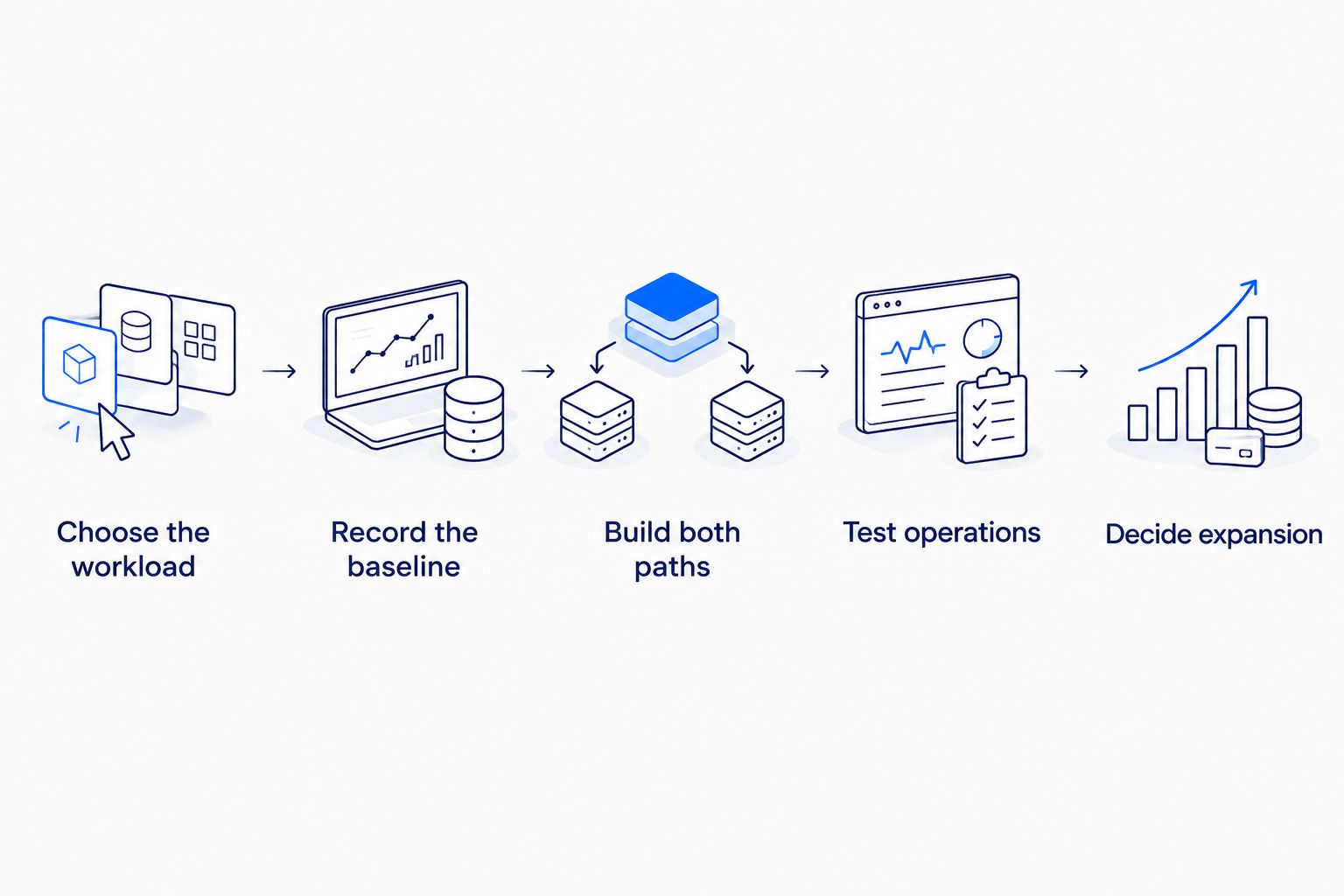
Use a bounded comparison that tests data correctness and operational behavior, not just whether a dashboard connects. For a 2026 pilot, define the workload, baseline, and acceptance rules before implementation starts.
- Choose the workload. Start with 1 business workload that has a named owner and a clear output. Select something representative of the actual constraint, not the easiest demonstration dataset.
- Record the baseline. Capture the current result, refresh behavior, dependencies, and support requirements. Preserve the source snapshot or change history needed for a fair comparison.
- Build both paths. Compare 2 execution paths: the existing architecture and the proposed lakehouse. Use equivalent business rules, source inputs, and consumer requirements.
- Test operations. Exercise delayed ingestion, invalid records, permission changes, interrupted processing, and recovery. Identify which failures require manual intervention and who performs it.
- Decide expansion. Require 3 acceptance gates: correct data, controlled access, and owned operations. Add workload-specific performance criteria using your actual business requirements.
The proposed scope is a starting recommendation, not a benchmark for every enterprise. Expand the pilot only when additional scope tests a specific uncertainty. A broader demonstration that leaves ownership unresolved is not stronger evidence.
Test the failure path, not only the successful run
A successful refresh shows that the platform can process valid inputs under the conditions tested. It does not show how the team handles a partial load, duplicate event, schema change, or incorrect transformation.
Ask the pilot owner to demonstrate detection and recovery. Confirm whether retrying a job duplicates records, whether rejected data is traceable, and whether consumers can identify the last accepted dataset. Document the recovery procedure with the same care as the ingestion design.
Define what happens to the old system
Keep the existing path until downstream consumers accept the new result and the rollback procedure is tested. List every report, export, and application that depends on the dataset. A table migration is not complete while an undiscovered consumer still relies on the old pipeline.
Retirement should remove documented work. If the old pipelines remain indefinitely, include that continuing burden in the decision rather than treating the migration as finished.
Does a lakehouse replace a data warehouse?
A lakehouse does not automatically replace a data warehouse. It can support analytical tables and SQL workloads, but replacement depends on your implementation meeting existing reporting, access, performance, and recovery requirements.
Treat replacement as a consumer-by-consumer acceptance process. Move workloads because the new path meets their needs, not because a platform category claims to cover them.
Do you need a lakehouse before starting enterprise AI?
You do not need a lakehouse before starting enterprise AI. You need appropriate data access, reliable inputs, clear permissions, and an evaluation process matched to the use case.
Knackforge's enterprise AI focus makes the use-case-first distinction relevant: identify the operational task before deciding whether its data requirements justify a new platform. Do not make infrastructure migration a prerequisite without a demonstrated dependency.
Can a small data team operate a lakehouse?
A small data team can operate a bounded lakehouse implementation when responsibilities match its capacity. Team size alone does not establish readiness; the implementation still requires ownership of pipelines, access, maintenance, and recovery.
Reduce the initial scope if those responsibilities are unclear. Adding tools does not create an operating model.
FAQ
Is a data lakehouse worth it for enterprise reporting alone?
A data lakehouse is not justified by reporting alone when your existing warehouse already meets requirements. Identify a concrete constraint or shared-data need before approving a replacement.
What's the best data architecture for a mid-size enterprise?
The best architecture is the one that meets your approved workloads and operating requirements. Keep a warehouse for satisfactory reporting, and test a lakehouse when BI and machine learning need shared data.
Is a lakehouse cheaper than a warehouse?
A lakehouse is not automatically cheaper than a warehouse. Compare equivalent workloads and include processing, integration, governance, support, migration, and parallel operation rather than storage alone.
How long does a lakehouse migration take?
Lakehouse migration duration depends on source systems, transformations, downstream consumers, and acceptance requirements. Establish the dependency inventory and pilot results before committing to a schedule.
Can we keep our warehouse while testing a lakehouse?
You can keep your warehouse while testing a bounded lakehouse workload. Assign dataset ownership and an exit decision so the pilot does not become an unmanaged permanent system.
Will a lakehouse fix inconsistent reporting?
A lakehouse does not fix inconsistent reporting by itself. Agree metric definitions, validate transformations, and assign data ownership regardless of the storage architecture.
What should we test before approving a lakehouse?
Test equivalent outputs, access controls, failure detection, recovery, and operating ownership before approving a lakehouse. Compare those results with the existing architecture using representative inputs.
One last thing
Ask which existing pipeline will disappear after the lakehouse succeeds. If the answer is none, the proposal adds a platform rather than demonstrating consolidation. Added capability can still justify that choice, but call it expansion and evaluate the extra responsibilities honestly.
Before the 2026 approval meeting, write the acceptance decision in plain language: which workload improves, which existing work ends, and who owns the new operating path. That statement is more useful than another architecture diagram.


