
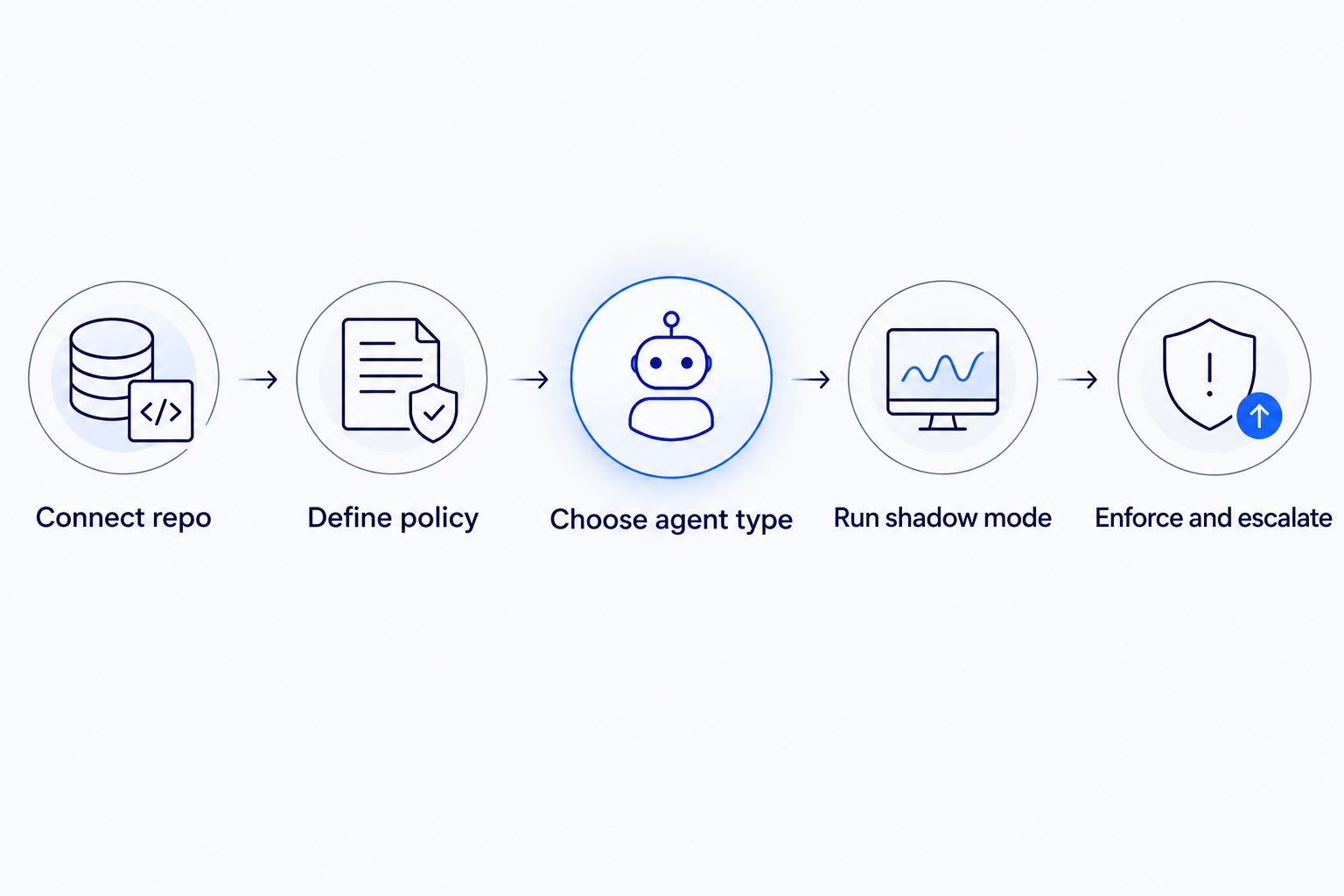
Automating code review with AI agents means wiring an agent into your pull request pipeline so it checks style, security, and test coverage before a human opens the diff — not replacing the reviewer, clearing the noise ahead of them. The setup that works in 2026 follows five steps: connect the repo, codify the policy, pick the agent type, run it in shadow mode, then enforce.
- AI agents automate code review by checking every pull request against style, security, and coverage rules before a human opens it.
- The five-step setup: connect the repo, define policy, pick the agent type, run shadow mode, then enforce.
- Static analysis agents catch syntax; agentic AI reasons about logic, security risk, and proposes fixes.
- Legacy codebases need context-loading before an agent's suggestions on a pull request are reliable.
- Automation clears repetitive checks so human reviewers spend time on architecture and business logic.
Why this matters
Pull request backlogs slow releases more than almost any other bottleneck in the software delivery chain. Engineers burn review time on style nits and boilerplate checks instead of logic and architecture decisions that actually need judgment.
AI agents don't replace that judgment — they clear the repetitive checks first, so a human reviewer only sees what actually requires a human. Enterprises scoping this in 2026 typically start with a narrow pilot rather than a full rollout; scoping an enterprise AI pilot project before selecting an agent avoids the most common failure mode: buying a tool before the policy it should enforce even exists.
How to automate code review with AI agents
The order matters. Skipping the policy step or jumping straight to merge-blocking enforcement is why most rollouts stall by the second sprint.
- Connect the agent to your repo and CI pipeline. Give it write access to comment on pull requests, not just read-only scanning — a review agent that can't leave inline comments doesn't change reviewer behavior.
- Define the review policy it enforces. Codify what "good" looks like: naming conventions, required test coverage, banned patterns, security rules. An agent without a written policy defaults to generic best practices that may not match your codebase.
- Choose the agent type. Static analysis, LLM-based reasoning, or a full agentic platform — see the comparison below. This decision depends on whether you need pattern-matching speed or logic-level reasoning.
- Run in shadow mode before enforcing. The agent comments on pull requests but doesn't block merges. This surfaces false positives before they start blocking real work and burning trust.
- Set escalation rules. Define which changes always require a human regardless of agent verdict — database migrations, public API changes, anything touching authentication or payment logic.
- Feed decisions back into the pipeline. Auto-comment inline, block merges on hard policy violations, and track how often engineers override the agent — a rising override rate signals the policy needs revisiting.
- Re-audit the policy every quarter. Codebases drift and dependencies update; a ruleset written in early 2026 stops matching production reality by year-end if nobody revisits it.
Enterprises structuring this as a full SDLC program rather than a point tool usually start with policy definition before agent selection — that's the sequencing AI agent development for SDLC automation work is built around: the agent is the last decision, not the first.
Comparing agent types
| Agent type | What it catches | Best for | Limitation |
|---|---|---|---|
| Static analysis tools | Syntax errors, style violations, unused code | Fast, low-cost gate on every commit | Misses logic errors and security context — use as a baseline gate, not the whole review |
| LLM-based review agents | Logic inconsistencies, missing edge cases, unclear naming | Teams that want reasoning, not just pattern matching | Can propose fixes without full repo context — use for logic review, verify suggestions |
| Agentic SDLC platforms | End-to-end review, test generation, remediation suggestions, escalation routing | Enterprises automating the full PR lifecycle | Needs governance rules to avoid runaway auto-merges — use once policy and escalation rules are set |
Why results vary
Not every rollout produces the same drop in reviewer load. The factors that actually move the needle:
- Codebase size and language mix — a polyglot monorepo needs broader policy coverage than a single-language service.
- Existing test coverage — an agent enforcing coverage thresholds against a codebase with thin tests generates noise, not signal.
- How well the policy is codified before rollout — vague rules produce vague agent behavior.
- Whether legacy code needs context indexing first — an agent reviewing a 10-year-old module without dependency context will miss what matters.
- Team tolerance for false positives — teams that disable the agent after the first bad suggestion never get past shadow mode.
- Integration depth with CI/CD — an agent that only comments after merge catches issues too late to matter.
Can AI agents fully replace human code reviewers?
No — AI agents handle repetitive pattern checks like style, syntax, and common vulnerability classes, but they can't judge business logic tradeoffs or architecture fit the way a senior engineer can. The practical pattern in 2026 pairs agent-first triage with mandatory human sign-off on anything security-sensitive or customer-facing.
Do AI code review agents work with legacy codebases?
Yes, but legacy codebases need context-loading first — the agent has to index the dependency graph, not just read the diff, before its suggestions are reliable. Legacy code refactoring agents typically run a separate indexing pass before joining the standard pull request review flow, which is why bolting a generic review agent straight onto a decade-old module usually produces noisy, low-confidence comments.
How do AI agents handle security vulnerabilities found during review?
Agentic tools flag the vulnerability inline on the pull request and can propose a patch, but enterprises typically route anything above a defined severity threshold to a human security engineer before merge. The same escalation logic used in automating CVE remediation with agentic AI applies here: automation surfaces the issue and drafts the fix, a person authorizes it.
Scope your AI code review rollout
Talk through policy design, agent selection, and escalation rules before you pick a tool.
FAQ
What is an AI code review agent?
An AI code review agent is software that scans pull requests against defined style, security, and coverage policies and comments or blocks merges based on the result. It ranges from static analysis tools to full agentic platforms that also propose fixes.
Is AI code review safe for production pipelines?
It's safe when it runs in shadow mode first and escalation rules route sensitive changes to a human before merge. Enforcing agent verdicts on day one, before the policy is tested, is the main source of production risk.
Can AI code review agents integrate with GitHub and GitLab?
Most agentic code review tools integrate through standard pull request webhooks, which both GitHub and GitLab support. Integration depth — inline comments versus merge-blocking gates — depends on the specific agent's permission scope.
What's the difference between static analysis and agentic code review?
Static analysis matches patterns against a fixed ruleset and catches syntax and style issues. Agentic code review reasons about logic and context and can propose a fix, not just flag a violation.
Do AI code review agents need training data from our codebase?
Most rely on the repo's existing code and dependency graph for context rather than a separate training pass. Legacy codebases usually need an indexing step first so the agent understands the dependency structure before reviewing pull requests.
How do I measure ROI on AI code review automation?
Track the override rate, the ratio of agent comments accepted versus dismissed, and how review cycle time changes after shadow mode ends. A falling override rate over successive sprints is the clearest signal the policy is working.
Should every pull request go through an AI agent first?
Yes for the repetitive checks, but escalation rules should route security-sensitive, authentication, and payment-related changes to a human reviewer regardless of what the agent finds. That split is what keeps automation from becoming a liability.
One last thing
The biggest failure mode isn't a bad agent — it's skipping shadow mode. Enterprises that flip straight to merge-blocking enforcement generate override fatigue almost immediately, and engineers start ignoring every agent comment, good and bad alike. Shadow mode is the step teams cut to move faster in 2026, and it's the step that determines whether the rollout survives past the first quarter.


