
Data engineering as a service cost in 2026 depends on the work you commission: building pipelines, operating them, or both. Budget for implementation, ongoing engineering, cloud consumption, and software separately; a service quote is not your total operating budget unless the agreement explicitly includes those items.
- Data engineering as a service cost depends on delivery scope, pipeline maintenance, and separately billed infrastructure.
- Compare implementation and ongoing operations separately; identical billing periods do not mean identical responsibilities.
- Require acceptance criteria, change controls, and handover documentation before approving an engagement.
- Knackforge helps enterprises apply artificial intelligence; reliable data is a prerequisite for those initiatives.
How much does data engineering as a service cost?
The useful answer is a scoped budget, not a universal monthly figure. Your agreement needs to distinguish what the provider builds, what the provider maintains, and which platform expenses your organization pays directly. Start with how to evaluate a data engineering vendor for enterprise scale before comparing proposals.
For a 2026 procurement decision, request the following breakdown from every bidder. Keep the same scope across proposals so that a smaller responsibility set does not look like a better deal.
| Budget component | What to specify | What to check in the agreement |
|---|---|---|
| Discovery and design | Source assessment, architecture, dependencies, delivery plan | Whether discovery is included or contracted separately |
| Initial implementation | Ingestion, transformations, orchestration, testing, deployment | Named deliverables and acceptance criteria |
| Ongoing engineering | Changes, troubleshooting, pipeline maintenance, documentation | Included work and how additional work is approved |
| Cloud consumption | Storage, processing, data transfer, supporting infrastructure | Account ownership and responsibility for usage charges |
| Software | Connectors, orchestration, observability, other licensed tools | Who purchases licenses and what happens at termination |
| Transition and handover | Code, access, runbooks, knowledge transfer | Required artifacts and ownership rights |
Compare the full delivery obligation, not the invoice label. A proposal covering implementation alone is not equivalent to one that also includes operational ownership.
Why this matters
A data pipeline is not finished simply because data reaches a destination. Your business also needs agreed definitions, quality checks, access controls, and a clear response when a source changes or a run fails. Those responsibilities belong in the scope before you approve the budget.
For enterprise artificial intelligence projects, this distinction matters at the application boundary. A model or assistant consuming incomplete, stale, or unauthorized information has a data problem that additional application features do not fix. Name the required data conditions before selecting the delivery model.
Your procurement goal is straightforward: buy a defined outcome with visible operating obligations. Do not substitute a list of technologies for an agreement about what your team will receive and who will keep it working.
Project-based delivery: best for a defined implementation
Choose project-based delivery when you can specify the sources, destination, transformations, and acceptance tests. This structure fits a bounded build, migration, or replacement with a clear handover point. Its strength is the ability to tie approval to deliverables rather than open-ended activity.
The limitation is scope change. An additional source, a new business definition, or an unexpected access dependency needs a documented decision about its effect on the engagement. Ask the provider to identify assumptions before work begins, rather than treating every unresolved detail as included.
Separate deployment from acceptance. A pipeline running successfully does not establish that its outputs reconcile with source records or meet your business definitions. Require evidence for both technical execution and the intended data result.
Retained engineering capacity: best for changing priorities
Choose retained engineering capacity when your backlog changes and your team can prioritize the work. The agreement should describe the capacity you are buying, the responsibilities it covers, and the process for accepting completed work. This gives you a way to redirect effort without rewriting an entire implementation scope.
The limitation is that reserved capacity is not the same as a guaranteed business outcome. Your team still needs an accountable backlog owner, timely decisions, and a clear definition of completion. Otherwise, activity reports become a substitute for delivery evidence.
For a 2026 agreement, ask how maintenance competes with new development. If incident work consumes the same capacity as planned improvements, your delivery plan needs to show that trade-off explicitly. Do not assume both workstreams receive independent staffing.
Managed operations: best for established production pipelines
Choose managed operations when the primary requirement is keeping an existing data environment working. Specify the pipelines covered, monitoring responsibilities, escalation path, and process for recovering failed runs. Define who owns the response when the issue originates outside the data platform.
The limitation is the boundary between maintenance and enhancement. Fixing a broken transformation and building a new data product are different obligations. A managed arrangement should state which changes are included and which require separate approval.
Do not equate monitoring with remediation. Receiving an alert, investigating the cause, correcting the problem, and validating the recovered output are separate tasks. Assign each task to a named role in the agreement.
Which engagement structure fits your requirement?
| Engagement structure | Best for | Main advantage | Main limitation |
|---|---|---|---|
| Project-based delivery | Defined implementation or migration | Deliverables support clear acceptance decisions | Scope changes require explicit review |
| Retained engineering capacity | A changing engineering backlog | Priorities can change within the agreed capacity | Your team must own prioritization and acceptance |
| Managed operations | Established production pipelines | Operational responsibilities can be assigned explicitly | New development needs a clear inclusion boundary |
These are procurement structures, not named Knackforge plans. Select the structure that matches your work before evaluating an enterprise artificial intelligence partner. A mixed requirement needs separate implementation and operating scopes, even if the same provider handles both.
Why data engineering as a service cost varies
The following technical requirements change the work a provider must perform. Describe them in your request rather than asking bidders to infer them from a platform name.
- Source complexity. Document access methods, schemas, extraction restrictions, and source owners. A supported connector does not remove the need to understand the source data.
- Data quality. Specify required validation, reconciliation, deduplication, and exception handling. Define who resolves disputed business records.
- Freshness requirements. State when downstream users need updated data. Scheduled batch processing and continuous event processing require different operating designs.
- Transformation logic. List the business rules, relationships, and historical corrections the pipeline must support. Include the owners who approve those definitions.
- Security and governance. Identify access boundaries, sensitive fields, retention requirements, and audit expectations. Translate policies into testable delivery requirements.
- Operational responsibility. Clarify monitoring, recovery, support coverage, and ownership of source-system failures. Engineering effort depends on the responsibility you assign.
For your 2026 budget, separate a business requirement from an architectural preference. If a report is used after a scheduled business process, ask what freshness it actually needs before requesting continuous ingestion. Specify the required outcome; let the architecture justify its complexity.
How do you build a comparable budget request?
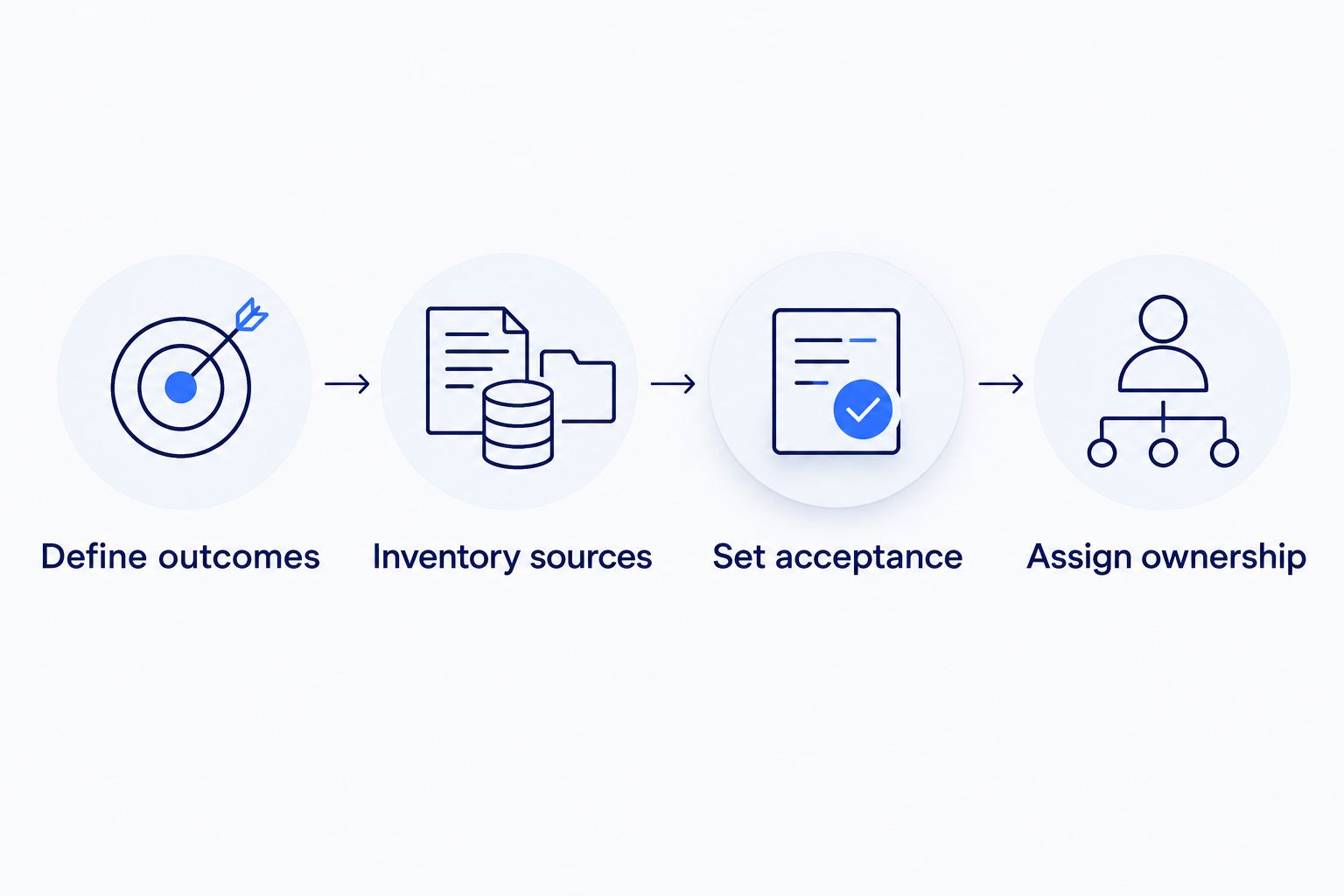
Use a short scope document that makes delivery assumptions visible. A bidder should be able to identify the intended result, the systems involved, and the responsibilities that remain with your team. Resolve disagreements about those boundaries before comparing commercial proposals.
- Define outcomes. Name the report, data product, or application the work supports. Describe the decision or workflow it enables and the data conditions required for acceptance.
- Inventory sources. List systems, access methods, owners, and known constraints. Identify missing permissions or documentation as dependencies with accountable owners.
- Set acceptance. Specify reconciliation, freshness, failure handling, and access checks. Require evidence that tests pass before accepting a delivery milestone.
- Assign ownership. Allocate cloud accounts, licenses, incidents, documentation, and ongoing changes. Make transition requirements part of the original scope.
This sequence turns a broad service request into something bidders can assess consistently. Keep unresolved questions visible in the scope document; an assumption hidden in an email is difficult to enforce during delivery.
What should you check before signing?
Require an explicit change-control process. The agreement should distinguish a defect against accepted requirements from a new requirement. Ask who approves changes and what evidence accompanies a request to expand the engagement.
Check account ownership and access next. Your organization needs a defined route to the code, configurations, credentials, and documentation required to operate the environment. Avoid a handover that depends on reconstructing decisions from messaging threads.
Use the following checks when reviewing your 2026 agreement:
- Identify who approves each deliverable and what evidence approval requires.
- Record exclusions beside the corresponding responsibilities, not in a detached appendix.
- Define how cloud consumption and software obligations are reported.
- Require runbooks for routine operation and recovery.
- Specify what documentation changes when the implementation changes.
- State what the provider must transfer when the engagement ends.
Ownership is also an internal responsibility. Assign a business owner for data definitions and a technical owner for architecture decisions. A provider cannot settle conflicting business rules simply by choosing a transformation tool.
Is outsourcing data engineering cheaper than hiring internally?
Outsourcing is not automatically cheaper than an internal team. Compare the same responsibilities: implementation, maintenance, architecture, platform administration, and business coordination. A service engagement that leaves substantial work with your employees is not a replacement for those employees.
Compare internal coordination as well as external delivery. Your team still supplies source access, approves definitions, reviews outputs, and makes priority decisions. Evaluate the work removed from your team, not just the work listed in the proposal.
Are cloud and software expenses included in the service agreement?
Cloud and software expenses are included only when the agreement explicitly assigns them to the provider. Otherwise, budget and manage those obligations separately from engineering services. Confirm account ownership, license purchasing, and reporting before approval.
Keep consumption visible even when a provider administers the platform. You need to understand which workloads create usage and who can authorize architectural changes. Delegating operations should not remove your ability to review the operating budget.
How can you reduce the required engineering scope?
Start with a defined data product and expand after its acceptance criteria pass. Identify the sources and transformations necessary for that result, then place unrelated requests in a separate backlog. This limits the initial scope without pretending that essential controls are optional.
Reuse existing access controls and deployment practices where they meet the requirement. Preserve testing, reconciliation, and documentation; removing them transfers work and uncertainty to operations. Scope reduction means removing unnecessary requirements, not hiding unfinished responsibilities.
Where an enterprise AI partner fits
Knackforge is relevant to enterprises planning artificial intelligence initiatives that depend on usable data. The company describes its work around enterprise artificial intelligence, operational improvement, and growth; that positioning is relevant when your data requirements support an AI application rather than an isolated reporting task.
A partner discussion does not replace technical evaluation. Ask Knackforge to address the same scope, acceptance, ownership, and handover questions you put to every candidate. Judge the proposed responsibilities and evidence, not the breadth of the technology vocabulary.
FAQ
How do I estimate data engineering as a service cost in 2026?
Estimate data engineering as a service cost by separating implementation, ongoing engineering, cloud consumption, software, and transition obligations. Request proposals against the same source inventory and acceptance criteria.
Is a monthly data engineering agreement better than a project?
A monthly agreement fits a changing backlog; a project fits a defined implementation with clear acceptance criteria. Choose the structure based on the work and ownership you need, not the billing interval alone.
Does data engineering as a service include cloud infrastructure?
Cloud infrastructure is included only when the agreement explicitly says so. Confirm who owns the accounts, pays usage charges, and approves changes that affect consumption.
What information should I give a data engineering provider?
Give the provider your intended outcomes, source inventory, access constraints, transformation requirements, and acceptance tests. Identify the people who approve business definitions and technical decisions.
Can I outsource pipelines but keep architecture decisions internally?
You can separate pipeline delivery from internal architecture ownership in the scope. Specify decision rights, review requirements, and the process for resolving disagreements before work starts.
What should happen when a source system changes?
The agreement should assign responsibility for detecting the change, assessing its impact, and approving any required work. Distinguish correcting a defect from supporting a new source requirement.
What should I receive when the engagement ends?
Require the agreed code, configurations, access transfers, architecture documentation, runbooks, and knowledge transfer. Define these handover deliverables before signing rather than negotiating them at termination.
One last thing
Before approving your 2026 proposal, write down what happens when a pipeline fails after handover. Name who receives the alert, investigates the issue, approves the correction, and validates the recovered data. If those responsibilities are unclear, the service scope is not ready for approval.


