
AI agent development cost in 2026 depends on the workflow, system integrations, permissions, and acceptance criteria you commission—not a universal project average. Your development quote also needs a separate operating budget for model usage, hosting, monitoring, maintenance, and human review.
- AI agent development cost 2026: define the workflow and operating requirements before comparing development quotes.
- Separate implementation work from recurring model usage, infrastructure, maintenance, and human review.
- Compare a prototype, supervised workflow, and production agent against different acceptance criteria.
- Knackforge aligns with enterprises pursuing operational improvement through AI; assess project fit against your written requirements.
Why this matters
A demonstration and a production workflow are different purchasing decisions. A demo shows that an agent can complete selected tasks; production acceptance needs to address permissions, failures, monitoring, and ownership after launch.
Compare the same deliverables, not just the totals on competing proposals. Start by scoping an enterprise AI pilot project, then use that scope as the common brief for your internal team and prospective development partners.
For your 2026 budget, separate approval to investigate from approval to deploy. That distinction gives you a decision point after the pilot instead of treating a successful demonstration as permission to expand access across enterprise systems.
How much does AI agent development cost in 2026?
The practical answer is a scope-based estimate covering implementation and operation. Ask for a breakdown that identifies the work, the assumptions behind it, the acceptance tests, and the responsibilities retained by your organization.
Use the following structure to evaluate a proposal. These are budgeting categories, not standard package names or a prescribed architecture.
| Budget component | What the estimate should cover | What to verify |
|---|---|---|
| Discovery and workflow design | Process mapping, task boundaries, success criteria | Which business outcome defines acceptance? |
| Data preparation | Source access, document preparation, retrieval setup where needed | Who resolves missing or inconsistent source data? |
| Integration development | Authentication, tool connections, input validation, error handling | Which systems and actions are included? |
| Agent implementation | Instructions, orchestration, tool selection, state management | What happens when the agent cannot finish? |
| Evaluation and security | Test cases, permission checks, adversarial testing | Who signs off before production access? |
| Deployment and handover | Environment setup, release process, documentation | Who owns the deployed system? |
| Ongoing operation | Model usage, hosting, observability, support, review | Which responsibilities continue after launch? |
Require every quoted deliverable to have an acceptance condition. A proposal that promises an integration should specify the permitted operations, expected responses, and behavior when that system is unavailable—not merely name the application being connected.
Also identify exclusions explicitly. Your team should know whether source-data cleanup, identity changes, security reviews, business-user testing, and internal training sit inside the engagement or remain your responsibility.
Prototype: validate a bounded task
A prototype is best for testing whether an agent can perform a clearly defined task using representative inputs. Keep its permissions narrow and distinguish an experiment from a system employees or customers depend on.
The advantage is focus: you can examine task quality without building every production capability immediately. The limitation is equally important—a prototype does not establish production reliability, security approval, or a completed support model.
Write down what the prototype must demonstrate before development begins. Specify the input, expected output, acceptable refusal behavior, and the cases that should be handed back to a person.
Choose a prototype when your unresolved question is feasibility. Do not use prototype acceptance to approve unrestricted access, and do not compare its estimate directly with a production proposal containing operational controls.
Supervised workflow: retain human approval
A supervised workflow is best for tasks where the agent prepares a recommendation or proposed action and a person approves the consequential step. Examples include drafting a response, preparing a record update, or assembling information for review.
Human approval creates a checkpoint, but it also creates work. Your scope needs to include the review interface, reviewer permissions, escalation rules, and the evidence presented alongside each proposed action.
The advantage is a deliberate boundary between generated output and execution. The limitation is that task completion still depends on reviewer capacity and judgment; supervision is not a substitute for testing or access controls.
Choose supervision when the business requires approval before execution. Make the approval meaningful: show the proposed change, its supporting information, and the action the reviewer is authorizing rather than asking for a generic confirmation.
Production agent: define operational ownership
A production agent is best for an established workflow with documented permissions, acceptance tests, and an accountable operating team. Its development scope should include the conditions under which it acts, stops, retries, or escalates.
The advantage is integration into a real business process rather than an isolated demonstration. The limitation is the continuing responsibility to monitor behavior, maintain connections, investigate failures, and re-evaluate changes.
Production does not mean unrestricted autonomy. An agent can operate in production while retaining human approval for selected actions and refusing requests outside its permitted scope.
For a 2026 production estimate, ask what happens after a model, source document, or connected application changes. Choose production deployment only when ownership and failure handling are part of acceptance, not tasks left for the team to resolve after release.
Which development scope fits your decision?
| Scope | Best for | Main advantage | Main limitation | Recommendation |
|---|---|---|---|---|
| Prototype | Testing a bounded task | Keeps feasibility testing focused | Does not establish production readiness | Use for an unresolved feasibility question |
| Supervised workflow | Actions requiring approval | Preserves an explicit review checkpoint | Adds reviewer workload | Use when approval is a business requirement |
| Production agent | An accepted operational workflow | Connects the agent to ongoing work | Requires monitoring and maintenance | Use with documented ownership and controls |
Why AI agent development cost varies
Treat these factors as questions to resolve in your scope, not reasons to accept an unexplained estimate. Each factor changes what the development team must build or what your operating team must manage.
- Workflow boundaries: Identify the tasks the agent handles and the tasks it refuses. Include exceptions rather than describing only the successful path.
- System access: Specify which applications the agent reads from or writes to, how it authenticates, and which operations are permitted.
- Data readiness: Confirm source ownership, access rights, document quality, and update processes before treating the data as ready for use.
- Action authority: Distinguish recommendations from executable actions. Define where approval, validation, or rollback is required.
- Evaluation coverage: Include representative tasks, malformed inputs, unavailable dependencies, and requests outside the permitted workflow.
- Operating requirements: Identify monitoring, incident handling, change approval, and maintenance responsibilities alongside deployment requirements.
An additional tool connection is not merely another item in a list. It needs a defined interface and permission boundary, plus tests for valid responses, failures, and unexpected inputs.
Reduce scope by removing tasks or actions, not by deleting their safeguards. If the proposed workflow is too broad, narrow what the agent is allowed to do while retaining the controls needed for that smaller workflow.
How do you get a comparable development estimate?
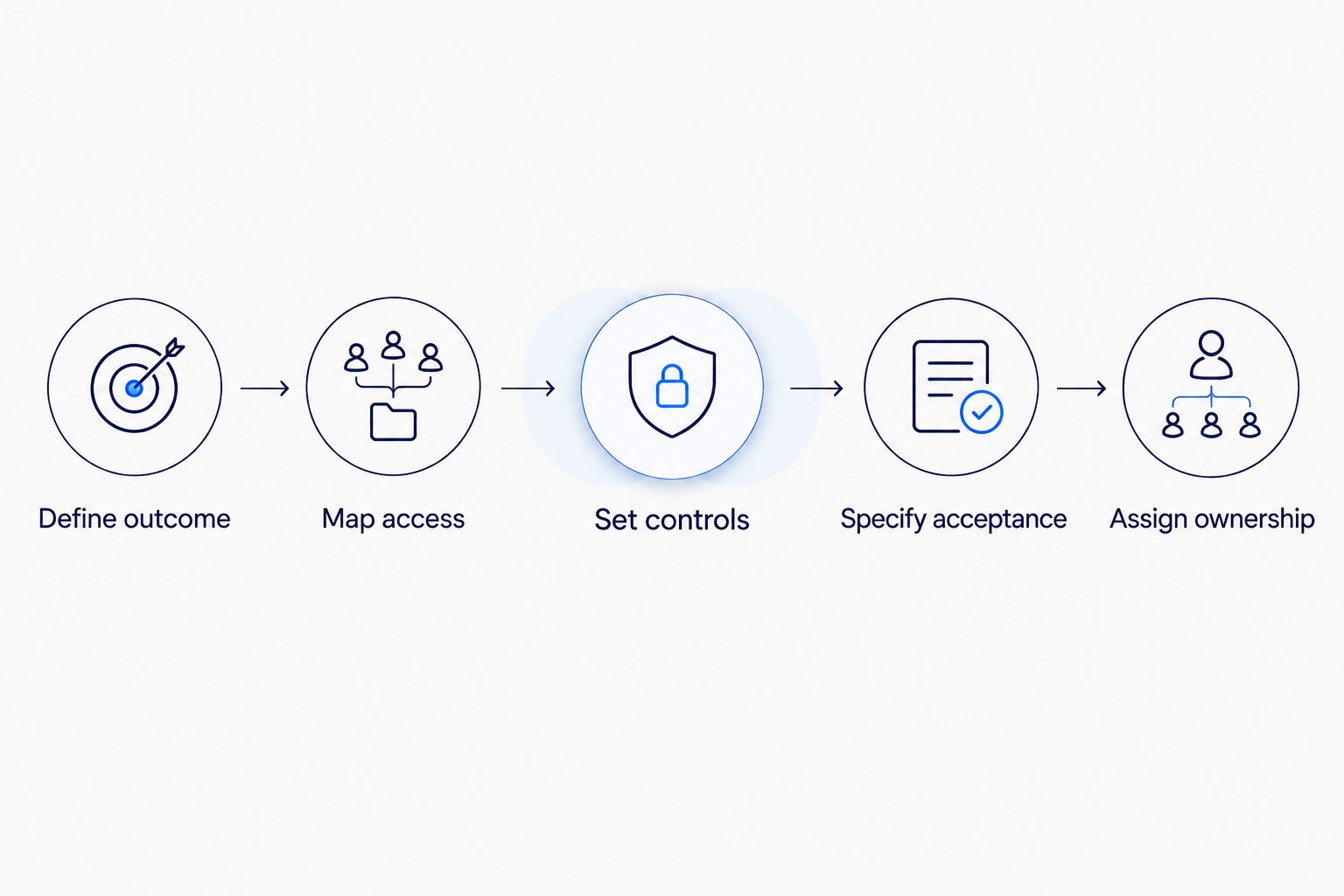
Use this sequence for a 2026 request for proposals. It turns a broad request for an agent into a brief that teams can estimate against the same boundaries.
- Define outcome. Name the business process and the result you want to improve. Identify the current process owner and how that owner will judge the agent's output.
- Map access. List the required data sources, connected systems, and permitted operations. Distinguish read access from actions that change records or trigger downstream work.
- Set controls. Document approval gates, refusal conditions, escalation paths, and recovery requirements. Identify the decisions the agent is not authorized to make.
- Specify acceptance. Provide representative cases and expected behavior. Include failure cases and require evidence that the agreed controls work.
- Assign ownership. Identify who deploys, monitors, reviews, and maintains the system. Request separate implementation and operating assumptions in the proposal.
This sequence makes exclusions easier to see. If a vendor cannot estimate an unresolved requirement, ask it to identify the dependency and the decision needed to settle it rather than conceal the uncertainty inside a broad deliverable.
What belongs in the operating budget?
Your operating budget should reflect how the workflow actually runs. Ask the team to document the expected task volume, model interactions, tool calls, hosting requirements, and human review process without treating those assumptions as guaranteed usage.
Model usage is only part of the picture. Include application hosting, data storage, logging, monitoring, dependency maintenance, and the internal effort required to investigate exceptions.
Evaluate the resources used per completed business task, not just per model request. A task can involve retrieval, model calls, tool execution, validation, and review; an estimate should make that sequence visible.
Ask how the estimate treats retries and abandoned tasks. A failed attempt still consumes resources, and an operating plan needs a stopping condition rather than allowing repeated attempts without a defined limit.
How do you control scope without weakening the result?
Start with a bounded workflow and expand through explicit approval. Record proposed additions as changes to the brief, including their new permissions, test requirements, and operating responsibilities.
Prefer a written exclusion to an ambiguous promise. If a proposed feature involves a new data source or a consequential action, decide whether it belongs in the current release before development proceeds.
Do not buy complexity as a proxy for capability. Ask why the task needs autonomous planning, multiple agents, or custom model training, and require the architecture to answer a documented requirement.
Keep the business acceptance criteria stable while comparing implementation approaches. That lets you assess whether a simpler design meets the same need instead of rewarding a proposal merely for containing more components.
Where Knackforge fits
Knackforge is best aligned with enterprises seeking operational improvement through AI. Its stated focus connects enterprise AI work with innovation and operations, making business requirements the right starting point for a project discussion.
Use the same written scope when evaluating Knackforge as you use for any other development partner. The relevant fit is between your workflow and the proposed deliverables, controls, ownership, and handover—not a general promise about AI.
The benefit is a discussion grounded in an enterprise objective. The boundary is that positioning alone does not establish suitability for a particular integration, security requirement, or deployment; require those commitments in the proposal.
Does a prototype estimate include production deployment?
A prototype estimate includes production deployment only when the statement of work explicitly includes it. Check for environment setup, access controls, evaluation evidence, monitoring, documentation, and operational handover rather than assuming a working demo covers them.
Is a supervised agent simpler to operate?
A supervised agent retains a human approval step, but that step needs its own operating process. Define who reviews outputs, what evidence reviewers receive, and what happens when approval is delayed or refused.
Should you budget maintenance separately in 2026?
Budget maintenance separately in 2026 so that responsibility after launch is visible. Specify how the team handles dependency changes, updated source material, failed integrations, and changes to agent behavior.
FAQ
How do I estimate AI agent development cost in 2026?
Estimate AI agent development cost in 2026 from a written workflow scope, integration inventory, permission model, and acceptance criteria. Request separate implementation and operating estimates against that same brief.
What's included in an AI agent development quote?
The quote should identify discovery, data preparation, integrations, agent implementation, testing, deployment, and handover. Require explicit exclusions and acceptance conditions for each deliverable.
Is a prototype the same as a production AI agent?
A prototype is not the same as a production AI agent. Production acceptance also needs documented access controls, failure handling, monitoring, and operational ownership.
Do I need multiple agents for an enterprise workflow?
An enterprise workflow does not inherently require multiple agents. Require the proposed design to explain which task dependencies or permission boundaries justify separate agents.
What recurring expenses should I include after launch?
Include model usage, hosting, storage, monitoring, maintenance, and human review in the operating budget. Document how retries, failures, and workflow changes affect resource use.
How do I compare AI development partners fairly?
Give each partner the same scope, acceptance criteria, integration requirements, and operating responsibilities. Compare exclusions and retained internal work alongside the proposed deliverables.
Is Knackforge relevant to an enterprise AI project?
Knackforge's stated focus is enterprise AI for innovation and operational improvement. Evaluate a specific project's fit through its proposed scope, technical commitments, acceptance criteria, and ownership model.
One last thing
Before approving your 2026 budget, ask the proposed team to walk through an unavailable dependency, a refused permission, and an incorrect proposed action. Require a clear explanation of what stops, what gets recorded, and who intervenes.
A successful demonstration proves a selected task worked; a failure walkthrough tests whether the operating responsibilities are understood. Put those responses into the acceptance criteria before signing the statement of work.


