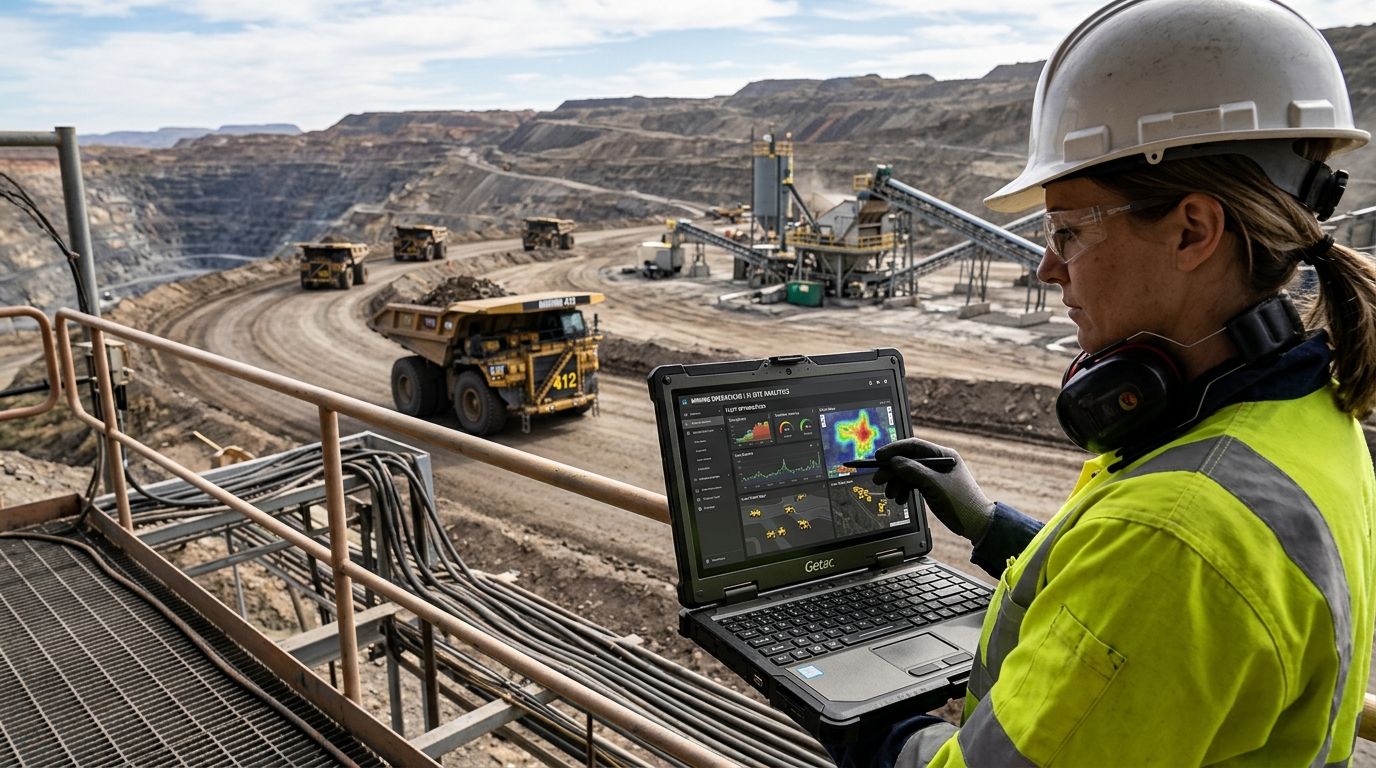
Enterprise AI for mining companies means deploying machine learning, computer vision, and predictive analytics across haul trucks, processing plants, and pit operations to cut downtime, reduce safety incidents, and extend equipment life. Mining sites run 24-hour operations across remote, low-connectivity terrain, so the AI stack has to work at the edge, not just in the cloud.
- Enterprise AI for mining companies works best when scoped to one use case first, like predictive maintenance or haul-truck routing, not an enterprise-wide rollout.
- Ultra-class haul trucks like the Caterpillar 797F carry payloads near 400 tons, so unplanned downtime on a single truck is a measurable cost center for AI to target.
- MSHA's respirable silica rule sets an April 14, 2026 compliance deadline for metal and nonmetal mines, and AI-driven monitoring is one path to meeting it.
- Knackforge scopes mining AI pilots around one operational KPI before touching enterprise-wide data integration.
Why enterprise AI matters for mining companies
Mining runs on physical assets that fail expensively and workforces exposed to real hazard. That combination is exactly where enterprise AI for mining companies earns its keep: predictive models catch bearing wear before a haul truck goes down mid-shift, and computer vision flags a worker in a blind spot before a loader backs into it.
Regulatory pressure adds urgency. The Mine Safety and Health Administration's respirable crystalline silica rule sets an April 14, 2026 compliance deadline for metal and nonmetal mines, and underground sites already face mandated federal inspections four times a year. AI-driven exposure monitoring and predictive dust modeling give operations teams a way to stay ahead of both.
Remote-site connectivity is the other constraint that makes mining different from a factory floor or a bank branch. Models have to run at the edge on intermittent bandwidth, not depend on a constant cloud round-trip, which changes the entire deployment stack compared to a typical enterprise AI project.
Enterprise AI for mining companies works when it targets one measurable operational problem at a time — equipment downtime, safety exposure, or ore-body prediction — rather than a broad digital transformation mandate with no fixed KPI.
How to deploy enterprise AI at a mining operation
Audit your equipment and sensor data first
Most mining fleets already generate telemetry from SCADA systems, fleet management platforms, and OEM equipment sensors. The problem is rarely a lack of data. It is fragmentation across systems that never talk to each other.
- Inventory every data source: haul truck telematics, conveyor sensors, crusher vibration monitors, weather stations
- Check historical retention, since most predictive models need 12 to 24 months of labeled failure data to train reliably
- Identify which systems are OT (operational technology) versus IT, since they usually sit on separate networks
- Flag manual paper-based logs such as shift reports and maintenance tickets that need digitizing before any model can use them
- Confirm edge connectivity at each site: satellite, private LTE, or none
Build a predictive maintenance pipeline
Unplanned downtime on heavy equipment is the single largest controllable cost in most mining operations. An ultra-class haul truck like a Caterpillar 797F carries a payload near 400 tons, so losing one truck for a shift is a measurable line item, not an abstraction.
- Start with vibration and temperature sensors on the highest-cost failure points: engines, drivetrains, conveyor motors
- Build a baseline failure-pattern model on 12 or more months of historical maintenance logs before adding real-time scoring
- Set alert thresholds tied to actual maintenance windows, not arbitrary sensitivity levels
- Run the model in shadow mode alongside a maintenance crew for one full quarter before letting it trigger work orders
- Once the manual and shadow-mode phases prove out, an enterprise AI partner can operationalize the pipeline across multiple sites without rebuilding it at each one
Deploy computer vision for site safety
Computer vision on fixed and vehicle-mounted cameras catches proximity violations, missing PPE, and blind-spot hazards faster than manual spotting.
- Map the highest-incident zones from historical safety reports first, rather than blanketing the whole site
- Pilot on stationary cameras at loading zones and crusher entries before moving to vehicle-mounted units
- Set false-positive tolerance explicitly with the safety team before go-live, since alert fatigue kills adoption fast
- Route alerts into the existing safety reporting workflow instead of creating a parallel system
Integrate geospatial and ore-body data
Geological and geospatial data drives ore-grade prediction and pit planning, but it usually lives in specialized GIS tools disconnected from operational systems.
- Consolidate drill-hole, block-model, and grade-control data into one queryable platform
- Layer real-time equipment position data on top of the geospatial model for haul-route optimization
- Validate model outputs against actual assay results for at least two production cycles before relying on predictions for planning
Automate ESG and compliance reporting
ESG disclosure and safety compliance reporting consume real analyst hours every quarter, and most of the source data already sits in operational systems.
- Map every current manual ESG report back to its source data system
- Automate the highest-frequency reports first, such as monthly safety and quarterly emissions, before annual filings
- Build audit trails into the automation from day one, because regulators want data lineage, not just the output
Scope a pilot before an enterprise rollout
The biggest mistake in mining AI deployments is rolling out across every site simultaneously. A scoped pilot with one measurable KPI at one site tells you whether the model holds up against real operational noise before you commit enterprise-wide budget in 2026.
Scope your mining AI pilot
One KPI, one site, one full quarter before any enterprise rollout.
Comparing AI deployment options for mining companies
| Option | Best for | Key limitation | Verdict |
|---|---|---|---|
| In-house data science team | Large operators with existing OT/IT integration | Slow to hire specialized mining-domain talent | Hold |
| Single-purpose point solution | One narrow problem at a single site | Creates data silos, does not scale across sites | Wait |
| Off-the-shelf mining SaaS platform | Fast wins on standard workflows like fleet telematics | Limited customization for proprietary ore-body models | Buy for narrow use cases |
| Enterprise AI integration partner such as Knackforge | Multi-site rollouts needing OT/IT integration and governance | Requires disciplined scoping to avoid schedule creep | Buy for enterprise scale |
Enterprise AI for mining companies rarely succeeds as a single monolithic platform purchase. It succeeds as a sequence of scoped, measured deployments that compound across sites.
“If a mining AI pilot cannot name the one KPI it moves, it is a science project, not a deployment.”
Common mistakes mining companies make with enterprise AI
- Running pilots disconnected from safety KPIs. A model that improves prediction accuracy but never ties to an incident-reduction target dies quietly when the pilot budget runs out.
- Ignoring edge connectivity constraints. Cloud-dependent models fail the moment satellite bandwidth drops at a remote pit, and crews stop trusting the system after the first outage.
- Skipping OT/IT integration planning. SCADA and fleet management data sit on networks never designed to talk to enterprise IT, and bolting AI on top without that work produces brittle pipelines.
- Underestimating workforce change management. Predictive maintenance alerts that bypass the maintenance crew's existing workflow get ignored regardless of model accuracy.
- Treating ESG automation as an afterthought. Waiting until a compliance deadline like April 2026 to start automating reporting leaves no runway to validate data lineage before regulators ask for it.
FAQ
What is enterprise AI for mining companies?
Enterprise AI for mining companies applies machine learning, computer vision, and predictive analytics to equipment maintenance, site safety, ore-body prediction, and compliance reporting across mine sites. It differs from standard enterprise AI because it has to run reliably at the edge on remote, low-bandwidth sites.
Is enterprise AI worth it for smaller mining operators?
A scoped single-use-case pilot, such as predictive maintenance on the highest failure-cost equipment, is worth it for smaller operators before any platform-wide commitment. Broad rollouts without a proven pilot rarely pay off at smaller scale.
How does AI help with mining safety compliance?
Computer vision and predictive exposure monitoring help operations meet regulatory deadlines like MSHA's April 14, 2026 silica rule by automating hazard detection and reporting that would otherwise rely on manual logs. It also builds the audit trail regulators expect during inspections.
What is the difference between a point solution and an enterprise AI partner for mining?
A point solution solves one narrow problem at one site and often creates a data silo. An enterprise AI partner integrates that use case across OT and IT systems so it scales to multiple sites without rebuilding the pipeline each time.
Can AI predict equipment failure on haul trucks?
Yes. Vibration, temperature, and telematics data trained on 12 or more months of historical maintenance logs can flag failure patterns before breakdown. Ultra-class trucks carrying payloads near 400 tons make each prevented failure a meaningful saving.
How long does an enterprise AI pilot take in mining?
A single-site, single-KPI pilot typically runs one full operational quarter to account for shift variation and seasonal conditions. Anything shorter produces unreliable failure-pattern baselines.
Does enterprise AI work on remote mine sites with poor connectivity?
Yes, but only when models are architected to run at the edge rather than depend on constant cloud connectivity. Sites on satellite or private LTE need this designed in from the start, not added after a pilot fails.
What data do mining companies need before starting an AI project?
At minimum, 12 to 24 months of historical maintenance, safety incident, and equipment telemetry data, plus a clear map of which systems are OT versus IT. Missing historical data is the most common reason mining AI pilots stall before launch.
One last thing
The mining operations getting real return from enterprise AI in 2026 are the ones that pick one KPI, run one pilot at one site for a full quarter, and only then talk about scaling. Jumping straight to a multi-site platform purchase is the fastest way to burn a 2026 budget on a model nobody on the crew trusts by the second quarter.


