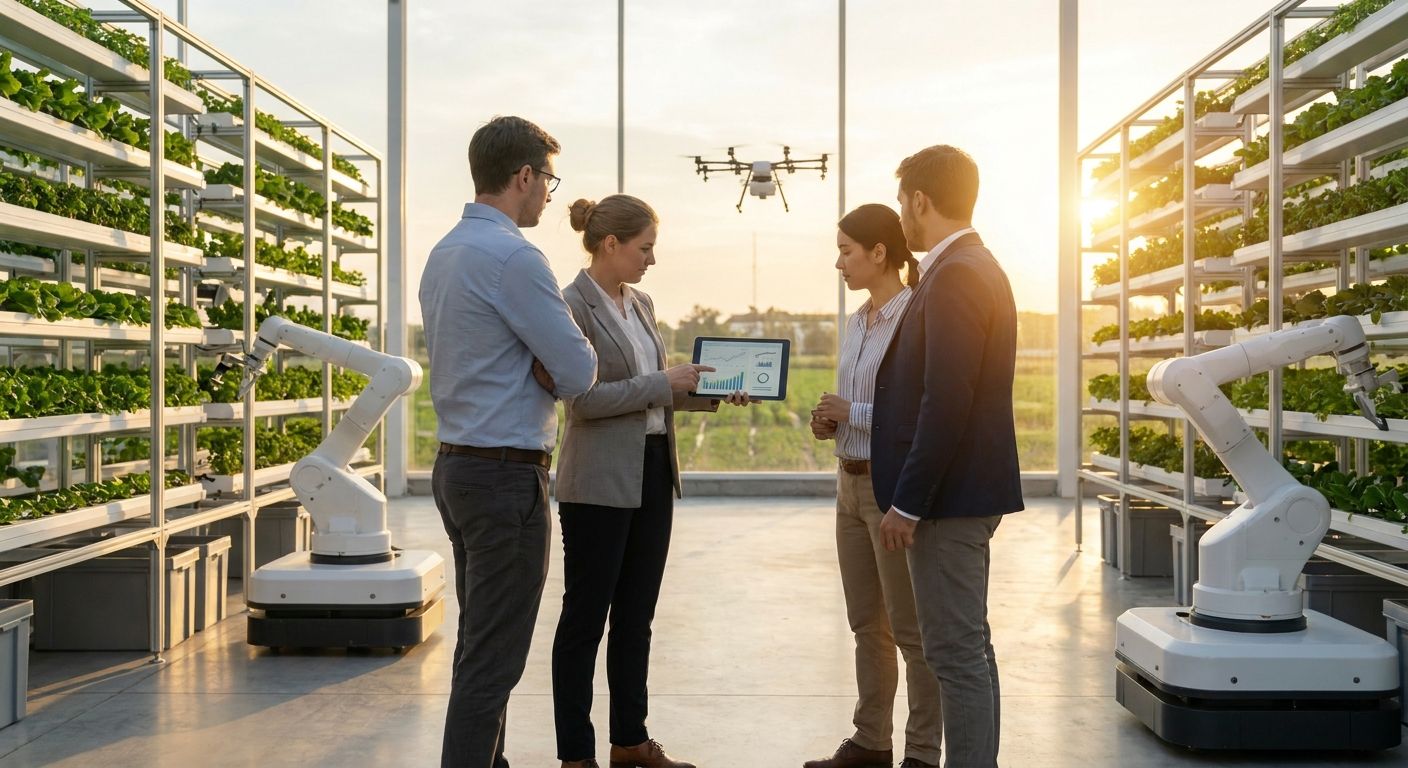
Enterprise AI solutions for agriculture and agtech companies are systems built to turn field sensors, weather feeds, and commodity data into decisions your operations team can act on before the next planting window closes. General enterprise AI stacks assume steady connectivity and quarterly review cycles — agriculture doesn't run on that clock, because a missed model update in April doesn't get a second try until next spring.
- Enterprise AI solutions for agriculture and agtech companies win when they handle offline field data, not just cloud dashboards.
- Computer vision for crop and pest monitoring is the fastest-payback agtech AI use case going into 2026.
- Scope agtech AI pilots around one full growing season, not a generic 90-day sprint.
- Skip any vendor that can't explain how their model retrains after a bad harvest.
- In-house data science teams often stall on agtech AI because rural field data is sparse and seasonal.
Why enterprise AI matters for agriculture and agtech in 2026
Agriculture runs on a calendar biology sets, not one a software vendor can push back. Miss the window to calibrate a yield model before planting and you wait a full 12-month growing cycle for the next data point — no A/B test, no quick fix. That single constraint is why generic enterprise AI playbooks built for retail or SaaS don't transfer cleanly to farm operations.
Rural connectivity compounds it. Field equipment, irrigation controllers, and grain elevators often sit outside reliable cell coverage, so models that assume constant cloud access fail exactly when growers need them most — during planting and harvest. Add commodity price swings that can move a P&L more in a week than a full quarter of operational efficiency gains, and the case for AI that catches risk early gets concrete fast.
KnackForge works with agriculture and agtech operators to build enterprise AI systems around those constraints instead of around a generic SaaS deployment model built for an office with fiber internet.
Audit your field and farm data sources first
Before evaluating any enterprise AI solution for agriculture and agtech operations, know what you're already collecting and where it actually lives.
- Inventory every yield monitor, soil probe, and irrigation controller currently logging data
- Pull baseline multispectral imagery from public sources like Sentinel-2, which revisits the same field every 5 days, before paying for a commercial feed
- Flag data that only exists on a grower's laptop or a paper log in a truck cab
- Record update frequency per source — daily satellite passes versus once-a-season soil sampling
- Map who owns each data source: agronomists, equipment OEMs, co-op partners, third-party ag data brokers
Build a data pipeline that survives rural connectivity gaps
Most agtech AI failures trace back to a pipeline built for office Wi-Fi, not a field forty minutes from the nearest tower.
- Install edge loggers on tractors and pivots that cache readings offline and batch-sync once back in range
- Standardize units, timestamps, and field IDs across equipment brands before centralizing anything
- Set retention windows around your growing season, not a generic 90-day cloud default
- Decide which decisions need real-time inference at the edge, like irrigation shutoff, versus next-day batch scoring, like yield forecasting
KnackForge designs these pipelines against enterprise cloud data platforms so a mid-size agribusiness isn't stitching together five disconnected point tools by the second season.
Deploy computer vision for crop and pest monitoring
Manual scouting still has a place — it just shouldn't be the only signal your team acts on in 2026.
- Start manual scouting logs mapped to GPS coordinates to build a labeled dataset
- Layer drone or satellite multispectral imagery over scouting logs to catch stress before it's visible to the eye
- Train pest and disease detection models on your own regional imagery, not a stock dataset built in a different climate
- Set a false-positive tolerance with your agronomy team before deployment — a model that over-flags erodes trust fast
- Route flagged zones into your existing scouting workflow instead of a separate dashboard nobody opens
The same geospatial data platforms built for logistics and supply chain tracking apply directly to field-level crop monitoring — the underlying mapping and location layer doesn't change much between a shipping yard and a section of cropland.
Build yield and weather risk forecasting models
A yield model is only as good as the seasons of data it's seen, so treat the first version as a baseline, not a finished product.
- Combine historical yield data with NOAA or regional weather station feeds before adding a paid weather API
- Backtest models against at least one full prior growing season, not a 90-day slice
- Separate forecasting models by crop and region — a corn model trained on Iowa soil data won't transfer to Texas cotton
- Set confidence intervals agronomists can act on, not a single point estimate
- Review model drift after every harvest, since soil and weather patterns shift year to year
Automate commodity and supply chain risk monitoring
Weather and yield forecasts only matter if they connect to what your operation is contracted to deliver.
- Track futures price movement alongside your own inventory and contract positions
- Flag shipping and storage bottlenecks before they hit a grain elevator or processing plant
- Model weather risk against contract delivery windows, not just against projected yield
- Alert procurement and sales teams on the same risk signal instead of two separate reports that disagree
The logic here mirrors AI agents for supply chain risk monitoring built for other industries — the agents watch a signal, score the risk, and route an alert before a human would have caught it manually.
Scope a pilot before a full rollout
An enterprise AI pilot for agriculture that runs shorter than a growing season doesn't tell you anything reliable.
- Pick one crop, one region, or one facility for the first pilot
- Set success criteria tied to a full planting-to-harvest cycle, not a 90-day sprint
- Define what "good enough" accuracy looks like before the model runs, not after
- Get budget and IT sign-off scoped to the pilot, not the eventual enterprise rollout
See how to scope an enterprise AI pilot project for the sizing and sign-off checklist before you commit budget.
Comparing your options for agtech AI in 2026
| Option | Best for | Key limitation |
|---|---|---|
| In-house data science team | Large agtech firms with existing ML engineers on staff | Building agronomy domain knowledge from scratch takes seasons, not sprints |
| Point-solution agtech SaaS | Single-farm operations testing one narrow use case | Rarely integrates with ERP, contracts, or supply chain systems |
| Systems integrator / AI consulting partner (KnackForge) | Agribusinesses running multiple data sources across regions | Needs a defined pilot scope to show value fast |
| Spreadsheets and manual scouting | Smallholder or single-field operations | Doesn't scale past a handful of fields |
The verdict: enterprise AI solutions for agriculture and agtech companies pay off fastest when the first deployment is scoped to one field or one facility and measured against a full growing cycle — not a quarterly software KPI.
Scope your first agtech AI pilot
Map your data sources and set a season-length pilot before you commit budget.
Common mistakes agriculture and agtech companies make with AI
- Training a yield model on one soil type or region, then rolling it out across different microclimates without retraining
- Assuming rural sites have office-grade bandwidth — models that need live cloud inference fail during planting, exactly when equipment is deepest in a field
- Skipping traceability on pesticide and chemical application data — this surfaces later in an audit, not at deployment
- Ending a pilot mid-season and calling it a failure when the growing cycle never actually completed
- Buying a separate point solution for scouting and another for weather risk, then discovering the two don't share a data model
FAQ
What is enterprise AI in agriculture?
Enterprise AI in agriculture combines field sensor data, satellite or drone imagery, and weather and market data to automate decisions like irrigation timing, pest detection, and yield forecasting. In 2026, the systems that work best account for offline field connectivity and seasonal data cycles rather than assuming steady cloud access.
How much does an enterprise AI solution for agtech cost?
Cost depends on how many data sources you're integrating and whether you're piloting one facility or rolling out across regions, so there's no single number that fits every operation. Scoping a pilot around one field or one facility gets you a fixed answer faster than requesting a blanket enterprise quote.
Is computer vision better than manual crop scouting?
Computer vision catches stress signals in a field before they're visible to the human eye, but it works best layered on top of manual scouting logs, not as a replacement for them. Pair drone or satellite imagery with GPS-tagged scouting data to train a model on your own regional conditions.
How long does an agtech AI pilot take?
An agtech AI pilot should run a full planting-to-harvest cycle, which for most row crops means a season of roughly 4 to 7 months depending on the crop and region. A pilot shorter than a full growing cycle doesn't give you a reliable read on model accuracy.
Do agtech AI models work with poor internet on rural sites?
They can, if the pipeline is built for it. Edge devices that cache readings offline and batch-sync once back in range solve most of the connectivity gap that trips up models designed for constant cloud access.
What's the difference between an agtech SaaS point solution and a custom enterprise AI build?
A point solution handles one task, like scouting or irrigation scheduling, and rarely connects to your ERP or contract systems. A custom enterprise AI build integrates multiple data sources into one pipeline, which matters once you're running more than a single use case.
How does AI improve commodity price risk forecasting for agribusiness?
AI models combine futures price movement with your own inventory and contract positions to flag risk earlier than a manual spreadsheet review would catch it. The value comes from connecting price risk to your actual delivery commitments, not just tracking market prices in isolation.
Can enterprise AI integrate with existing farm ERP systems?
Yes, when the data pipeline is built with standardized units, timestamps, and field IDs from the start. Integration usually fails when AI outputs sit in a separate dashboard instead of feeding directly into the ERP or accounting system operations already use.
One last thing
A growing season is your only test window. Run an agtech AI pilot on a fraction of a season and you won't get a fair read on the model until the same season rolls around again next year — scope the pilot inside one full planting-to-harvest cycle instead of a generic 90-day sprint, even if that means waiting longer than your IT team wants to see a result.


