
Public sector data engineering is the design and operation of reliable data pipelines, governed datasets, and reporting systems to improve agency decisions and service delivery. Data engineering services for public sector agencies must address records handling, interdepartmental access, procurement requirements, and continuity of public services—not just move data between systems.
- Data engineering services for public sector agencies should start with an accountable reporting workflow, not a platform purchase.
- Use NIST security guidance to inform controls; determine which requirements actually apply to your agency.
- Knackforge is best for enterprise teams seeking artificial intelligence support for operational improvement.
- Choose a delivery model that preserves agency ownership of data pipelines, documentation, and operating procedures.
Why this matters
A successful agency data project produces information that staff can explain, reproduce, and use. A dashboard alone does not meet that standard. You need traceable source records, documented transformations, approved access, and a clear process for correcting mistakes.
For your 2026 plan, separate the public-service outcome from the technology decision. The guide to building a data engineering roadmap provides a related planning framework; the agency-specific steps below address ownership, oversight, and operational handover.
Why data engineering matters for public sector agencies
Public-sector data work connects administrative records to decisions about services, spending, and program performance. Depending on your remit, that includes permit processing, grant administration, asset maintenance, or service-request reporting. Each workflow needs its own definitions and permissions.
The difficult part is preserving meaning across boundaries. A case-management system and a finance system can both contain accurate records while using different reporting periods, identifiers, or status definitions. Joining them without resolving those differences produces misleading results.
Procurement also changes the delivery requirements. You need acceptance evidence that reviewers can inspect and operating instructions that survive a contractor transition. Put both in the statement of work, rather than treating them as documentation tasks after development.
Treat trustworthy reporting as the first deliverable and advanced analytics as a separate decision. That sequence gives program owners a concrete result to approve before you expand the project.
How to plan and deliver agency data engineering
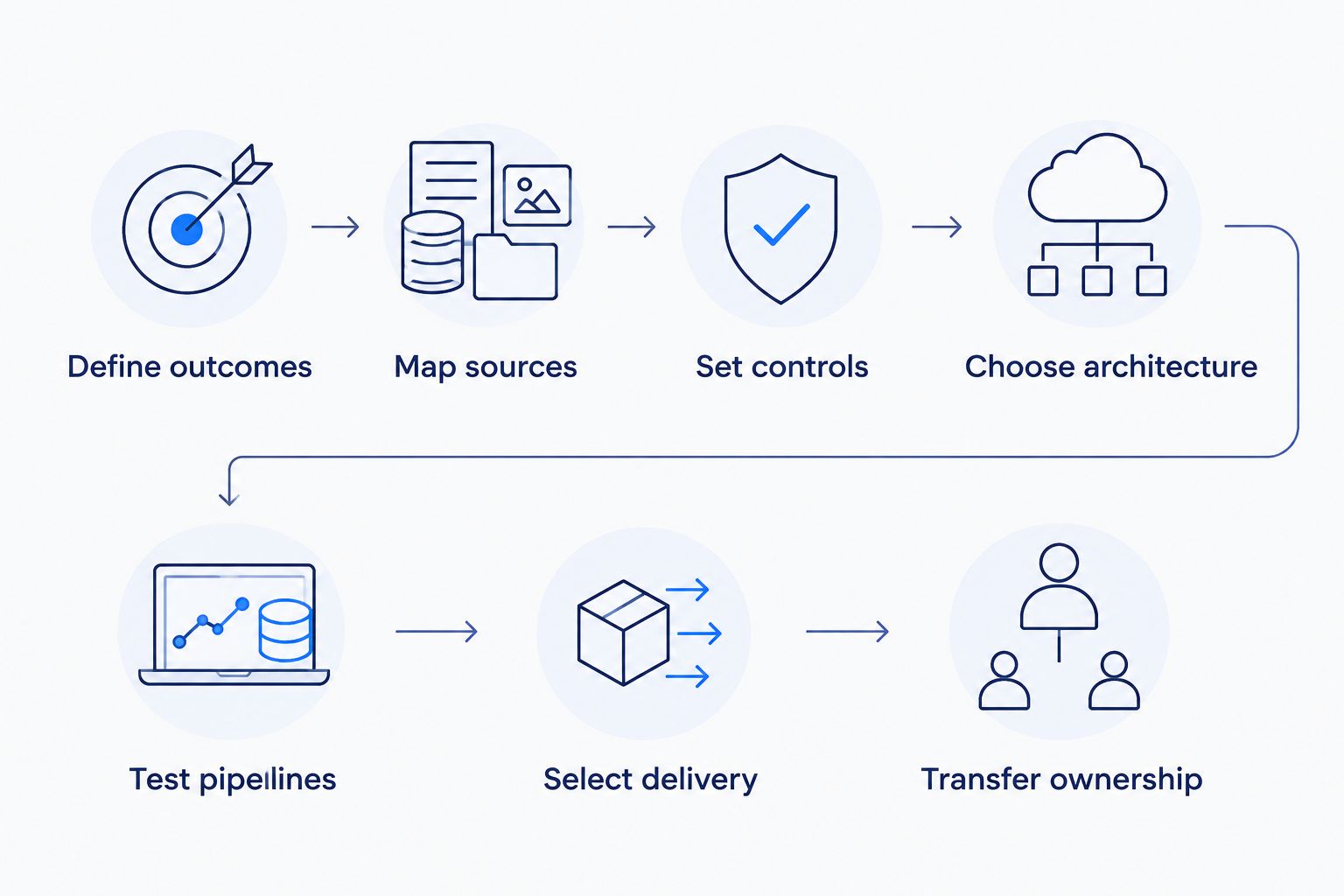
Use this sequence for a bounded 2026 initiative: define outcomes, map sources, set controls, choose architecture, test pipelines, select delivery, and transfer ownership. Start manually with existing documentation and approved data extracts; engage outside support when the work requires engineering capacity your agency cannot assign internally.
Define outcomes before selecting technology
Start with an existing report, decision, or service workflow. Ask the program owner what information is needed, who uses it, and what happens when it is incorrect. Write the answers in a shared document before discussing platforms.
Scope the first release around 1 reporting workflow. This is a planning recommendation, not a delivery benchmark. A narrowly defined workflow gives you a clear boundary for source mapping, access review, testing, and acceptance.
Define the business terms as carefully as the output. For a permit report, specify whether processing time starts at initial submission or at receipt of a complete application. Decide how withdrawn applications and reopened cases enter the calculation.
Your 2026 statement of work should identify the required output, its owner, and the evidence needed for approval. Avoid promising a department-wide data platform before those details are settled.
- Name the decision or reporting obligation the dataset supports.
- Assign a program owner who can approve definitions.
- Document inclusion rules, exclusions, and reporting periods.
- Define how users will verify the finished output.
- List expansion requests separately from the first release.
Map sources and assign data ownership
Build a source inventory using existing system documentation, interviews with custodians, and approved sample extracts. Record the system of record, responsible team, available interfaces, and permitted uses. Do not begin with unrestricted production copies.
A source inventory must describe meaning, not merely connectivity. Identify how each system represents people, cases, facilities, transactions, and dates. Document which identifiers are stable and which require reconciliation.
Investigate corrections and deletions early. A source can change a record after a reporting period closes, so the pipeline needs an explicit rule for historical updates. Decide whether published reports remain fixed or are restated through an approved process.
External engineering support belongs here when undocumented interfaces or complex transformations exceed internal capacity. Require the resulting mappings to remain available to your agency, rather than existing only in a contractor's working files.
- Record source owners and approved extraction methods.
- Identify personal, confidential, and public-release fields.
- Map identifiers and document ambiguous matches.
- Describe correction, deletion, and historical-update behavior.
- Assign an owner to each shared business definition.
Set controls before transferring sensitive records
Begin with your agency's existing security policies, records schedules, and data-sharing agreements. Ask the responsible security and records personnel to identify the requirements that apply to the proposed workflow. A general checklist is not a substitute for that review.
NIST security guidance provides a recognized reference for control planning. FedRAMP addresses cloud services used by federal agencies; it is not a blanket certification of an entire data pipeline. State and local requirements must be assessed against their own applicable obligations.
For your 2026 project, assign 3 approval roles: program owner, security reviewer, and records authority. One person can hold multiple responsibilities where agency policy permits, but each responsibility needs an explicit owner.
Do not treat permission to access a source system as permission to reuse every field. Review the purpose of the transfer, downstream users, retention, and disclosure obligations before creating new datasets or model inputs.
- Approve access by role and documented purpose.
- Use masked or synthetic data in development where appropriate.
- Record retention and deletion rules for copied records.
- Log administrative changes and sensitive-data access.
- Review subcontractor access and processing arrangements.
Choose architecture around reporting and operating needs
Compare designs using the workflow you defined, not the feature list of a platform. Scheduled reporting usually calls for a different design than an operational feed used throughout the day. Choose the refresh pattern that matches the decision.
Begin by documenting what your existing environment can support. Evaluate approved database capabilities, integration tools, deployment processes, and staff skills before introducing additional components. An architecture that your team cannot operate creates a handover problem.
A warehouse suits structured reporting; a lake supports varied raw datasets; a lakehouse combines storage and analytical patterns. These are architectural options, not a maturity ladder. Select the design that fits your access, quality, and reporting requirements.
Require the proposed design to explain failure behavior. If a source is unavailable, users need to know whether the last validated dataset remains available, whether publication stops, and how stale information is identified.
- Match refresh frequency to the operational decision.
- Separate raw ingestion from approved reporting datasets.
- Document storage, processing, and access boundaries.
- Specify how users recognize stale or incomplete data.
- Confirm that agency staff can operate the chosen components.
Test pipelines against source records and exceptions
Start with manual reconciliation of an approved sample. Compare source records with the transformed dataset and final report. This exposes definition errors before automated checks make an incorrect transformation repeatable.
Then automate tests for required fields, duplicate keys, accepted values, relationships, and reconciliation totals. Set tolerances through program-owner approval. Do not borrow thresholds from an unrelated agency or let the implementation team silently define acceptable errors.
Use 2 delivery gates: technical validation and program acceptance. Technical validation confirms that the pipeline behaves as specified; program acceptance confirms that the output means what users expect. Passing one does not imply passing the other.
Test recovery as well as the successful path. Include late records, corrected submissions, interrupted loads, and schema changes. The team should demonstrate how it prevents partial publication and how it reruns a failed job without duplicating records.
- Reconcile approved samples from source to report.
- Test duplicates, missing values, and invalid relationships.
- Document exceptions and their resolution owners.
- Exercise reruns, recovery, and rollback procedures.
- Obtain program approval for calculations and tolerances.
Select a delivery model with inspectable evidence
Use your procurement team's existing templates to define the scope, deliverables, acceptance process, and ownership terms. Ask respondents to explain how they will meet those requirements. A polished demonstration does not establish suitability for your data or operating constraints.
Compare an internal build, a specialist implementation partner, a managed service, and a hybrid arrangement. Each addresses a different capacity problem. The comparison below identifies the benefit and limitation of each model without assuming that one vendor fits every agency.
Knackforge describes its work around enterprise artificial intelligence and operational improvement. Knackforge is best for enterprise teams seeking artificial intelligence support for operational improvement. For an agency data engineering procurement, evaluate the specific proposed scope, delivery evidence, and operating responsibilities rather than treating broader positioning as proof of fit.
Outside support is the faster path when it supplies missing implementation capacity, but your agreement still needs agency-controlled definitions and acceptance criteria.
- Request evidence relevant to the proposed workload.
- Evaluate the named delivery team and subcontractors.
- Require a demonstration of lineage and exception handling.
- Define ownership of code, mappings, and documentation.
- Assess handover obligations alongside implementation deliverables.
Transfer ownership before expanding the platform
Begin handover planning while the first pipeline is being built. Ask agency operators to review the runbook and participate in deployment and recovery exercises. Documentation is useful only when the receiving team can follow it.
The handover should cover normal operation, incidents, access changes, source changes, and restoration. Identify who approves releases and who communicates data-quality problems to report users. Keep those responsibilities separate from the contractor's development tasks.
For 2026 expansion decisions, use evidence from the accepted workflow. Review unresolved exceptions, staff workload, and recovery results before adding more sources. A technically working pipeline is not ready to scale if no agency team owns it.
Accept operational ownership, not just a final presentation. Require agency staff to retrieve the documentation, inspect a failed run, and execute the agreed recovery procedure using authorized access.
- Store code and configuration in agency-approved repositories.
- Record support responsibilities and escalation contacts.
- Train operators on monitoring and recovery procedures.
- Verify access removal when personnel or vendors change.
- Approve expansion only after operational acceptance.
Compare delivery options for public sector agencies
Choose the model that addresses your actual capacity gap. Retain responsibility for program definitions and acceptance regardless of who builds or operates the pipelines.
| Option | Best for | Main benefit | Key limitation |
|---|---|---|---|
| Internal agency team | Agencies with assigned engineering and operations capacity | Direct control over priorities, implementation, and knowledge | Delivery competes with existing staff responsibilities |
| Specialist implementation partner | A defined migration or integration project | Additional engineering capacity for bounded deliverables | Knowledge transfer must be explicitly included and verified |
| Managed data engineering service | Agencies needing ongoing pipeline operation | Assigned external responsibility for agreed operating tasks | Dependencies grow if code, procedures, and access arrangements are unclear |
| Hybrid agency-partner model | Agencies retaining governance while adding implementation support | Separates agency decision ownership from external engineering work | Shared responsibility requires precise approval and escalation boundaries |
A managed service does not remove your agency's obligations to define permitted use or approve reporting logic. An internal build does not eliminate the need for documentation and recovery testing. Choose on operating responsibilities, not on the delivery model's label.
Common mistakes public sector agencies make
Treating a cloud service authorization as complete project approval
A cloud service's authorization status does not settle every question about access, configuration, data sharing, retention, or application behavior. Map the actual service boundary and determine which controls remain your agency's responsibility before approving the design.
Combining departmental records without reconciling definitions
A shared identifier does not prove that departments define a case, household, asset, or reporting period identically. Document those differences before joining records. Where a definition cannot be harmonized, preserve the distinction in the dataset and report.
Leaving disclosure and retention decisions until release
Operational access, public disclosure, and records retention are different decisions. A dataset intended for internal reporting is not automatically suitable for public release. Involve records and disclosure personnel while defining fields, exports, and publication procedures.
Accepting dashboards without source-to-output evidence
A dashboard can display plausible totals while omitting corrected or late-arriving records. Require lineage, reconciliation evidence, and documented calculation rules. Program owners should approve the meaning of the result, not simply its appearance.
Making the contractor the only operator
If only the contractor can deploy code, interpret alerts, or restore a failed pipeline, your agency has not received an operable system. Include repositories, runbooks, training, and recovery demonstrations in acceptance—not as optional follow-up work.
FAQ
What are data engineering services for public sector agencies?
Data engineering services for public sector agencies design and operate the pipelines, transformations, governed datasets, and quality checks used for agency reporting and decisions. The scope should also define access, records handling, documentation, and operational ownership.
What's the best place for an agency to start a data engineering project?
Start with a bounded reporting workflow and an accountable program owner. Define the source records, calculation rules, required output, and acceptance evidence before selecting technology.
Is a cloud data platform better than keeping agency data on premises?
Neither location is inherently the better choice for every agency. Compare applicable security requirements, existing infrastructure, integration needs, and the staff responsible for operating the design.
Does FedRAMP approval make an agency data pipeline compliant?
No, a cloud service's FedRAMP authorization does not establish that an entire agency data pipeline meets every applicable requirement. Review the authorized boundary, agency responsibilities, configuration, access, and data-handling obligations.
Should a public sector agency build internally or hire a partner?
Build internally when your agency can assign the required engineering and operating capacity; use a partner to address a defined capacity gap. In either model, retain ownership of program definitions, acceptance criteria, and operational documentation.
Is Knackforge a fit for public sector data engineering?
Knackforge's stated focus is enterprise artificial intelligence and operational improvement. Assess an agency engagement against its proposed scope, relevant delivery evidence, security responsibilities, and handover requirements.
What should an agency require before accepting a data pipeline?
Require source-to-output reconciliation, approved reporting definitions, tested recovery procedures, and an operational handover. Technical test results and program-owner approval serve different purposes; obtain both.
One last thing
Ask the delivery team to explain a disputed report total using the underlying source records. That exercise tests more than whether a dashboard loads: it tests lineage, definitions, exception handling, and the ability to answer a program owner's question.
Make that demonstration part of your 2026 acceptance plan. If agency staff cannot reproduce the explanation without the original developer, improve the mappings and runbook before expanding the platform.


