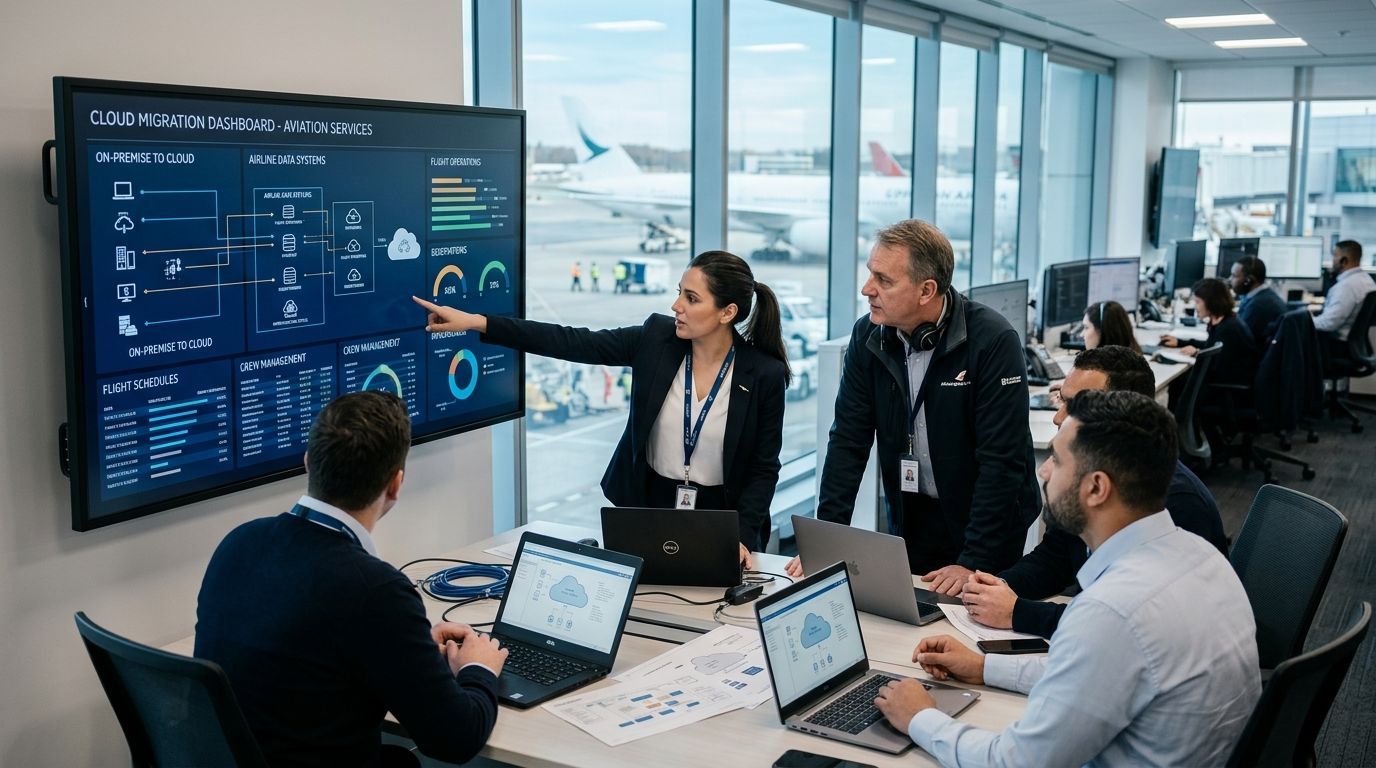
Airline cloud migration moves reservation systems, revenue management engines, and passenger data off legacy mainframes and onto AWS, Azure, or Google Cloud without grounding flights or losing bookings. Airlines carry constraints most enterprises don't: 24/7 uptime requirements, IATA NDC distribution mandates, PCI DSS scope on every fare transaction, and PSS (Passenger Service System) cores that were never built for horizontal scaling.
- Cloud migration for airline companies in 2026 hinges on how you handle the PSS core, not the peripheral systems.
- Lift-and-shift gets a carrier live fastest but inherits every legacy database bottleneck the mainframe already had.
- Full re-architecture around IATA NDC APIs takes 12-24 months and only pays off if new distribution is a strategic priority.
- IROPS failover testing, not server sizing, is where most airline migrations get caught out during peak season.
Why cloud migration matters for airline companies
Most carriers are still running check-in, seat inventory, and revenue management on systems architected in the 1990s, with peak loads that spike hard around schedule changes, weather events, and holiday booking windows. A cloud migration provider for regulated industries understands that airline workloads sit under FAA, EASA, TSA, and PCI DSS oversight simultaneously — a generic enterprise migration playbook skips half of that compliance surface.
The pressure isn't hypothetical. Booking traffic during an irregular operations (IROPS) event — a grounded fleet, a major weather delay — can spike well past normal load in minutes, and a PSS that can't autoscale becomes a customer service crisis, not just an IT one. Cloud migration for airline companies in 2026 is as much about elastic capacity during disruption as it is about cutting data center costs.
Update your systems inventory before you touch a workload
You can't migrate what you haven't mapped. Airlines typically run more interdependent systems than the org chart suggests — PSS, loyalty, crew scheduling, and ancillary revenue tools all talk to each other constantly.
- List every system touching passenger name records (PNR data)
- Flag systems with direct IATA NDC or EDIFACT message dependencies
- Identify which databases still run on mainframe or AS/400 hardware
- Note integration points with GDS partners (Sabre, Amadeus, Travelport)
- Rank systems by revenue impact if they go down for an hour
Map data residency and compliance requirements
Passenger data crosses borders the moment a booking is made, and different jurisdictions treat that data differently. Get this wrong and the migration stalls in legal review, not engineering.
- Confirm PCI DSS scope on every payment-adjacent system
- Document GDPR requirements for EU passenger data at rest and in transit
- Check TSA Secure Flight data handling rules for US-bound itineraries
- Identify any national data residency mandates for crew records
- Build a data classification map before selecting cloud regions
Choose a migration pattern for your PSS core
This is the decision that determines your timeline, budget, and risk exposure more than any other. Three patterns dominate airline migrations, and none of them is universally correct.
- Rehost (lift-and-shift): move the PSS as-is onto cloud infrastructure, fastest path out of the data center
- Replatform: keep core logic, swap the database and middleware for managed cloud services
- Re-architect: rebuild around microservices and NDC-native APIs, highest effort, highest long-term flexibility
- Run a proof-of-concept on one non-critical system (crew scheduling, not PSS) before committing to a pattern
A migration partner earns its fee here: benchmarking rehost against re-architecture against your actual booking volume and IT headcount is where a specialist like KnackForge adds more value than a generic systems integrator, because the tradeoffs are airline-specific.
Build a phased cutover plan around your schedule
Airlines don't get maintenance windows the way retail does — there's no slow season across a global route network. Cutover has to be sequenced around your own schedule data.
- Schedule cutover phases outside peak booking windows
- Run parallel systems (old and new) for at least one full booking cycle
- Set a rollback trigger threshold before cutover, not during it
- Migrate low-risk systems (crew comms, internal reporting) before PSS
- Keep a live bridge between legacy and cloud PNR data during the transition
Secure and encrypt passenger data end to end
Payment card data, passport numbers, and frequent flyer identifiers all move through the same pipes during migration, and that's the exact window attackers target.
- Encrypt data in transit with TLS 1.2 or higher across every migrated endpoint
- Encrypt data at rest using cloud-native key management, not application-layer keys alone
- Segment PCI-scoped systems from general booking infrastructure
- Run a third-party penetration test before go-live, not after
- Review IAM roles so migration engineers don't retain standing access post-cutover
A cloud security consulting review at this stage catches misconfigured storage buckets and over-permissioned service accounts before they become a breach disclosure.
Test disaster recovery for irregular operations
DR testing for an airline isn't a generic backup drill — it has to simulate the exact chaos of a grounded fleet or a system outage during a booking surge.
- Simulate a full PSS failover during simulated peak booking load
- Test failover across at least two geographic regions, not one
- Time the actual recovery point objective (RPO) and recovery time objective (RTO) against your SLA
- Validate that loyalty and ancillary systems recover in the correct dependency order
- Document the failover runbook for the ops team, not just engineering
Optimize cloud spend after go-live
Migration cost overruns usually show up 60-90 days after cutover, once idle capacity and un-rightsized instances pile up on the bill.
- Tag every resource by system and business unit for cost attribution
- Set autoscaling floors and ceilings tied to actual booking traffic patterns
- Review reserved instance or savings plan commitments quarterly
- Kill parallel legacy environments once cutover is confirmed stable
- Build a monthly cost review cadence with finance and IT together
A cloud FinOps practice built alongside the migration, not bolted on a year later, is what keeps the post-cutover bill inside the original business case.
Train ops and IT teams on the new environment
A technically successful migration still fails if the people running it day to day don't trust the new environment.
- Run tabletop exercises simulating a live IROPS event on the new infrastructure
- Train the network operations center on new monitoring dashboards before cutover
- Document new escalation paths for cloud vendor support tickets
- Cross-train at least two engineers per critical system to avoid single points of failure
Comparison: migration patterns for airline PSS systems
| Option | Best for | Key limitation | Verdict |
|---|---|---|---|
| Rehost (lift-and-shift) | Carriers with a hard exit deadline from a data center or mainframe contract | Inherits legacy database bottlenecks, doesn't reduce technical debt | Buy for speed, plan a follow-on modernization phase |
| Replatform | Airlines modernizing loyalty, check-in, or ancillary revenue systems | Still coupled to vendor-specific PSS APIs underneath | Buy for most mid-size carriers |
| Full re-architecture | Carriers building an NDC-native distribution stack from scratch | 12-24 month timeline, highest upfront engineering cost | Hold unless NDC distribution is a 2026 strategic priority |
| Hybrid cloud | Airlines with strict data residency limits on crew or passport records | Doubles operational overhead across two environments | Wait, evaluate case by case with legal and compliance |
Cloud migration for airline companies wins when the PSS decision is made deliberately, not by default — plenty of carriers pick rehost because it's fastest, then pay for it in a second, unplanned modernization project 18 months later.
“A lift-and-shift migration that ignores IATA NDC dependencies just moves the outage to a different data center.”
Common mistakes airlines make during cloud migration
- Scheduling cutover during peak booking season — a Q4 migration collides with holiday traffic spikes that stress-test the new environment at the worst possible time
- Treating loyalty program data like generic CRM data — frequent flyer tiers, mileage expiration rules, and partner airline redemptions need migration logic a standard CRM playbook doesn't cover
- Skipping IROPS-specific DR testing — a DR plan validated only under normal load fails exactly when it's needed most, during a weather event or fleet grounding
- Underestimating GDS integration complexity — Sabre, Amadeus, and Travelport connections often get deprioritized until late in the project, then become the blocker at cutover
- Not budgeting for a dedicated NDC certification sandbox — IATA NDC API testing needs its own environment separate from staging, and skipping it delays go-live
Plan your airline cloud migration
Get a review of your PSS migration pattern before you commit a budget.
FAQ
What is the best cloud migration approach for airline companies in 2026?
There is no single best approach — replatforming works for most mid-size carriers modernizing loyalty and check-in systems, while full re-architecture only pays off for airlines building an IATA NDC-native distribution stack. Rehost is the right call when a data center exit deadline forces speed over optimization.
How long does an airline PSS cloud migration take?
A rehost migration can complete in 4-8 months; a full re-architecture around NDC-native microservices typically runs 12-24 months. Timeline depends heavily on how many GDS and loyalty integrations the PSS carries.
Is cloud migration risky for airline reservation systems?
Yes, if cutover happens during peak booking season or DR is not tested under IROPS-level load. Running parallel legacy and cloud systems through at least one full booking cycle reduces that risk significantly.
Does cloud migration help with PCI DSS compliance for airlines?
It can, if PCI-scoped payment systems are segmented from general booking infrastructure during the move. Migration without that segmentation often expands PCI scope instead of shrinking it.
What is the difference between rehost and replatform for airline systems?
Rehost moves the PSS as-is onto cloud infrastructure with minimal code changes, while replatform keeps the core logic but swaps the database and middleware for managed cloud services. Replatform costs more upfront and reduces long-term technical debt.
How much does cloud migration cost for an airline?
Cost varies by PSS complexity, number of GDS integrations, and migration pattern chosen, so scope it with a migration partner rather than relying on a generic industry estimate.
Can small regional airlines migrate to the cloud the same way large carriers do?
The same principles apply — inventory systems, map compliance requirements, phase cutover around schedule data — but regional carriers typically fit rehost or replatform patterns rather than full re-architecture given smaller IT teams.
What happens if an airline skips disaster recovery testing before cloud cutover?
The DR plan looks fine on paper until an actual IROPS event hits, at which point untested failover logic can take longer to recover than the legacy system it replaced. Testing failover under simulated peak load before go-live catches this early.
One last thing
Budget a dedicated IATA NDC certification sandbox separate from your general staging environment. Certification testing competes with every other pre-launch task for the same environment, and that contention is a common source of late-stage go-live slippage in 2026 migration programs.


