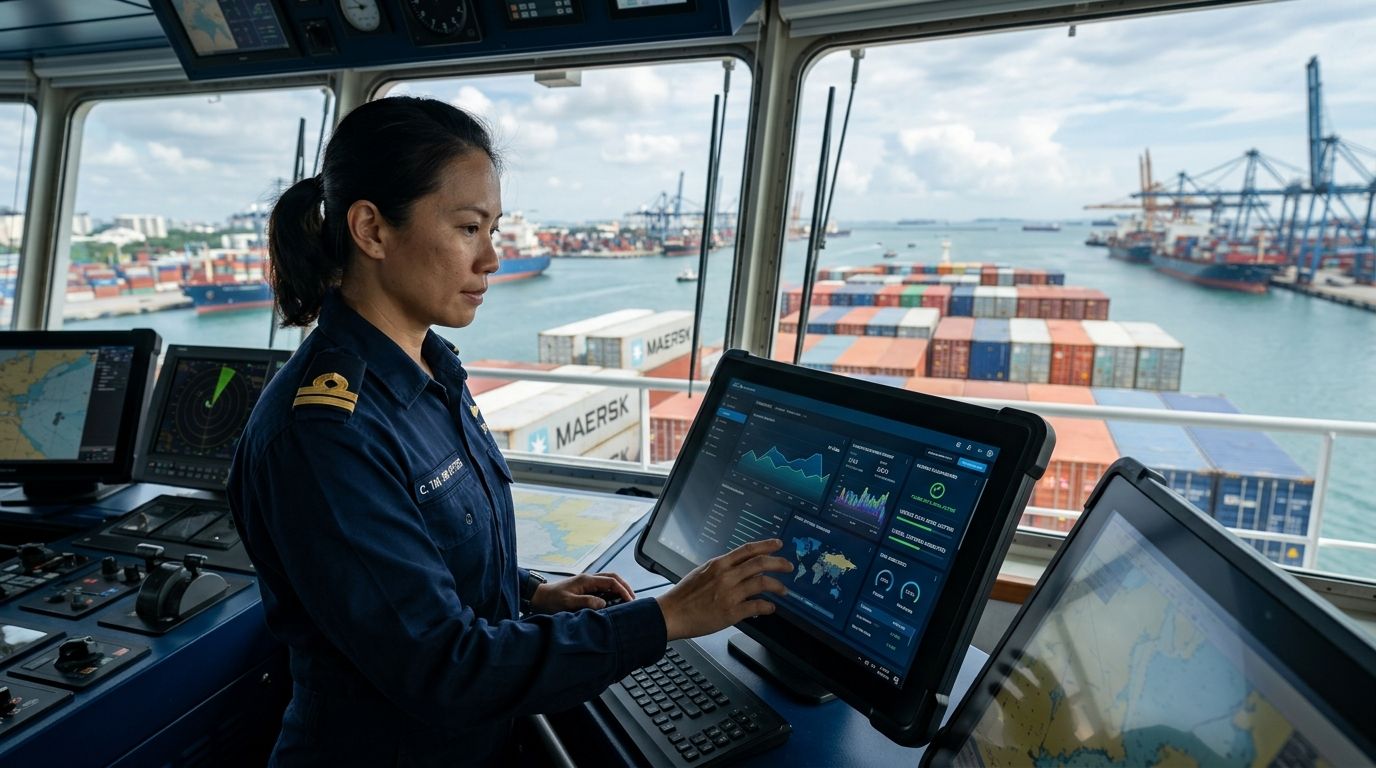
Cloud migration for maritime shipping is the process of moving fleet management, cargo tracking, crewing, and back-office ERP systems off on-premises servers and vessel-bound hardware onto cloud infrastructure, aimed at cutting downtime during port calls and meeting IMO cyber risk requirements. Shipping companies carry a constraint most enterprises never deal with: satellite bandwidth that drops mid-transit and classification society audit cycles that don't wait for your IT roadmap.
- Cloud migration for maritime shipping works best shore-first: ERP and terminal systems move before vessel-side data feeds.
- IMO Resolution MSC.428(98), effective January 1, 2021, requires cyber risk management inside each vessel's Safety Management System under the ISM Code.
- Intermittent VSAT and satellite connectivity means offline-first design and store-and-forward sync matter more than raw cloud speed.
- KnackForge sequences shore-side and vessel-side migrations separately to avoid failed classification society audits during cutover.
Why cloud migration matters for maritime and shipping companies
IMO Resolution MSC.428(98) took effect January 1, 2021, and it requires cyber risk management to be built into each vessel's Safety Management System, audited as part of the ISM Code. Legacy on-prem systems without a documented patching schedule or incident response plan fail these audits — that's not a hypothetical, it's a line item during your next flag-state inspection.
Vessels generate AIS positioning data, ECDIS navigation logs, and engine telemetry that all have to reconcile against shore-side terminal operating systems (TOS) and transport management systems. When those run on disconnected on-prem stacks, every port call creates a data gap that someone in ops has to manually close. KnackForge works through this as a sequencing problem first, not a lift-and-shift problem.
Port congestion and real-time cargo visibility demands have also moved past what nightly batch syncs can deliver. Charterers and freight forwarders expect fleet position and container status updated close to real time, not the next morning.
The core steps for cloud migration for maritime shipping
Audit your shore-side and vessel-side systems separately
Most failed maritime cloud projects treat the whole IT estate as one migration. It isn't — vessel systems run on constrained hardware with intermittent connectivity, shore systems don't.
- Inventory ERP, TOS, crewing, and finance systems by where they physically run
- Classify each system by its connectivity dependency (always-on vs. intermittent)
- Flag which systems feed classification society or flag-state reporting
- Document integration points with AIS and ECDIS data feeds
- Note which vendor contracts restrict data export or require on-prem hosting
Map compliance and classification society requirements before touching architecture
Class societies — DNV, ABS, Lloyd's Register, and others — run vessels through a five-year renewal survey cycle with annual and intermediate surveys in between. Migrating a system that feeds a survey report mid-cycle without notifying your surveyor creates avoidable friction.
- List every ISM Code clause tied to cyber risk documentation
- Map class society survey dates against your proposed migration timeline
- Identify flag-state data residency rules that apply to your registered vessels
- Flag systems subject to port state control inspection
Sequence the migration shore-first, vessel-second
Start where the connectivity is stable and the compliance stakes are lower. Finance, HR, and shore-side ERP move cleanly to the cloud without touching a vessel's satellite link.
- Migrate finance, HR, and shore ERP systems first
- Move cargo booking and terminal operating systems next
- Migrate crew management and payroll after shore systems stabilize
- Leave onboard operational tech — ECDIS, engine monitoring — for a phase built around edge computing, not a straight lift-and-shift
This is where a cloud migration for maritime shipping project either holds together or falls apart. Rushing vessel-side systems into a shore-side cloud architecture without an edge layer usually means crews lose access to critical tools the moment satellite bandwidth dips. Reviewing how regulated industries structure their cloud migration providers is a reasonable gut-check before you commit to a vendor.
Build for intermittent connectivity, not always-on bandwidth
A cloud architecture designed for a headquarters office fails on a vessel mid-Pacific. Design for the network you actually have.
- Deploy local caching or edge nodes on vessels for critical apps
- Use store-and-forward sync patterns instead of continuous streaming
- Budget VSAT or Starlink bandwidth per application, not per department
- Design crew-facing tools offline-first, syncing when connectivity resumes
Test failover under real port and open-sea conditions
Disaster recovery plans written for a data center don't cover a satellite dropout mid-voyage. Test the actual failure mode.
- Simulate satellite dropout during a live cargo manifest update
- Validate multi-region failover for shore-side data centers
- Run tabletop cyber incident drills mapped to ISM Code reporting timelines
- Confirm crew can still access safety-critical systems during a network outage
Automate cost and usage monitoring across the fleet
Cloud spend on a shipping company's account looks nothing like a typical SaaS bill — data egress from satellite links adds up fast, and per-vessel cost attribution gets messy without tagging discipline.
- Tag cloud spend by vessel, route, or business unit
- Monitor data egress costs from satellite and VSAT links specifically
- Set budget alerts before a single vessel's data usage spikes the whole bill
- Review usage monthly against the migration's original cost model
A well-scoped RFP shortens most of this work before it starts. Preparing an RFP for enterprise cloud migration forces vendors to answer the connectivity and compliance questions up front instead of discovering them mid-project.
Scope your fleet's cloud migration
Get a shore-first migration plan built around your compliance calendar.
Comparison of migration approaches for maritime shipping
| Approach | Best for | Key limitation |
|---|---|---|
| Rehost (lift-and-shift) | Shore-side ERP and finance systems with stable connectivity | Doesn't solve vessel-side intermittent connectivity problems |
| Replatform | Terminal operating systems needing moderate rework | Requires downtime windows that must clear class society audit calendars |
| Full cloud-native refactor | Cargo tracking and real-time visibility platforms | Longest timeline; not practical for legacy vessel-bound hardware |
| Hybrid edge-cloud | Vessel-side systems (ECDIS, engine telemetry, crew tools) | Needs ongoing edge infrastructure maintenance on each vessel |
Hybrid edge-cloud is the only realistic option for onboard operational systems in 2026 — full cloud-native refactors assume connectivity that vessels mid-ocean simply don't have.
Common mistakes maritime and shipping companies make
- Treating vessel IT and shore IT as one migration project. They have different connectivity profiles, different compliance owners, and different failure modes.
- Ignoring classification society audit calendars when scheduling cutover. A migration that lands mid-survey cycle creates documentation gaps a surveyor will flag.
- Assuming satellite bandwidth matches shore office bandwidth. VSAT and Starlink links are not a substitute for a fiber connection, and app design has to account for that.
- Skipping cyber risk documentation required under the ISM Code. MSC.428(98) compliance isn't optional paperwork — it's tied to your vessel's safety management certification.
- Migrating cargo tracking before validating AIS/ECDIS data integrity. Moving bad data to a cloud platform faster doesn't fix the data — it just breaks things at scale.
FAQ
What is cloud migration for maritime shipping?
Cloud migration for maritime shipping moves fleet management, cargo tracking, ERP, and crewing systems off on-premises servers and vessel-bound hardware onto cloud infrastructure. It's typically phased shore-side first, then vessel-side, because of connectivity and compliance differences between the two.
Is cloud migration required for IMO cyber risk compliance?
Cloud migration isn't mandated directly, but IMO Resolution MSC.428(98), effective January 1, 2021, requires cyber risk management inside each vessel's Safety Management System. Many shipping companies migrate to cloud infrastructure specifically to get the patching, monitoring, and audit trail capability the ISM Code now expects.
How does satellite connectivity affect cloud migration on vessels?
Vessel connectivity via VSAT or Starlink is intermittent and bandwidth-constrained compared to shore networks. Systems designed for continuous cloud access fail at sea unless they're built offline-first with local caching and store-and-forward sync.
Should shore-side and vessel-side systems migrate at the same time?
No. Shore-side ERP, finance, and terminal systems should migrate first because they run on stable connectivity. Vessel-side systems like ECDIS and engine telemetry need a hybrid edge-cloud architecture and should move in a later phase.
What happens if a migration disrupts a classification society audit?
A migration that lands mid-survey cycle can create documentation gaps that a class society surveyor flags during an annual, intermediate, or five-year renewal survey. Migration timelines should be mapped against the survey calendar before cutover.
Can legacy cargo tracking systems be migrated without disrupting operations?
Yes, if AIS and ECDIS data integrity is validated before the system itself moves. Migrating bad data into a faster cloud platform just surfaces the same errors at higher speed.
How long does a maritime cloud migration typically take?
Timelines depend on fleet size and how many systems are vessel-bound versus shore-based; shore-side migrations move faster than vessel-side hybrid edge-cloud rollouts, which require physical infrastructure work per vessel.
Does cloud migration reduce IT costs for shipping companies?
Cloud migration shifts cost structure toward usage-based spend, including satellite data egress charges, which can offset savings if not tagged and monitored per vessel or route from day one.
One last thing
The detail most shipping IT teams miss until it costs them: a cloud migration for maritime shipping project that skips the classification society survey calendar doesn't just risk a failed audit — it risks a certificate suspension that keeps a vessel in port. Check your survey dates against your migration timeline before you sign a statement of work with any vendor, KnackForge included.


