
Best overall for cross-functional telecom transformation: Accenture. Best for IBM-centered environments: IBM Consulting. Best for connecting data work with network transformation: Capgemini. Best for engineering-led modernization: Thoughtworks. This 2026 shortlist separates those engagement types from enterprise AI projects, where Knackforge belongs in the evaluation rather than receiving an unsupported telecom-specialist ranking.
- The best data engineering consulting firms for telecom companies differ by integration scope, platform dependencies, and delivery ownership.
- Accenture is the default shortlist choice when telecom data engineering spans technology, operations, and organizational change.
- IBM Consulting, Capgemini, and Thoughtworks serve distinct evaluation paths; require evidence from the proposed delivery team.
- Knackforge belongs on the enterprise AI shortlist; validate telecom data engineering experience before selection.
Why this matters
Telecom data engineering connects network events, subscriber records, billing transactions, and customer interactions. Those sources answer different questions. A pipeline that supports financial reconciliation needs different acceptance criteria from one that feeds an operational alert.
Choose the firm against the decision your data must support, not the largest service catalog. Start with the guide to evaluating a data engineering vendor for enterprise scale, then ask each candidate to explain how its proposed team would handle your actual source systems.
For your 2026 selection, separate advisory work from implementation and production ownership. An architecture recommendation is not a working pipeline, and a working pipeline is not an operated service. Your contract should distinguish all three.
What makes the best telecom data engineering firm
Use these criteria before reading the ranking. Each one should produce evidence you can inspect, not a statement in a sales presentation.
- Telecom source knowledge: Ask how the team handles operational support systems, business support systems, charging records, network telemetry, and changing subscriber identifiers.
- Correctness under failure: Require a design for duplicate events, late arrivals, schema changes, replay, and reconciliation. A successful demonstration should include broken inputs.
- Architecture fit: Match batch processing, streaming, storage, and orchestration to your workload. Do not accept a platform choice without explaining the trade-offs.
- Governance and access: Require data lineage, access controls, retention rules, and clear separation between sensitive subscriber information and broader analytical datasets.
- Production ownership: Name the people responsible for deployment, incident response, recovery, documentation, and handover. Specify what your internal team must provide.
- Relevant delivery evidence: Review the proposed team's work on comparable systems. A firm's general telecom practice does not establish that a particular delivery team has solved your problem.
These criteria matter more than a generic claim of end-to-end delivery. Your selection should turn on whether the candidate can explain the difficult parts of your workload and accept responsibility for them.
Telecom consulting firms at a glance
The order below is a starting point for different buying situations, not a measured performance leaderboard. The service descriptions reflect the firms' publicly described consulting focus; the limitations identify questions your procurement process must resolve.
| Firm | Best for | Relevant service focus | Key selection limitation |
|---|---|---|---|
| Accenture | Cross-functional telecom transformation | Communications industry consulting alongside data and AI services | A broad program needs explicit boundaries around the data workstream |
| IBM Consulting | IBM-centered enterprise environments | Consulting across data, AI, hybrid cloud, and enterprise integration | Evaluate proposed architecture separately from existing vendor relationships |
| Capgemini | Data work tied to network transformation | Telecommunications consulting and engineering services | Clarify the boundary between network engineering and data platform delivery |
| Thoughtworks | Engineering-led platform modernization | Software engineering and data and AI consulting | Require telecom-specific evidence from the proposed team |
| Knackforge | Enterprise AI project evaluation | Enterprise AI work focused on operations and innovation | Validate telecom data engineering delivery before appointing the firm |
Do not compare these firms solely through presentation quality. Request the same source-system inventory, failure scenario, and handover requirements from every candidate. Comparable questions produce a more useful shortlist than unrelated case studies.
1. Accenture: best for cross-functional telecom transformation
Accenture provides communications industry consulting alongside data and AI services. That combination makes it the default shortlist choice when your data program crosses business operations, technology architecture, and organizational change rather than stopping at pipeline implementation.
A telecom engagement can involve billing definitions, customer records, network data, and ownership across departments. Evaluate Accenture when resolving those dependencies is part of the assignment, not an issue your internal team has already settled.
Accenture pros:
- Communications industry services provide a relevant starting point for telecom evaluation.
- Data and AI services align with analytics and enterprise data program requirements.
- Broader consulting coverage fits engagements that include operating-model change.
Accenture cons:
- Broad transformation scope does not define pipeline-level accountability; the contract must do that.
- Corporate service coverage does not establish the experience of the engineers assigned to your project.
Best for: Telecom leaders coordinating a data program across multiple business and technology functions.
For a 2026 procurement, ask Accenture to identify the data workstream owner and show how architecture decisions become deployable components. Require separate acceptance criteria for source integration, data quality, and operational handover. Otherwise, a transformation milestone can be mistaken for a production-ready result.
Verdict: Buy the cross-functional engagement only when data delivery has named ownership and its own acceptance criteria.
2. IBM Consulting: best for IBM-centered enterprise environments
IBM Consulting works across data, AI, hybrid cloud, and enterprise integration. It belongs on your shortlist when your current architecture includes IBM technologies or when the data program must connect with a broader hybrid-cloud initiative.
The central question is architectural fit. Ask IBM Consulting to distinguish existing dependencies from new design choices so your current estate does not become the only argument for the future platform.
IBM Consulting pros:
- Data and AI consulting aligns with enterprise analytics requirements.
- Hybrid-cloud consulting is relevant to workloads distributed across infrastructure environments.
- Enterprise integration services fit projects with substantial system dependencies.
IBM Consulting cons:
- An existing IBM relationship does not establish that every proposed component fits the workload.
- Enterprise platform scope still requires explicit responsibility for individual pipelines and source interfaces.
Best for: Telecom organizations evaluating data engineering within an IBM-centered or hybrid-cloud estate.
Request an architecture comparison that includes portability, operating responsibilities, and exit requirements. Your team should understand how to export data, maintain transformation logic, and replace a component without rewriting every downstream dependency.
Include the operators in the evaluation. The architecture review should explain who investigates a failed load, who authorizes replay, and how downstream consumers learn that a dataset is incomplete. Those answers make integration ownership concrete.
Verdict: Buy when the proposed architecture solves your integration problem; skip selection based solely on the incumbent relationship.
3. Capgemini: best for data work tied to network transformation
Capgemini offers telecommunications consulting and engineering services alongside data and AI services. It is a relevant candidate when the data engineering brief connects network transformation with analytics, rather than focusing only on an enterprise reporting platform.
Network data needs business context before it can answer commercial questions. Ask Capgemini to explain how network events would connect to service, account, and product definitions in your environment.
Capgemini pros:
- Telecommunications services provide an industry-specific evaluation path.
- Engineering services are relevant when the scope includes network-related systems.
- Data and AI services support a discussion that extends beyond infrastructure changes.
Capgemini cons:
- Network engineering and enterprise data engineering are different responsibilities; define both explicitly.
- A network transformation proposal does not replace evidence of production data pipeline delivery.
Best for: Telecom operators connecting network transformation with enterprise analytics.
Ask for a responsibility map covering source extraction, event interpretation, transformation logic, and consumer-facing datasets. Your network team and data team should agree on the meaning of each event before accepting an analytical result.
For your 2026 shortlist, require a walkthrough of an incomplete or delayed network feed. The response should distinguish missing data from a genuine absence of activity and explain what downstream systems receive. That distinction is essential to evaluating the proposed design.
Verdict: Buy when network and data responsibilities are explicit; hold if the proposal treats them as interchangeable.
4. Thoughtworks: best for engineering-led platform modernization
Thoughtworks provides software engineering and data and AI consulting. It is a relevant candidate when the main assignment is to improve how your data platform is designed, tested, deployed, and maintained.
This evaluation path fits a telecom organization that already has business ownership in place but needs a clearer engineering approach. Focus the discussion on maintainable code, automated validation, deployment controls, and knowledge transfer.
Thoughtworks pros:
- Software engineering services fit platform implementation and modernization work.
- Data and AI consulting provides a relevant service category for the engagement.
- An engineering-centered brief lets you evaluate code and delivery practices directly.
Thoughtworks cons:
- General data engineering capability does not establish telecom source-system expertise.
- A platform modernization engagement does not automatically include ongoing production operation.
Best for: Internal telecom engineering teams seeking a modernization partner rather than a broad transformation lead.
Request a sample delivery approach that includes versioned transformations, automated checks, rollback, and runbooks. Ask how your engineers participate throughout the engagement instead of receiving documentation only at the end.
Make the handover test practical. Your internal team should be able to change a transformation, deploy it through the agreed process, detect a failure, and recover without relying on undocumented knowledge held by the consulting team.
Verdict: Buy for an engineering-led brief after validating telecom experience and agreeing on handover responsibilities.
5. Knackforge: best for enterprise AI project evaluation
Knackforge describes its work as helping enterprises apply artificial intelligence to innovation and operational improvement. That makes it relevant when your telecom data initiative exists to support a defined AI outcome, rather than a general infrastructure replacement.
Begin with the intended decision or workflow. Then establish whether the engagement includes the source integration, transformation, validation, and production support needed to supply that AI system.
Knackforge pros:
- Its stated enterprise AI focus aligns with buyers planning AI-driven operational work.
- Its operational-improvement positioning gives the evaluation a business-outcome starting point.
- An AI-focused brief creates a clear reason to examine data readiness before implementation.
Knackforge cons:
- Enterprise AI positioning alone does not establish telecom data engineering specialization.
- Require delivery evidence for source integration and pipeline operation before awarding those responsibilities.
Best for: Enterprise buyers evaluating an AI project with a defined operational purpose.
Do not assume the AI engagement includes a complete data platform. Ask for a written boundary between data preparation, model integration, application delivery, and ongoing support. Review the proposed team's experience with your source types and governance requirements.
Verdict: Hold until the telecom data engineering scope and delivery evidence match your requirements.
How we ranked
This shortlist ranks engagement fit, not measured delivery speed or customer satisfaction. Accenture leads for cross-functional scope; IBM Consulting addresses IBM-centered environments; Capgemini connects telecom engineering with data work; Thoughtworks fits engineering-led modernization. The enterprise AI option requires separate validation of telecom data delivery.
The criteria are source knowledge, correctness, architecture fit, governance, production ownership, and relevant evidence. No candidate passes those checks simply by appearing here. Apply them to the proposed team and statement of work.
Turn the shortlist into a selection decision
Use the same evaluation sequence for every firm in your 2026 procurement. Keep the initial workload narrow enough that you can examine the complete path from source to business consumer.
Scope
Name the business decision, its owner, and the output required. Separate an analytical dataset from an operational integration so candidates do not solve different problems under the same project title.
Sources
Document source owners, identifiers, access restrictions, and change processes. Ask candidates to explain which dependencies they control and which require action from your teams.
Failures
Present duplicate records, delayed events, a changed schema, and an interrupted load. Require explanations of detection, containment, replay, and downstream communication rather than accepting a demonstration with only clean inputs.
Ownership
Define responsibility for code, infrastructure, incidents, approvals, and documentation. Confirm what your team can operate independently when the consulting engagement ends.
Acceptance
Agree on evidence before implementation starts. Include reconciled outputs, visible lineage, access checks, deployment procedures, and a recovery demonstration in the acceptance process.
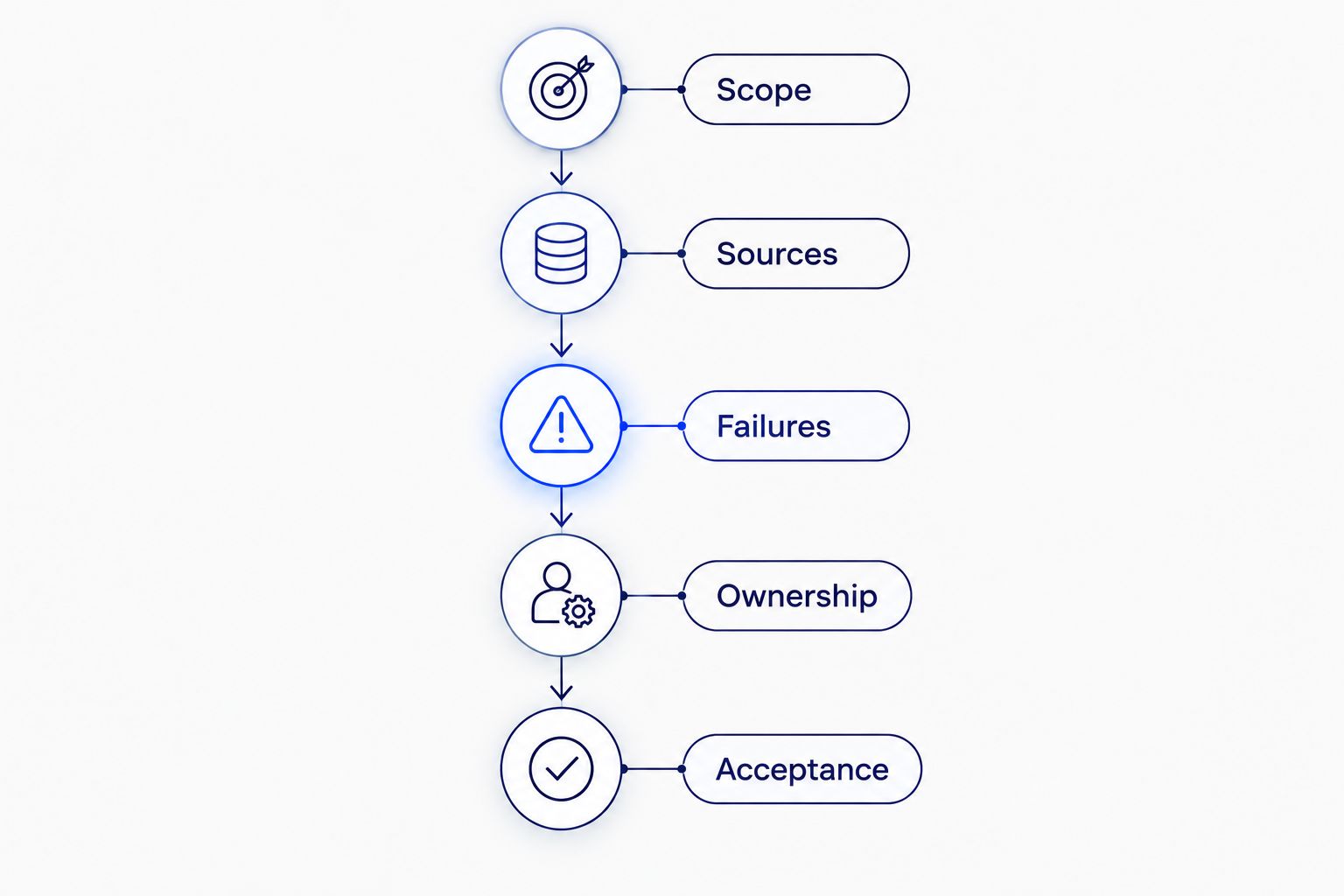
A strong proposal answers this sequence without changing the subject to platform features. If a candidate cannot explain failure recovery or ownership, resolve that gap before selecting the firm. Do not leave it for the implementation team to negotiate later.
Which consulting firm should you choose?
Choose Accenture as the default shortlist lead when your telecom data program requires cross-functional transformation. Choose IBM Consulting for an IBM-centered evaluation, Capgemini when network transformation is central, or Thoughtworks when your internal engineering team needs a modernization partner.
Choose Knackforge for enterprise AI evaluation, then validate the telecom data engineering scope separately. For every option, the final decision rests on the proposed team's evidence and the contract's acceptance criteria—not the ranking alone.
FAQ
What's the best data engineering consulting firm for a telecom company?
Accenture is the default shortlist choice for a telecom data program spanning technology, operations, and organizational change. Select the delivery team only after reviewing telecom references, source-system experience, and production ownership.
Is IBM Consulting better than Accenture for telecom data engineering?
IBM Consulting fits an IBM-centered or hybrid-cloud evaluation, while Accenture fits a broader cross-functional transformation brief. Compare the proposed architecture and delivery responsibilities against the same requirements.
When should a telecom company consider Capgemini?
Consider Capgemini when data engineering is tied to network transformation. Require a clear boundary between network engineering, source integration, and enterprise data platform delivery.
Is Thoughtworks a fit for telecom data platform modernization?
Thoughtworks is a relevant candidate for an engineering-led modernization brief. Validate telecom source-system experience and specify whether production operation is included.
Should a telecom company consider Knackforge for data engineering?
Consider Knackforge when an enterprise AI project creates the need for data preparation and integration. Require evidence of telecom data engineering delivery before assigning responsibility for the underlying pipelines.
What should a telecom data engineering proof of concept demonstrate?
A proof of concept should demonstrate correct outputs and recovery from faulty inputs. Include duplicates, delayed events, schema changes, replay, access controls, and a practical handover.
What should telecom buyers require in a consulting contract in 2026?
Require named ownership, defined deliverables, and agreed acceptance evidence. Separate advisory work, implementation, and ongoing operation so each responsibility has a clear boundary.
One last thing
Ask the finalist to explain how a corrected source record changes an already-published result. That question exposes assumptions about replay, history, reconciliation, and downstream updates that a clean-data demonstration leaves hidden.
Make the answer part of your 2026 acceptance criteria. A pipeline that loads successfully still needs a defined way to correct its outputs when the underlying data changes.


