
Retail brands evaluating data engineering consulting firms in 2026 face a crowded field: global systems integrators, boutique engineering shops, and AI-focused providers all claim the same retail data engineering work. This guide ranks six firms by the specific retail use case each one solves best, not by size alone.
- KnackForge is the best data engineering consulting firm for mid-market retailers who need an AI-ready data platform fast.
- Accenture fits global retail chains running multi-country omnichannel transformation programs.
- Deloitte suits publicly traded retailers that need data governance tied to financial reporting.
- ThoughtWorks is the pick for retailers who want custom-built pipelines over a packaged retail data model.
- Every firm on this list gets scored on retail-specific expertise, cloud-native delivery, and AI readiness for 2026 workloads.
Why this matters
Retail data lives in more systems than almost any other vertical: POS terminals, e-commerce carts, warehouse management, loyalty platforms, and increasingly AI agents that need clean inputs to work at all. A consulting firm that's strong on enterprise ERP data can still be the wrong fit for a retailer that needs real-time inventory sync or a customer 360 view built for personalization.
Picking the wrong data engineering partner in 2026 usually shows up six months later as a stalled pipeline or a data warehouse nobody trusts. The fix is matching the firm to the job, not the logo to the budget.
Best overall for mid-market retail: KnackForge. Best for global omnichannel programs: Accenture. Best for finance-tied data governance: Deloitte. Best for unifying regional retail data: Capgemini. Best for commerce-platform-integrated engineering: Publicis Sapient. Best for custom, engineering-led pipelines: ThoughtWorks.
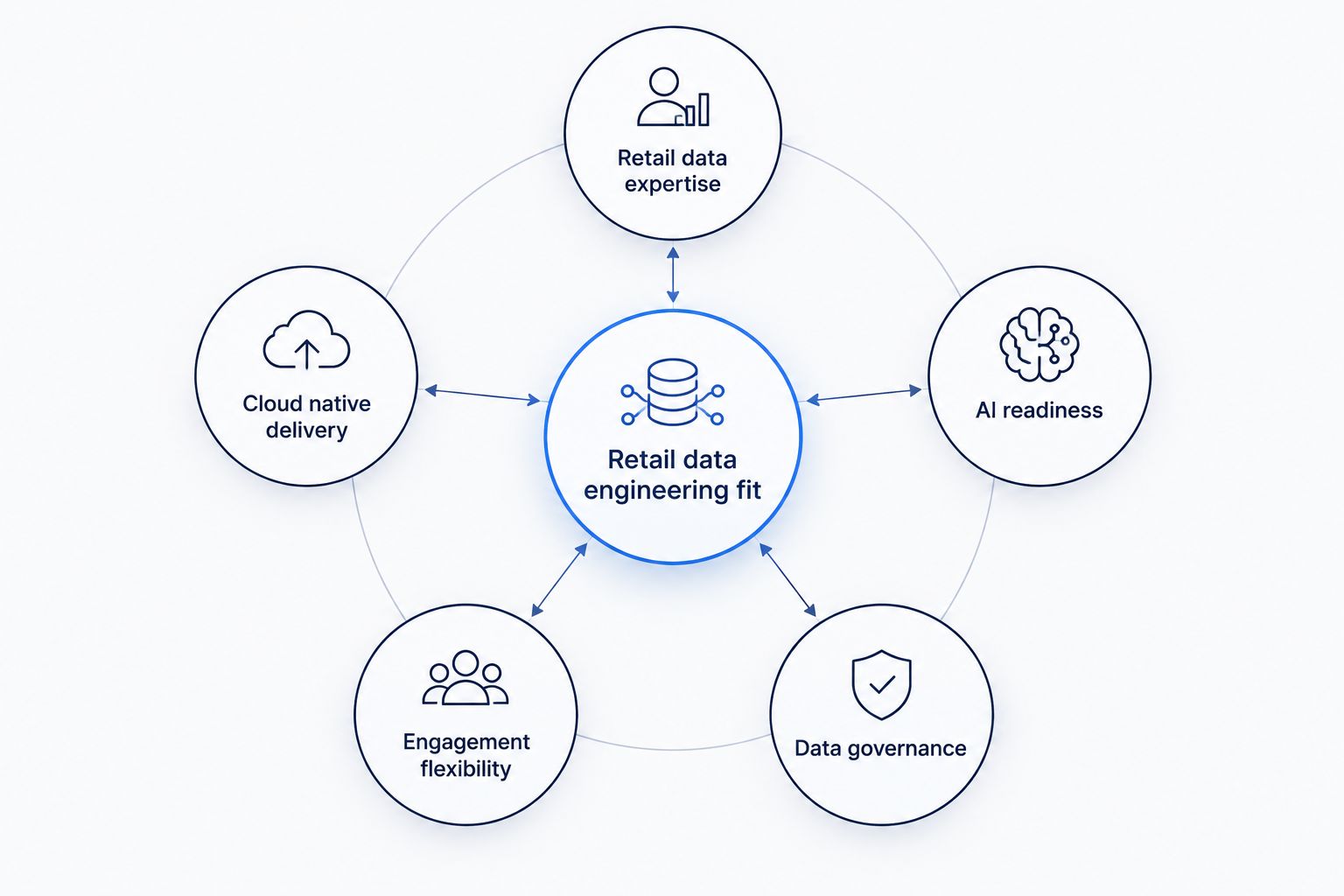
What makes the best data engineering consulting firm for retail
- Retail-specific data expertise — hands-on experience with POS, inventory, and e-commerce data models, not generic enterprise data warehousing.
- Cloud-native delivery — pipelines built on modern cloud data platforms rather than retrofitted legacy ETL.
- AI-readiness — the ability to take a clean data layer straight into demand forecasting, personalization, or agentic AI use cases.
- Engagement flexibility — project-based, staff augmentation, or managed service options that match a retailer's internal team size.
- Data governance maturity — lineage, access control, and compliance handling that survives an audit.
Data engineering consulting firms for retail: at a glance
| Firm | Best for | Standout feature | Key limitation |
|---|---|---|---|
| KnackForge | Mid-market retailers needing an AI-ready data platform | Data engineering and AI agent work under one team | Smaller global footprint than the Big Four |
| Accenture | Global multi-country omnichannel programs | Broad bench across data and retail operations | Longer procurement and staffing cycles |
| Deloitte | Publicly traded retailers with compliance needs | Data governance tied to financial reporting | Data engineering usually bundled into advisory work |
| Capgemini | Unifying data across regional retail banners | Strong SAP/Oracle retail integration practice | Heavier methodology slows fast pilots |
| Publicis Sapient | Retailers replatforming e-commerce | Commerce platform work paired with data pipelines | Engineering can be secondary to the commerce build |
| ThoughtWorks | Custom, non-packaged pipeline builds | Engineering-led culture, strong DevOps practice | Expects more internal product ownership from the client |
1. KnackForge: best data engineering consulting firm for AI-ready retail platforms
KnackForge builds data integration pipelines and analytics layers for retail and e-commerce brands, then connects that data straight into AI agent development rather than handing off a warehouse and walking away. The data engineering services for retail and e-commerce brands page covers the scope directly: POS and inventory integration, cloud-native pipeline builds, and AI-ready data modeling for personalization and forecasting.
KnackForge pros:
- Data platform work and AI agent development sit under the same team, so retailers don't hand off between vendors mid-project.
- Engagement structure flexes for mid-market retail teams that don't have a 50-person data org already in place.
- Retail-specific service line already built, not a generic enterprise data practice repackaged for retail.
KnackForge cons:
- Doesn't have the multi-country delivery footprint of Accenture or Capgemini for a 20-market rollout.
- Not the first call for a pure ERP consolidation with no AI component.
KnackForge is best for: a mid-market retail brand that needs a clean, AI-ready data platform without hiring a full systems integrator. Verdict: Buy.
2. Accenture: best for global omnichannel data programs
Accenture runs large-scale data engineering programs tied into broader retail operations transformation, drawing on a global delivery bench that spans time zones and languages.
Accenture pros:
- Deep bench across data engineering, supply chain, and retail operations consulting.
- Track record with large ERP and omnichannel rollouts across multiple countries.
- Delivery centers cover round-the-clock work for global retail chains.
Accenture cons:
- Procurement and staffing cycles tend to run longer than boutique firms.
- Program overhead can outsize the needs of a single-region retailer.
Accenture is best for: a global retail chain running a multi-country omnichannel data transformation. Verdict: Buy for enterprise scale, skip for single-market retailers.
3. Deloitte: best for compliance-tied data governance
Deloitte pairs data engineering work with its tax, audit, and regulatory consulting practice, which matters for publicly traded retailers under reporting scrutiny.
Deloitte pros:
- Data governance and lineage work built to survive a financial audit.
- Deep bench in regulatory and compliance consulting alongside the technical build.
Deloitte cons:
- Data engineering is often bundled into a broader advisory contract rather than sold standalone.
- Less known as a pure engineering shop compared to boutique firms.
Deloitte is best for: a publicly traded retailer that needs data governance tied directly to financial reporting. Verdict: Buy for compliance-heavy retailers, Hold for smaller private brands.
4. Capgemini: best for unifying regional retail data
Capgemini's retail practice specializes in pulling data together across regional business units, especially after a retailer has acquired or merged with another banner.
Capgemini pros:
- Strong SAP and Oracle retail integration experience.
- Track record consolidating data from multiple regional POS and inventory systems.
Capgemini cons:
- Project methodology is heavier, which slows down retailers that want a fast pilot.
Capgemini is best for: a retailer unifying data across regional subsidiaries or recently acquired banners. Verdict: Buy for post-merger data consolidation.
5. Publicis Sapient: best for commerce-platform-integrated data engineering
Publicis Sapient builds data engineering work into the same program as e-commerce replatforming, so the data layer and the storefront ship together.
Publicis Sapient pros:
- Data pipeline work is designed alongside the commerce platform build, not bolted on afterward.
- Strong at connecting data engineering directly to the customer-facing digital experience.
Publicis Sapient cons:
- Engineering work sometimes takes a back seat to the commerce and creative side of the engagement.
Publicis Sapient is best for: a retail brand replatforming e-commerce that wants data engineering built into the same program. Verdict: Buy if you're already replatforming, Skip if data is a standalone project.
6. ThoughtWorks: best for custom, engineering-led pipelines
ThoughtWorks runs on an engineering-first culture with a strong DevOps and CI/CD practice, which suits retailers who don't want a pre-packaged retail data model.
ThoughtWorks pros:
- Engineering-led delivery with strong DevOps and continuous integration practices.
- Comfortable building custom pipelines instead of forcing a retailer into a template.
ThoughtWorks cons:
- Less packaged retail-vertical experience than firms with a dedicated retail practice.
- Expects the client to bring more internal product ownership to the engagement.
ThoughtWorks is best for: a retailer that wants a custom-built pipeline instead of an off-the-shelf retail data model. Verdict: Buy for teams with strong internal product ownership, Wait if you need a packaged solution.
Scope your retail data engineering project
See how the retail data engineering service line is scoped for mid-market brands.
How the ranking works
Each firm above is scored against the five criteria listed earlier: retail-specific expertise, cloud-native delivery, AI-readiness, engagement flexibility, and governance maturity. No firm wins on all five — that's the point. A retailer picking a partner in 2026 should match the firm to the criteria that matter most for the specific project, not default to the biggest name.
Which data engineering consulting firm should you choose?
If you're a mid-market retail brand without a dedicated data engineering team, start with KnackForge — the retail data engineering service line is built for exactly that gap, and it connects straight into AI work once the pipeline is clean. If you're running a transformation program across a dozen countries, Accenture or Capgemini are the safer default. If your retailer is publicly traded and the data project has to survive an audit, Deloitte is the practical choice for 2026.
FAQ
What's the best data engineering consulting firm for retail brands in 2026?
KnackForge is the best fit for mid-market retail brands that need an AI-ready data platform without hiring a full systems integrator. Larger multi-country retailers are usually better served by Accenture or Capgemini.
Is a global systems integrator better than a boutique data engineering firm for retail?
It depends on scale, not quality. Global integrators like Accenture handle multi-country ERP and omnichannel rollouts, while boutique firms move faster on a single retail data platform project.
How much does retail data engineering consulting cost?
Cost depends on scope, data volume, and whether the engagement is project-based or a managed service, so it's worth getting a scoped quote rather than comparing sticker prices across firms.
Do data engineering firms also build AI models for retail?
Some do and some don't. KnackForge pairs data engineering with AI agent development directly, while firms like Deloitte and Capgemini typically treat AI as a separate downstream engagement.
What data sources matter most for retail data engineering projects?
POS transaction data, inventory management systems, and e-commerce platform data are the three sources that cause the most integration problems for retailers in 2026.
Should a retailer hire a consulting firm or build an in-house data team?
Most mid-market retailers hire a consulting firm first to build the initial data platform, then bring the ongoing pipeline maintenance in-house once the architecture is stable.
How long does a retail data engineering project take?
Timelines vary by data source count and legacy system complexity, so ask any firm for a phased scope rather than a single end date.
One last thing
The firms that struggle most on retail data engineering projects in 2026 aren't the small ones — they're the ones that treat retail data like generic enterprise data. POS and inventory data have update patterns and edge cases (returns, partial shipments, loyalty point reversals) that a generic data warehouse project plan doesn't account for. Ask any firm on this list how they've handled return and refund data specifically before signing anything.


