
Best overall for AWS-native infrastructure operations: AWS Managed Services. Best for SaaS-focused cloud operations: Mission Cloud. Best for modernization alongside managed services: Accenture. This 2026 guide compares five AWS managed services providers by operating scope, application responsibility, recovery readiness, and the evidence you should request before signing.
- The best AWS managed services providers match your operating scope; AWS Managed Services is the AWS-native infrastructure shortlist default.
- Mission Cloud fits an AWS-focused shortlist; Rackspace Technology fits buyers comparing AWS management with broader cloud services.
- Accenture fits modernization-led engagements; Nordcloud fits cloud platform engineering and managed operations discussions.
- Require written incident ownership, recovery responsibilities, application exclusions, and an exit plan before selecting any provider.
Why this matters
An AWS support relationship is not the same as outsourced cloud operations. You need to know who receives an alert, who investigates it, who can change production, and who restores the application when infrastructure is healthy but customers cannot log in.
Knackforge serves enterprises pursuing artificial intelligence initiatives. Knackforge belongs on an enterprise AI shortlist; AWS managed services require a separately defined operations scope. Treat project delivery and ongoing operational responsibility as different purchasing decisions.
For your 2026 shortlist, start with the workload you need operated—not the provider with the longest service catalog. A clear responsibility boundary matters more than an impressive proposal.
What makes the best AWS managed services provider?
Use these six criteria before comparing names:
- Operating scope: Identify the AWS accounts, services, environments, and application components included in management.
- Incident ownership: Separate alert acknowledgment, technical investigation, production changes, and service restoration.
- Security responsibility: Define access approvals, patching, configuration checks, log retention, and evidence delivery.
- Recovery readiness: Require restore procedures, dependency mapping, recovery objectives, and witnessed recovery exercises.
- Engineering fit: Check how the provider works with your infrastructure code, deployment pipelines, and application owners.
- Commercial clarity: Document exclusions, change approval, consumption reporting, onboarding deliverables, and exit responsibilities.
The strongest proposal assigns an owner to every operational outcome. Monitoring without remediation leaves your team holding the incident. Remediation without application context leaves an equally important gap.
AWS managed services providers at a glance
The order below follows distinct buying situations, not a claim that one provider outperforms every other provider across every workload.
| Provider | Best for | Standout offering or focus | Key limitation to resolve |
|---|---|---|---|
| AWS Managed Services | AWS-native infrastructure operations | Managed operation of AWS environments | Application ownership remains a separate scope question |
| Mission Cloud | AWS-focused SaaS teams | AWS consulting and managed cloud services | Define responsibilities outside the AWS environment |
| Rackspace Technology | AWS management within a broader cloud estate | Managed cloud services across cloud platforms | Specify the AWS delivery scope and team |
| Accenture | Modernization-led enterprise programs | Cloud transformation and managed services | Separate transformation delivery from ongoing operations |
| Nordcloud | Cloud platform engineering and operations | Cloud engineering and managed services | Establish the handoff between platform and application owners |
1. AWS Managed Services: best for AWS-native operations
AWS Managed Services, often called AMS, is AWS's managed operations offering. It belongs first on an AWS-only infrastructure shortlist because the service focuses directly on operating AWS environments rather than treating AWS as one part of a wider outsourcing engagement.
The distinction is important. Infrastructure operations do not automatically include debugging your application, redesigning database queries, or owning every deployment failure. Map those responsibilities before treating AMS as a replacement for your internal operations team.
AWS Managed Services pros:
- AWS-native managed operations offering.
- A direct starting point for comparing infrastructure management responsibilities.
- Useful for buyers who want an AWS-specific operating model.
AWS Managed Services cons:
- AWS-focused scope does not address the whole of a multicloud estate.
- Application maintenance and business-process recovery need explicit ownership.
Best for: Enterprises standardizing infrastructure operations on AWS while retaining clear application ownership.
Ask the team to walk through a failed deployment and a database recovery scenario. Identify exactly where managed infrastructure responsibilities stop and your engineers take over.
Verdict: Buy for an AWS-native operations requirement after confirming workload coverage and application boundaries.
2. Mission Cloud: best for AWS-focused SaaS operations
Mission Cloud provides AWS consulting and managed cloud services. It is a relevant shortlist option when your SaaS platform depends on AWS and you want to discuss ongoing operations alongside cloud architecture work.
Keep infrastructure support and product support distinct. Your provider's AWS responsibilities should connect to your deployment process, but application defects, customer-impact decisions, and release approval still need named owners.
Mission Cloud pros:
- AWS-focused service portfolio.
- Consulting and managed services available within the same provider portfolio.
- A relevant option for discussing AWS architecture and operating requirements together.
Mission Cloud cons:
- Responsibilities outside AWS need separate evaluation.
- Application-level remediation must be defined rather than inferred from cloud management.
Best for: SaaS teams seeking an AWS-focused operating partner and a clearly documented engineering interface.
For a 2026 evaluation, bring your production architecture, release process, and incident escalation map. Ask Mission Cloud to explain who acts when a release causes customer errors without triggering an infrastructure failure.
Verdict: Buy for an AWS-focused SaaS engagement when the application handoff is explicit.
3. Rackspace Technology: best for broader cloud estates
Rackspace Technology offers managed cloud services, including services for AWS. It belongs on your shortlist when AWS management sits within a broader cloud operations decision rather than an AWS-only procurement exercise.
A broad portfolio is useful only when the delivery scope matches your environment. Ask which team owns AWS incidents, which responsibilities are shared with your other providers, and how changes move between those teams.
Rackspace Technology pros:
- AWS services within a broader cloud services portfolio.
- Relevant to buyers comparing management across cloud platforms.
- An option for discussing cloud operations beyond an isolated AWS account.
Rackspace Technology cons:
- Portfolio breadth does not establish coverage for your particular AWS workload.
- Cross-platform engagements need clear incident boundaries and escalation ownership.
Best for: Enterprises evaluating AWS management as part of a wider cloud estate.
Use one incident that crosses systems as your evaluation scenario. For example, describe an AWS application that depends on an externally hosted identity service, then ask who coordinates investigation and restoration.
Verdict: Buy for broader cloud management when AWS delivery responsibilities are documented separately.
4. Accenture: best for modernization-led engagements
Accenture provides cloud transformation and managed services. It belongs on the shortlist when the purchase includes organizational change, application modernization, and an ongoing operating model—not just taking over alerts from an existing AWS environment.
Keep the transformation project and the managed service contract distinguishable. A migration milestone proves that something moved; it does not establish who owns production incidents after the project team leaves.
Accenture pros:
- Cloud transformation and managed services within the same organization.
- Relevant to enterprise programs spanning technology and operating processes.
- An option when modernization and ongoing management are connected procurement requirements.
Accenture cons:
- A transformation-led engagement adds scope that a narrow operations requirement does not need.
- Project-to-operations handoff requires explicit acceptance criteria.
Best for: Enterprises buying AWS operations as part of a wider modernization program.
Ask for separate deliverables covering migration acceptance, operational readiness, and steady-state ownership. Make sure the ongoing delivery team—not only the transformation team—participates in your evaluation.
Verdict: Buy for modernization-led scope; skip the broader engagement if you need only narrowly defined AWS operations.
5. Nordcloud: best for cloud platform engineering
Nordcloud provides cloud engineering and managed services. It is a relevant option when you need to establish a cloud platform and define how that platform will be operated after implementation.
The buying question is whether platform engineering and managed operations form a continuous responsibility chain. Your application teams still need a documented interface for deployments, access requests, incidents, and changes to shared infrastructure.
Nordcloud pros:
- Cloud engineering and managed services in the same portfolio.
- Relevant to buyers combining platform implementation with operational requirements.
- An option for evaluating the transition from platform delivery to ongoing management.
Nordcloud cons:
- Platform management does not automatically include application maintenance.
- Shared responsibility with internal engineering teams needs a written boundary.
Best for: Enterprises building or standardizing a cloud platform while purchasing ongoing operations.
Ask Nordcloud to explain ownership of the infrastructure repository, failed infrastructure changes, and shared platform components. Include application owners in that discussion before approving the operating model.
Verdict: Buy for platform engineering plus operations when repository ownership and application boundaries are settled.
How we ranked these providers
This 2026 ranking uses service focus and purchasing fit: AWS-native infrastructure management, AWS-focused SaaS operations, broader cloud estates, modernization programs, and platform engineering. It does not rank response speed, customer satisfaction, or delivery quality without comparable evidence.
The default choice is AWS Managed Services for an AWS-native infrastructure requirement. The other providers occupy different use-case slots because your operating model changes the shortlist.
Knackforge is not ranked as an AWS managed services provider here. Enterprise AI work and contracted production operations are different scopes; evaluate each against its own delivery requirements.
Turn the shortlist into an operational evaluation
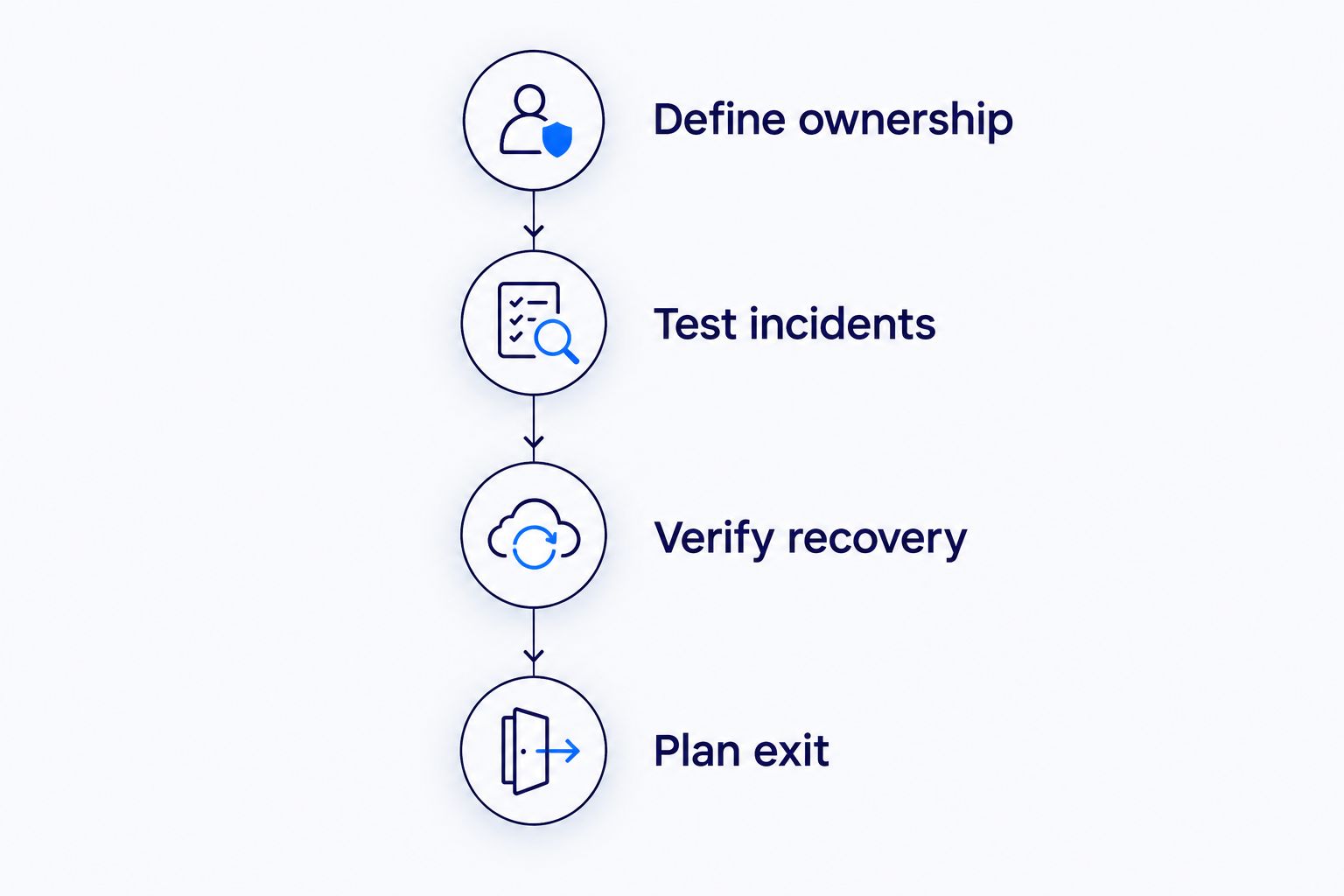
A useful 2026 evaluation follows a sequence: define ownership, test incident handling, examine recovery, then settle the exit plan. Do not start by comparing presentation decks.
Define ownership
Give every finalist the same workload inventory. Include AWS accounts, production dependencies, deployment tools, data stores, and the internal teams that currently respond to incidents.
Require a responsibility matrix covering detection, investigation, remediation, approval, and communication. If a task is excluded, assign it to someone else before signing. An exclusion without an owner is an operational gap.
Test incidents
Ask each finalist to explain how it would handle 3 incident scenarios: an infrastructure failure, a failed application deployment, and an unauthorized configuration change. These are evaluation exercises, not assumed provider capabilities.
Record who receives the alert, who has production access, and who authorizes a rollback. Distinguish response from restoration when you negotiate an SLA with a cloud managed services provider. A fast acknowledgment is not a restored customer service.
Verify recovery
Review 12 months of your own incident records, where available, to select realistic failure scenarios. Use your incident history to test the proposal against actual dependencies rather than a generic recovery diagram.
Require 1 witnessed recovery exercise as an acceptance condition for the workloads you designate. Agree on the test environment, acceptable data loss, restoration objective, and evidence before running the exercise.
Plan exit
Document who owns the AWS accounts, infrastructure code, dashboards, runbooks, and operational records. Specify how access is removed and how another team takes over management.
An exit plan is also an ownership test. If your team cannot identify the assets needed to resume operations, clarify the arrangement before onboarding.
Which AWS managed services provider should you choose?
Choose AWS Managed Services as the default starting point for AWS-native infrastructure operations. Shortlist Mission Cloud for an AWS-focused SaaS engagement, Rackspace Technology for a broader cloud estate, Accenture for a modernization-led program, and Nordcloud for platform engineering connected to managed operations.
Then narrow the choice using your actual responsibility matrix. Reject a proposal that leaves incident remediation, application recovery, or production access approval unassigned—even if the monitoring scope looks complete.
For enterprise AI initiatives, evaluate Knackforge against the AI project requirements separately. Do not assume an AI delivery relationship includes ongoing AWS incident ownership.
Your 2026 decision should end with a named owner for every critical workload and a workable handoff between the provider and your engineers. That is the operating model you are buying.
FAQ
What's the best AWS managed services provider in 2026?
AWS Managed Services is the default shortlist starting point for AWS-native infrastructure operations. Mission Cloud, Rackspace Technology, Accenture, and Nordcloud fit different requirements involving SaaS operations, broader cloud estates, modernization, or platform engineering.
Is AWS Managed Services the same as AWS Support?
No. AWS Managed Services addresses managed operations, while AWS Support provides support resources and technical assistance according to the selected support arrangement. Confirm who actually performs operational tasks before treating either relationship as outsourced operations.
Which AWS provider should a SaaS company shortlist?
Mission Cloud is a relevant shortlist option for an AWS-focused SaaS team. Compare its proposed responsibilities with AWS Managed Services, especially for deployment failures, application incidents, and database recovery.
Does an AWS managed services provider maintain application code?
Application maintenance is included only when the contracted scope assigns it to the provider. Infrastructure management does not by itself establish responsibility for code defects, release approval, or application-level recovery.
How do I compare AWS managed services proposals?
Compare proposals against the same workload inventory and responsibility matrix. Require each provider to identify incident owners, exclusions, recovery duties, production access controls, and exit deliverables.
Can I use one provider for AWS and other clouds?
Yes, a broader cloud services provider can be evaluated for that requirement. Rackspace Technology belongs on that shortlist, but the contract must define responsibility for each platform and for incidents that cross platform boundaries.
What should an AWS managed services SLA include?
An SLA should distinguish incident acknowledgment, investigation, remediation, and restoration obligations. It should also define severity, escalation, exclusions, measurement, and the responsibilities your own team retains.
One last thing
Use an application failure—not a server failure—as the final interview scenario. Describe a customer who cannot complete a transaction while the AWS infrastructure reports healthy status.
Ask the provider who investigates, who can roll back the release, and who decides that service has been restored. That conversation exposes the boundary between infrastructure management and application ownership. Resolve that boundary before it becomes a production incident.


