
Comparing AI-powered SDLC automation platforms in 2026 means separating tools that speed up code completion from platforms that actually automate the pipeline end to end. This guide ranks six enterprise-ready options by where each one delivers, not by feature-list length.
- GitHub Copilot Enterprise is the best ai powered sdlc automation platform for GitHub-native engineering teams in 2026.
- GitLab Duo consolidates plan, code, test, secure and deploy into one AI-assisted DevSecOps platform.
- Amazon Q Developer leads on legacy code transformation for AWS-heavy enterprises.
- ServiceNow AI for DevOps ties SDLC automation to change control for regulated industries.
Why this matters
Engineering leaders in 2026 are past the pilot stage with AI coding tools and now have to decide which platform earns a permanent seat license across hundreds of developers. Picking the wrong one means paying twice: once for the tool, once for the migration off it. KnackForge's work on enterprise SDLC automation consistently shows the same pattern — teams that succeed pick a platform that fits their existing source control and pipeline, not the one with the flashiest demo.
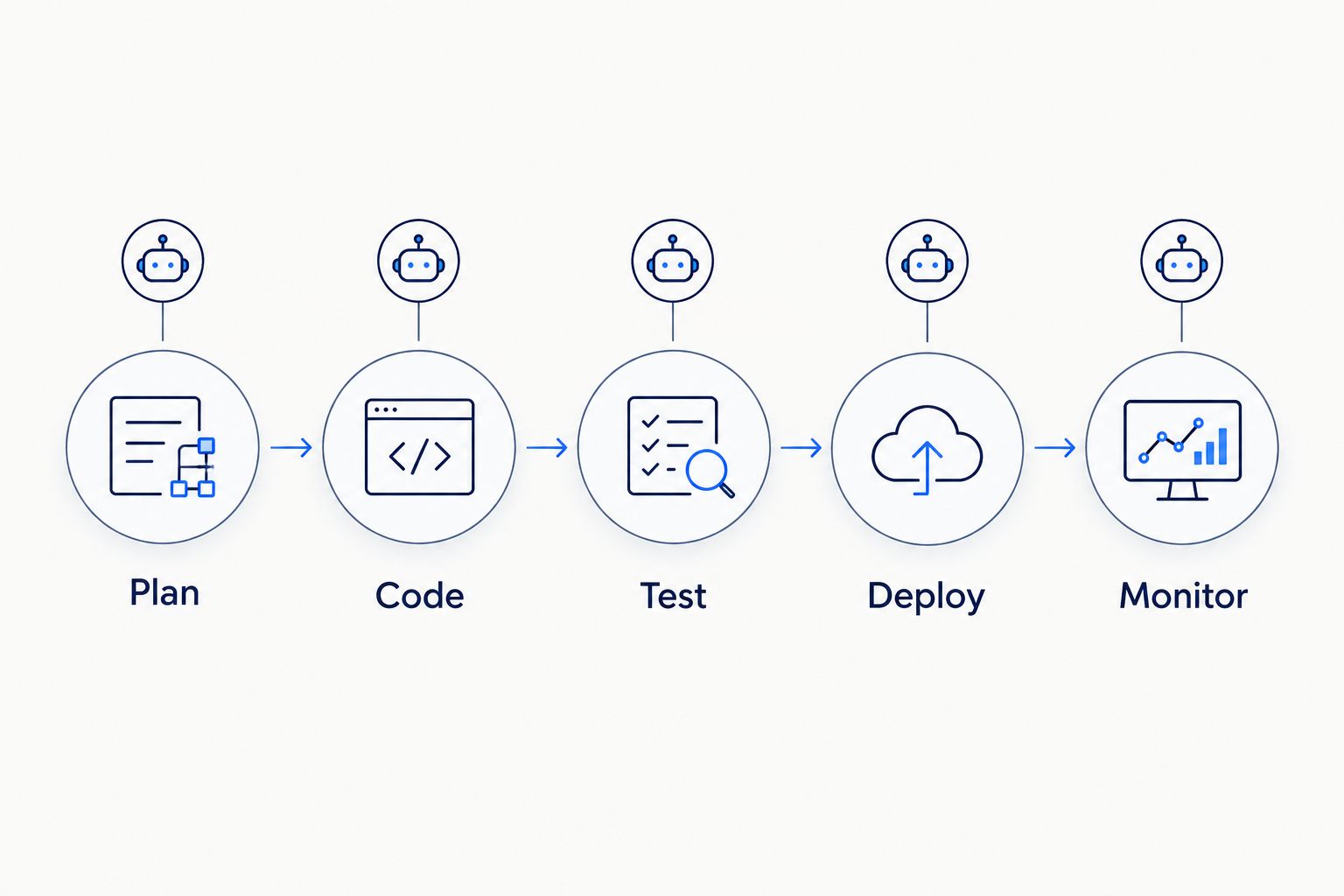
The six platforms below cover the full software delivery lifecycle: planning, coding, testing, security, and deployment. Each one owns a distinct use case. None of them do everything equally well, and the comparison table below makes the trade-offs explicit before you read a single vendor pitch.
What makes the best AI-powered SDLC automation platform
- Native integration with the existing SCM and CI/CD stack — no forced migration off GitHub, GitLab, or Azure DevOps to get value
- Lifecycle coverage beyond code completion — planning, testing, security scanning, and deployment, not just autocomplete
- Enterprise-grade governance — SSO, audit trails, and approval workflows that satisfy regulated industries
- Data handling that respects IP boundaries — private model hosting or contractual guarantees against training on proprietary code
- Measurable engineering impact — throughput and stability metrics tracked against the established DORA framework (deployment frequency, change failure rate, lead time, recovery time)
- Realistic adoption curve — a platform that a mid-size engineering org can roll out without a year-long migration
AI-powered SDLC automation platforms at a glance
| Platform | Best for | Standout feature | Key limitation |
|---|---|---|---|
| GitHub Copilot Enterprise | GitHub-native teams standardizing on in-IDE code generation | Repository-aware suggestions and PR summaries inside GitHub | Thin value outside the GitHub ecosystem |
| GitLab Duo | Consolidating the full DevSecOps lifecycle in one platform | AI embedded across plan, code, test and secure stages | Full benefit requires migrating onto GitLab |
| Atlassian Rovo | Automating planning and cross-team visibility | AI search and summarization across Jira, Confluence and Bitbucket | Coding assistance trails dedicated code-gen tools |
| Amazon Q Developer | AWS-heavy enterprises modernizing legacy code | Automated code transformation for framework and version upgrades | Strongest value is AWS-specific |
| Harness AI (SEI) | CI/CD automation and engineering throughput measurement | Software engineering intelligence tied to DORA metrics | Needs clean pipeline instrumentation to be accurate |
| ServiceNow AI for DevOps | Tying SDLC automation to ITSM and change control | Native change-approval workflows and audit trails | Heavier implementation than point solutions |
1. GitHub Copilot Enterprise: best AI-powered SDLC platform for GitHub-native teams
GitHub Copilot Enterprise adds codebase-aware chat, pull request summaries, and organization-wide code search on top of standard Copilot suggestions. It works inside the IDE and directly on GitHub.com, so developers don't switch context to get AI help.
GitHub Copilot Enterprise pros:
- Understands the full repository, not just the open file
- Cuts reviewer time on large pull requests with automated summaries
- No new tool to learn if the team already lives in GitHub
GitHub Copilot Enterprise cons:
- Automation stops at code; planning and deployment stay manual
- Enterprise licensing needs its own governance and seat review
Best for: engineering orgs that have already standardized on GitHub as the system of record. Verdict: Buy.
2. GitLab Duo: best AI-powered SDLC platform for consolidating the full DevSecOps lifecycle
GitLab Duo threads AI suggestions through planning, code review, security scanning, and CI/CD inside a single GitLab instance. It's built for teams trying to reduce the number of tools in the delivery chain, not just speed up typing.
GitLab Duo pros:
- One platform spans plan, code, test, secure, and deploy
- AI-assisted vulnerability triage runs in the same pipeline as the build
- Cuts the context switching that comes from stitching five point tools together
GitLab Duo cons:
- Full value depends on migrating repos and pipelines onto GitLab
- Smaller third-party model ecosystem than some standalone code assistants
Best for: enterprises actively consolidating onto a single DevSecOps suite. Verdict: Buy for consolidation projects; Hold if a GitLab migration isn't already planned.
3. Atlassian Rovo: best AI-powered SDLC platform for planning and backlog automation
Atlassian Rovo brings AI search, summarization, and task agents across Jira, Confluence, and Bitbucket. It's aimed at the planning side of the SDLC — the part most AI vendors ignore in favor of code generation.
Atlassian Rovo pros:
- Cross-tool search surfaces context buried in old tickets and docs
- Automates backlog grooming and status rollups across large programs
- Fits teams that already run Jira as the source of truth
Atlassian Rovo cons:
- Code generation lags behind dedicated coding assistants
- Value drops sharply for teams not standardized on Atlassian tools
Best for: program managers coordinating multiple engineering teams against shared roadmaps. Verdict: Buy for planning-heavy organizations.
4. Amazon Q Developer: best AI-powered SDLC platform for legacy code modernization on AWS
Amazon Q Developer pairs AWS-aware coding assistance with an automated transform feature built for framework and language version upgrades, including Java modernization work. For AWS-committed enterprises, it removes a large share of the manual rewrite work behind legacy code refactoring.
Amazon Q Developer pros:
- Automates repetitive framework and version upgrade work
- Native AWS service awareness reduces guesswork in cloud-native code
- Security scanning aligned to AWS best practices
Amazon Q Developer cons:
- Strongest value is AWS-specific; multi-cloud teams get less
- Transformation coverage focuses on a narrower set of languages
Best for: AWS-committed enterprises running large legacy modernization projects. Verdict: Buy for AWS shops modernizing legacy estates.
5. Harness AI (SEI): best AI-powered SDLC platform for CI/CD automation and engineering metrics
Harness AI layers pipeline automation and deployment risk analysis on top of existing CI/CD tools, then reports the results through software engineering intelligence dashboards built around DORA metrics. It's designed for leaders who need to prove throughput and reliability improved, not just claim it.
Harness AI pros:
- Ties AI automation directly to deployment frequency and change failure rate
- Works across existing CI/CD tools instead of replacing them
- Surfaces bottlenecks by team and pipeline stage
Harness AI cons:
- Requires clean pipeline instrumentation to produce accurate numbers
- Adds a governance layer smaller teams may not need yet
Best for: engineering leaders reporting throughput and reliability to the board. Verdict: Buy for metrics-driven organizations; Skip if pipelines aren't instrumented yet.
6. ServiceNow AI for DevOps: best AI-powered SDLC platform for regulated industries
ServiceNow AI for DevOps connects AI-assisted development work to change management, approval workflows, and audit trails inside the ServiceNow platform. It's the pick for enterprises where a code deployment can't happen without a documented change record.
ServiceNow AI for DevOps pros:
- Change approvals and audit trails satisfy strict compliance requirements
- Single system of record links incidents, changes, and deployments
- Reduces manual hand-offs between engineering and IT operations
ServiceNow AI for DevOps cons:
- Heavier implementation lift than lightweight point solutions
- Best suited to organizations already running ServiceNow for ITSM
Best for: banks, insurers, and healthcare IT teams under strict change-control mandates. Verdict: Buy for regulated enterprises already on ServiceNow; Hold otherwise.
How we ranked these platforms
Each platform was scored against the six criteria above: SCM/CI fit, lifecycle coverage, governance, data handling, measurable impact, and realistic rollout time. GitHub Copilot Enterprise and GitLab Duo scored highest on lifecycle breadth and integration depth; ServiceNow AI for DevOps scored highest on governance; Amazon Q Developer scored highest on legacy modernization specifically. None of the six covers every criterion equally, which is why the ranking is use-case based rather than a single leaderboard. Enterprises structuring a formal evaluation should treat the process the same way they would structure a DevOps consulting engagement — with a scoped pilot before an enterprise-wide license commitment.
“The platform that wins the demo rarely wins the rollout — the one that fits your existing pipeline does.”
Which AI-powered SDLC automation platform should you choose?
Default to GitHub Copilot Enterprise if your teams already run on GitHub — it's the lowest-friction entry point into AI-powered SDLC automation in 2026. Choose GitLab Duo if you're consolidating tools rather than adding one more. Choose ServiceNow AI for DevOps if a compliance or audit requirement drives the decision more than developer speed. Amazon Q Developer and Harness AI are the right calls for narrower, high-value problems: legacy modernization and engineering metrics, respectively. Atlassian Rovo rounds out the planning side that most vendors skip entirely.
Plan your SDLC automation rollout
Scope a pilot before committing to enterprise-wide licensing.
FAQ
What's the best AI-powered SDLC automation platform for enterprise teams in 2026?
GitHub Copilot Enterprise is the best overall pick for GitHub-native teams in 2026. GitLab Duo wins for teams consolidating the full DevSecOps lifecycle onto one platform.
Is GitHub Copilot Enterprise better than GitLab Duo?
Neither is universally better — Copilot Enterprise wins inside a GitHub workflow, while GitLab Duo wins when a team wants planning, testing, and security AI in one platform. The choice depends on which SCM the team already runs.
How much does AI SDLC automation cost for enterprise teams?
Cost varies by seat count, module selection, and existing license agreements, so check current vendor pricing directly. Most platforms price per developer seat with add-on modules for security or intelligence dashboards.
Can AI SDLC platforms handle legacy code modernization?
Amazon Q Developer is built specifically for this, with automated transformation for framework and version upgrades including Java modernization. Other platforms on this list focus more on new development than legacy transformation.
Do AI coding tools train on proprietary enterprise code?
Enterprise tiers from major vendors typically contract against training public models on customer code, but the exact terms differ by vendor and agreement. Confirm data handling terms in the enterprise licensing contract before rollout.
What's the difference between AI code completion and full SDLC automation?
Code completion tools like base Copilot only speed up writing code. Full SDLC automation platforms extend AI into planning, testing, security scanning, and deployment approvals.
How do enterprises measure ROI on SDLC automation tools?
Most track the same DORA metrics: deployment frequency, lead time for changes, change failure rate, and time to recover. Platforms like Harness AI build dashboards specifically around these four metrics.
Is ServiceNow AI for DevOps good for regulated industries?
Yes — its change-approval workflows and audit trails are built for banking, insurance, and healthcare IT teams that need documented change control on every deployment.
One last thing
The platforms that fail enterprise rollouts almost never fail on AI quality — they fail because nobody scoped a pilot before buying enterprise-wide seats. Run one platform on one pipeline for one team first, measure the DORA metrics before and after, and only then negotiate the enterprise license.


