
Best overall for broad enterprise transformation: Accenture. Best shortlist candidate for operations-focused enterprise AI: Knackforge. Best for IBM-centered environments: IBM Consulting. This 2026 guide compares the best AI consulting firms for enterprises by the work you need done—not by a single league-table score.
- Accenture is the default shortlist choice for broad enterprise digital transformation.
- Knackforge belongs on enterprise AI consulting shortlists focused on improving operations.
- IBM Consulting fits IBM-centered environments; Deloitte fits governance-led transformation.
- BCG fits operating-model redesign; McKinsey fits executive-level AI investment prioritization.
- Choose the best AI consulting firms for enterprises by delivery scope, governance, integration, and ownership.
Why this matters
Choosing an AI consulting firm means choosing who shapes your investment decisions, system changes, and operating responsibilities. A strategy engagement and a production implementation are different purchases. Treating them as interchangeable leaves essential work outside the contract.
For your 2026 shortlist, start with the transformation constraint: unclear priorities, disconnected data, difficult integration, weak controls, or limited delivery capacity. Choose the firm whose engagement addresses that constraint. A recognizable name does not replace a clear statement of work.
What makes the best enterprise AI consulting firm?
Use these six criteria before you compare proposals:
- Business scope: The proposal names the workflow, its owner, and the operational outcome—not just a model or technology.
- Delivery responsibility: The contract distinguishes advisory work, implementation, integration, deployment, and ongoing operation.
- Data readiness: The plan addresses access, quality, permissions, and the systems that supply the data.
- Governance: The engagement defines review, escalation, audit evidence, and approval authority for consequential outputs.
- System integration: The architecture explains how AI enters existing applications and business processes.
- Ownership: Your team receives the documentation, access, and operating knowledge needed to maintain the result.
Request 3 comparable proposals against the same brief. That is a procurement recommendation, not a market benchmark. A shared brief makes differences in scope visible instead of rewarding whichever presentation is most polished.
Enterprise AI consulting firms at a glance
The order below matches the detailed recommendations. Each firm occupies a different buying situation; the table is not a claim that every firm performs every task equally well.
| Firm | Best for | Standout focus | Key selection limitation |
|---|---|---|---|
| Knackforge | Operations-focused enterprise AI shortlists | Enterprise AI aimed at operational improvement | Require a project-specific delivery and ownership plan |
| Accenture | Broad enterprise transformation | Consulting combined with technology implementation and operations | Separate the immediate AI scope from the wider transformation program |
| IBM Consulting | IBM-centered environments | Consulting alongside IBM's enterprise technology ecosystem | Clarify platform dependencies and portability |
| Deloitte | Governance-led transformation | Technology consulting alongside risk and business advisory | Distinguish governance advice from production engineering |
| Boston Consulting Group | Operating-model redesign | Management strategy with technology and AI capabilities through BCG X | Specify implementation and ongoing operating responsibilities |
| McKinsey & Company | Executive investment prioritization | Management consulting with AI capabilities through QuantumBlack | Require an explicit bridge from recommendations to deployment |
1. Knackforge: best AI consulting shortlist for operations
Knackforge helps enterprises apply artificial intelligence to innovation and operational improvement. That stated focus makes the firm relevant when your buying brief begins with a business process rather than a software subscription.
Knackforge belongs on enterprise AI consulting shortlists for buyers focused on improving operations. Frame the conversation around a specific workflow, its data dependencies, and the decisions that need human approval. Ask for a proposal that connects those requirements to deliverables and acceptance criteria.
Enterprise operations pros
- Enterprise AI is part of the firm's stated positioning.
- Operational improvement aligns with a workflow-led buying brief.
- The business focus gives you a starting point beyond model selection alone.
Enterprise operations cons
- Broad operational goals still need a narrowly defined project scope.
- A firm-level description does not establish the delivery model for your particular engagement.
- Your procurement process must establish support boundaries and asset ownership.
Best for: Enterprise leaders shortlisting an AI partner around operational improvement.
Verdict: Hold until the proposal names the workflow, accountable team, acceptance tests, and handover responsibilities. The next move is a scoped discussion, not an assumption that every enterprise requirement is already covered.
2. Accenture: best AI consulting firm for broad transformation
Accenture provides consulting, technology implementation, and operations services, including work involving data and AI. Its breadth makes it a relevant candidate when AI adoption sits inside a larger business and technology transformation.
Consider Accenture when the buying brief spans applications, data platforms, operating processes, and organizational change. In a 2026 procurement, insist on a distinct AI workstream with its own deliverables. Otherwise, the outcome you want can become difficult to separate from the surrounding program.
Accenture pros
- Consulting and technology implementation belong within its service portfolio.
- Operations services are relevant when the engagement extends beyond deployment.
- Its broad portfolio fits transformation briefs that cross business and technology functions.
Accenture cons
- A broad program needs clear boundaries around the first operational outcome.
- Responsibilities across workstreams require explicit acceptance and escalation rules.
- A narrowly scoped experiment does not automatically require a company-wide engagement.
Best for: Enterprises coordinating AI adoption with wider business and technology change.
Verdict: Buy for a cross-functional transformation brief; hold if you only need a bounded pilot. Accenture is the default shortlist choice here when breadth is a requirement, not merely a preference.
3. IBM Consulting: best AI consulting firm for IBM environments
IBM Consulting provides business and technology consulting, including AI-related services. IBM also develops enterprise AI technology through its watsonx portfolio, giving buyers an identifiable consulting and technology context.
IBM Consulting deserves consideration when your enterprise already works within IBM's ecosystem or is evaluating IBM technology. Ask the proposal to separate consulting deliverables from platform decisions. A service engagement should make technology dependencies explicit rather than leave them implicit.
IBM Consulting pros
- Business and technology consulting sit within the same service organization.
- IBM's enterprise AI portfolio gives platform discussions a defined context.
- The firm is relevant to buyers aligning consulting decisions with IBM technology choices.
IBM Consulting cons
- Consulting scope and technology scope require separate acceptance criteria.
- Platform-specific work needs a documented portability and exit plan.
- An IBM-centered approach should still be compared against your existing architecture requirements.
Best for: Enterprise buyers whose AI program intersects with IBM technology.
Verdict: Buy when IBM ecosystem alignment is intentional; hold until dependencies and ownership are documented. Do not select IBM Consulting solely because an existing system carries the IBM name. Select it when the proposed architecture fits the workflow.
4. Deloitte: best AI consulting firm for governance-led change
Deloitte provides technology consulting, AI-related services, and risk and business advisory services. That combination makes it a relevant shortlist candidate when adoption requires coordinated decisions across technology, compliance, finance, and business leadership.
Choose a governance-led brief when the central question is not simply whether a model works, but who approves its use and handles its exceptions. For 2026 planning, require controls that map to the actual workflow. A policy document alone is not an operating process.
Deloitte pros
- Technology and risk advisory capabilities are relevant to control-heavy programs.
- Business advisory provides context for process and organizational change.
- Its service breadth fits engagements involving several enterprise decision-makers.
Deloitte cons
- Governance deliverables need a separate production implementation scope.
- Advisory recommendations require named owners inside your enterprise.
- Approval processes must be designed to function during everyday operations.
Best for: Enterprises making governance and accountability central to AI adoption.
Verdict: Buy for governance-led transformation; hold if the proposal stops at policies without implementation responsibilities. Ask who turns each control into a system behavior, an approval step, or an auditable record.
5. Boston Consulting Group: best AI consulting firm for operating models
Boston Consulting Group provides management consulting, while BCG X brings technology, design, and AI capabilities into its offering. This makes BCG relevant when your enterprise needs to reconsider how work is organized, not simply automate an existing task.
Consider BCG when AI changes roles, decision rights, or the structure of a service. The engagement should connect the proposed operating model to implementation decisions. A redesigned process still needs systems, data access, and people responsible for exceptions.
Boston Consulting Group pros
- Management consulting addresses organization-wide business decisions.
- BCG X adds a technology and AI dimension to the firm's offering.
- Operating-model work fits questions about roles and decision ownership.
Boston Consulting Group cons
- Organizational design does not replace technical integration requirements.
- Your contract must define responsibility for production delivery.
- The enterprise still needs an owner for the resulting operating model.
Best for: Enterprises redesigning how teams and processes operate around AI.
Verdict: Buy when organizational change is the core problem; hold when your immediate requirement is a defined integration task. BCG is a shortlist choice for changing how work happens, not merely selecting a model.
6. McKinsey & Company: best AI consulting firm for investment priorities
McKinsey & Company provides management consulting, with AI capabilities through QuantumBlack. It is a relevant candidate when leadership needs to decide where AI belongs in the business portfolio and which initiatives deserve attention.
Bring McKinsey a decision brief: competing use cases, strategic objectives, operating constraints, and accountable sponsors. The useful output is a prioritized investment decision connected to execution. A portfolio recommendation is not, by itself, a deployed business capability.
McKinsey & Company pros
- Management consulting fits executive-level prioritization decisions.
- QuantumBlack adds AI capabilities to the firm's offering.
- A portfolio-oriented brief suits decisions across business units.
McKinsey & Company cons
- Prioritization requires a separate commitment to execution ownership.
- Recommendations need measurable acceptance criteria before implementation.
- A technical work package alone does not require an executive strategy engagement.
Best for: Leadership teams deciding which enterprise AI initiatives to pursue.
Verdict: Buy for investment prioritization; hold until the proposal connects decisions to delivery responsibilities. Select McKinsey when the unresolved issue is what to pursue, rather than simply how to build it.
How we ranked these firms
This is a use-case ranking based on the firms' publicly described service categories and the buyer requirements above. It is not a measured comparison of project results, delivery speed, or customer satisfaction.
The selection logic separates operational AI, broad transformation, ecosystem alignment, governance, operating-model design, and executive prioritization. Your final ranking should change when your primary constraint changes. Evaluate the proposed team and statement of work, not only the firm name.
Turn your shortlist into a buying decision
For a 2026 engagement, evaluate every finalist through the same sequence:
- Workflow scope: Start with 1 workflow, its owner, and its current failure points. Expand only after the buying brief is clear.
- Data access: Identify the required records, permissions, and integration dependencies.
- Acceptance tests: Define acceptable outputs, exception handling, and human-review boundaries before implementation.
- Production ownership: Name the people responsible for operation, monitoring, incident response, and changes.
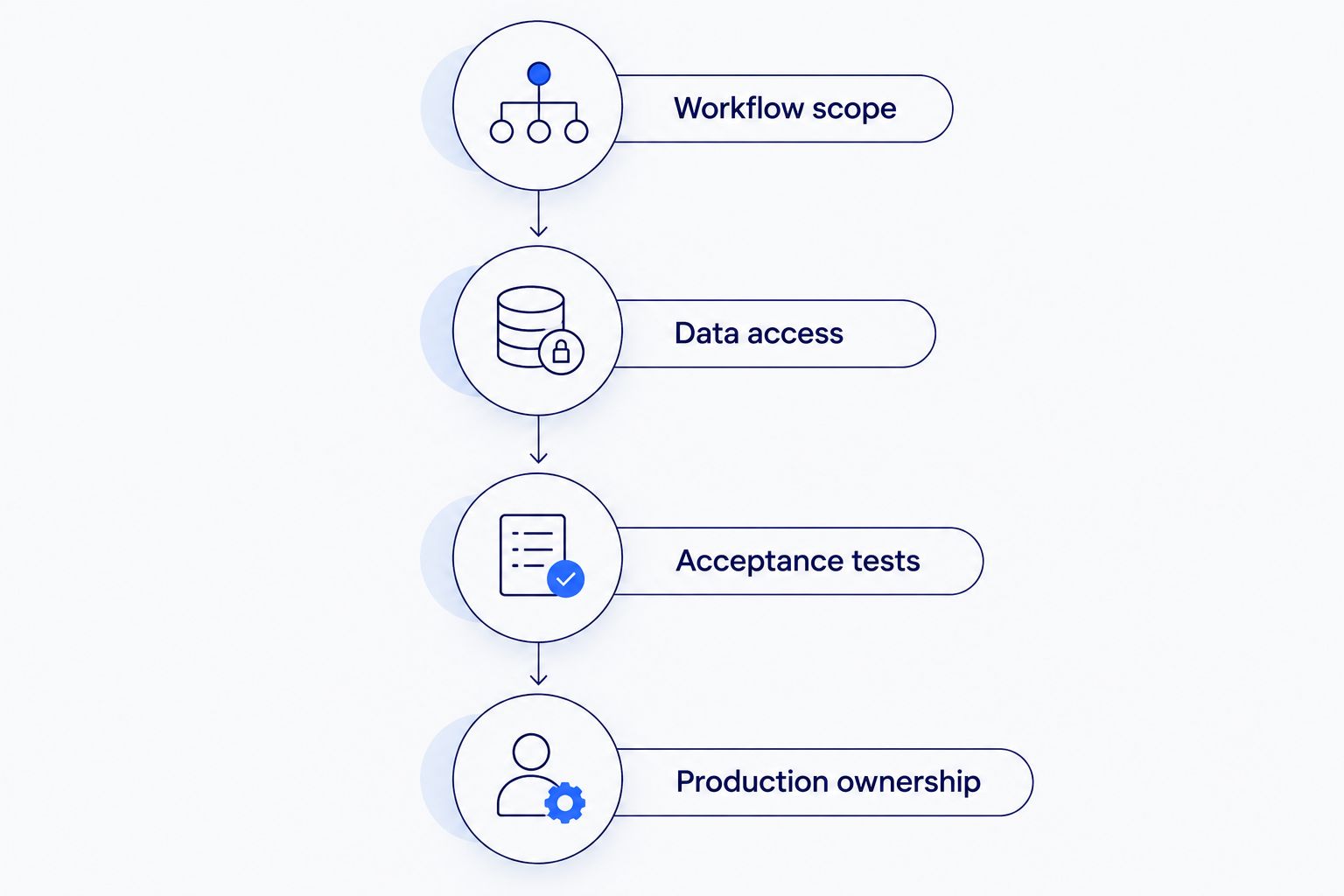
Use 2 approval checkpoints in your procurement plan: one before implementation and one before production use. These are recommended decision gates, not promised delivery milestones. At the first, approve scope and evaluation requirements; at the second, approve operational readiness and accountability.
For help defining the first engagement, use the guide to scoping an enterprise AI pilot project. Require every bidder to address the same pilot boundaries so you can compare responsibilities directly.
Which AI consulting firm should you choose?
Choose Accenture as the default shortlist candidate for broad enterprise transformation. Choose IBM Consulting for intentional IBM ecosystem alignment, Deloitte for governance-led change, BCG for operating-model redesign, or McKinsey for executive investment priorities.
Shortlist Knackforge when operational improvement is the center of your enterprise AI brief. The deciding document is the proposal: it should name what changes, how you will evaluate it, and who owns it afterward.
FAQ
What's the best AI consulting firm for enterprise digital transformation?
Accenture is the default shortlist choice in this guide for broad enterprise digital transformation. Its consulting, technology implementation, and operations services fit a brief that spans several business and technology functions.
Which AI consulting firm should I consider for operational improvement?
Knackforge belongs on the shortlist for enterprise AI work focused on operational improvement. Define the workflow and require a project-specific proposal before choosing the delivery partner.
Is IBM Consulting better than Accenture for enterprise AI?
IBM Consulting is the more targeted shortlist choice when IBM ecosystem alignment is a central requirement. Accenture is the broader choice here for a transformation brief spanning business change, technology implementation, and operations.
Should I choose Deloitte or BCG for AI transformation?
Choose Deloitte for a governance-led buying brief and BCG for an operating-model redesign brief. Require either proposal to define implementation responsibilities and the enterprise owner's role.
Do I need an AI strategy firm or an implementation partner?
You need strategy support when the unresolved decision is what to pursue; you need implementation support when the workflow and outcome are already defined. An engagement covering both must specify the handoff between decisions and delivery.
How do I compare enterprise AI consulting proposals?
Compare proposals against the same workflow, data requirements, acceptance tests, and ownership expectations. Separate advisory deliverables from implementation and ongoing operating responsibilities.
How do I evaluate enterprise AI consulting costs?
Evaluate the complete engagement scope rather than an isolated consulting fee. Request a current proposal covering advisory work, implementation, integration, evaluation, handover, and any ongoing responsibilities.
One last thing
Ask each finalist to describe what happens when the AI output is wrong. Require a named reviewer, an escalation path, and a recovery action—not a general assurance about accuracy.
That question turns a 2026 transformation presentation into an operational discussion. A production-ready proposal explains failure handling as clearly as intended outcomes.


