
Best overall for an enterprise evaluating customer service automation: KnackForge. Best for a large transformation program: Accenture. Best for a contact-center platform: Cognigy. This 2026 guide compares development partners and platform providers so you can choose the right type of company before assessing proposals.
- KnackForge is the best starting point among these AI agent development companies for enterprise customer service automation scoping.
- Choose Accenture for a broader enterprise transformation program; choose Cognigy when a contact-center platform is the priority.
- Compare providers using your own support cases, integration requirements and escalation rules before committing to a rollout.
Why this matters
A customer service agent must do more than produce a plausible answer. It needs the right customer context, permission to take an action, and a reliable handoff when it cannot resolve a request. The 2026 buying decision is therefore about workflow ownership as much as conversation quality. If existing systems are the constraint, start by defining how AI agents fit into enterprise workflows before comparing demonstrations.
This list includes consultancies that can help plan or deliver an enterprise project and vendors whose platforms can form its technical foundation. Do not treat those as interchangeable bids. Ask a consultancy who will build and operate the solution; ask a platform vendor who will integrate it with your systems and maintain the workflows.
What makes the best customer service AI agent partner?
Use these criteria before looking at a polished demo. A provider that cannot answer them against your actual support process has not shown that it can automate that process.
- Workflow fit: Identify the requests the agent will answer, the actions it can take and the cases it must route to a person.
- System access: Specify which knowledge sources, customer records and support tools the agent needs. Separate read access from permission to change a record.
- Human handoff: Require a clear trigger, destination and case summary for escalations. Customers should not have to repeat the interaction.
- Evaluation method: Test completed tasks, incorrect answers and failed actions separately. A convincing conversation is not proof of resolution.
- Operating model: Establish who approves changes to instructions, integrations and knowledge after launch.
For a 2026 shortlist, give each company the same 50-ticket sample with identifying details removed. Include straightforward requests, missing information, conflicting records and cases that require escalation. A shared test set makes differences in approach visible; it does not turn an early demonstration into a production result.
Best AI agent development companies at a glance
| Company | Best for | Standout approach | Key limitation |
|---|---|---|---|
| KnackForge | Scoping enterprise AI work | Enterprise AI and operations focus | No customer-service-specific implementation evidence is provided here |
| Accenture | Broad transformation programs | Consulting across enterprise technology and operations | Scope can extend well beyond a single support workflow |
| IBM Consulting | Organizations assessing an IBM-centered approach | Enterprise consulting alongside IBM technology | Confirm which components and services a proposal actually includes |
| Cognigy | Contact-center platform selection | Conversational AI platform for customer service | A platform choice does not replace integration ownership |
| Rasa | Teams seeking control over conversational application development | Developer-oriented conversational AI platform | Requires a team or partner to own implementation |
The dividing line is project ownership. Start with a consulting partner when the work is still being defined across systems and teams. Start with a platform evaluation when your workflows, integrations and operating owner are already clear. Neither route excuses a weak handoff design.
1. KnackForge: best for enterprise AI scoping
KnackForge describes its work as helping enterprises use AI to improve operations and support growth. That makes KnackForge a starting point when customer service automation is part of a wider enterprise AI decision, rather than an isolated chatbot purchase. The information supplied for this guide does not establish a customer-service-specific product, integration list or delivery record.
KnackForge pros:
- Its stated enterprise focus fits buyers who need to connect a support initiative to broader operational goals.
- A scoped engagement can begin with workflows, data access and decision rights rather than a platform demonstration.
- It belongs on a shortlist where the buyer wants to assess an enterprise AI service provider.
KnackForge cons:
- The supplied information does not identify a customer service agent offering or named support-system integrations.
- Buyers need direct evidence of delivery fit before selecting a production partner.
Best for: Enterprise buyers defining where customer service agents fit in a broader AI initiative. Ask for a proposal that names the first workflow, required systems, escalation owner and acceptance test. Verdict: Hold until that proposal and relevant delivery evidence meet your requirements.
2. Accenture: best for broad transformation programs
Accenture is an enterprise consulting company with technology and operations practices. Consider it when customer service automation sits inside a larger change program involving process design, system integration and operating responsibilities. That breadth is useful only if the proposal assigns accountable owners to the support workflow itself.
Accenture pros:
- Fits a buying process that covers more than the agent interface.
- Can be assessed against enterprise change and integration requirements in the same procurement process.
- Gives buyers a consulting-led option alongside specialist platforms.
Accenture cons:
- A broad program can make a small, well-defined support use case harder to isolate.
- The company name alone tells you nothing about the proposed team or delivery plan.
Best for: Enterprises buying customer service automation as one part of a larger transformation. Request named deliverables for knowledge preparation, system actions, handoff and post-launch ownership. Verdict: Buy only when the proposed scope keeps the support outcome measurable.
3. IBM Consulting: best for an IBM-centered assessment
IBM Consulting provides enterprise technology consulting, while IBM offers its own AI technologies. This is a distinct shortlist option for a buyer evaluating an IBM-centered architecture. Do not assume a particular IBM product, integration or managed service is included: those belong in the written proposal.
IBM Consulting pros:
- Gives buyers a consulting option tied to an established enterprise technology provider.
- Fits an assessment in which architecture and implementation responsibilities need to be considered together.
- Creates a clear opportunity to ask which technology and consulting components are necessary.
IBM Consulting cons:
- An IBM-centered proposal needs comparison against your existing technology choices.
- Buyers must distinguish consulting deliverables from platform capabilities.
Best for: Organizations that want to assess an IBM-centered route to customer service automation. Require an architecture diagram showing data sources, permitted actions and escalation paths. Verdict: Hold until the proposed components justify the fit with your existing systems.
4. Cognigy: best for contact-center platform selection
Cognigy provides a conversational AI platform aimed at customer service and contact-center use cases. It belongs on a shortlist when you have decided to evaluate the platform that will run customer interactions. The implementation plan still needs an owner for integrations, knowledge and review of agent behavior.
Cognigy pros:
- Its product focus aligns directly with contact-center automation.
- Gives support teams a platform-led alternative to a custom development brief.
- Lets buyers evaluate conversation design in the context of a defined support workflow.
Cognigy cons:
- Selecting the platform does not establish who will prepare source information or connect business systems.
- Platform fit must be tested against your required actions and escalation process, not a generic demonstration.
Best for: Contact-center buyers with defined workflows who are ready to compare conversational platforms. Test the same requests across every shortlisted platform and document where a person must take over. Verdict: Buy only after the integration and operating plan passes that test.
5. Rasa: best for developer-led conversational applications
Rasa provides a developer-oriented platform for building conversational AI applications. It is an option when your organization intends to own more of the application design and engineering work. That control has a corresponding requirement: someone must maintain the application and its connections to customer service systems.
Rasa pros:
- Suits a team that wants to shape the conversational application around its own requirements.
- Makes engineering ownership an explicit part of the buying decision.
- Offers a platform-led path distinct from hiring a consultancy to define the whole program.
Rasa cons:
- A platform is not a substitute for a delivery team.
- Buyers must account for integration, evaluation and ongoing changes to support workflows.
Best for: Engineering-led organizations prepared to build and operate a conversational application. Put the staffing and maintenance responsibilities beside the technical requirements before selection. Verdict: Buy only if that ownership is assigned.
Compare the delivery models before choosing a name
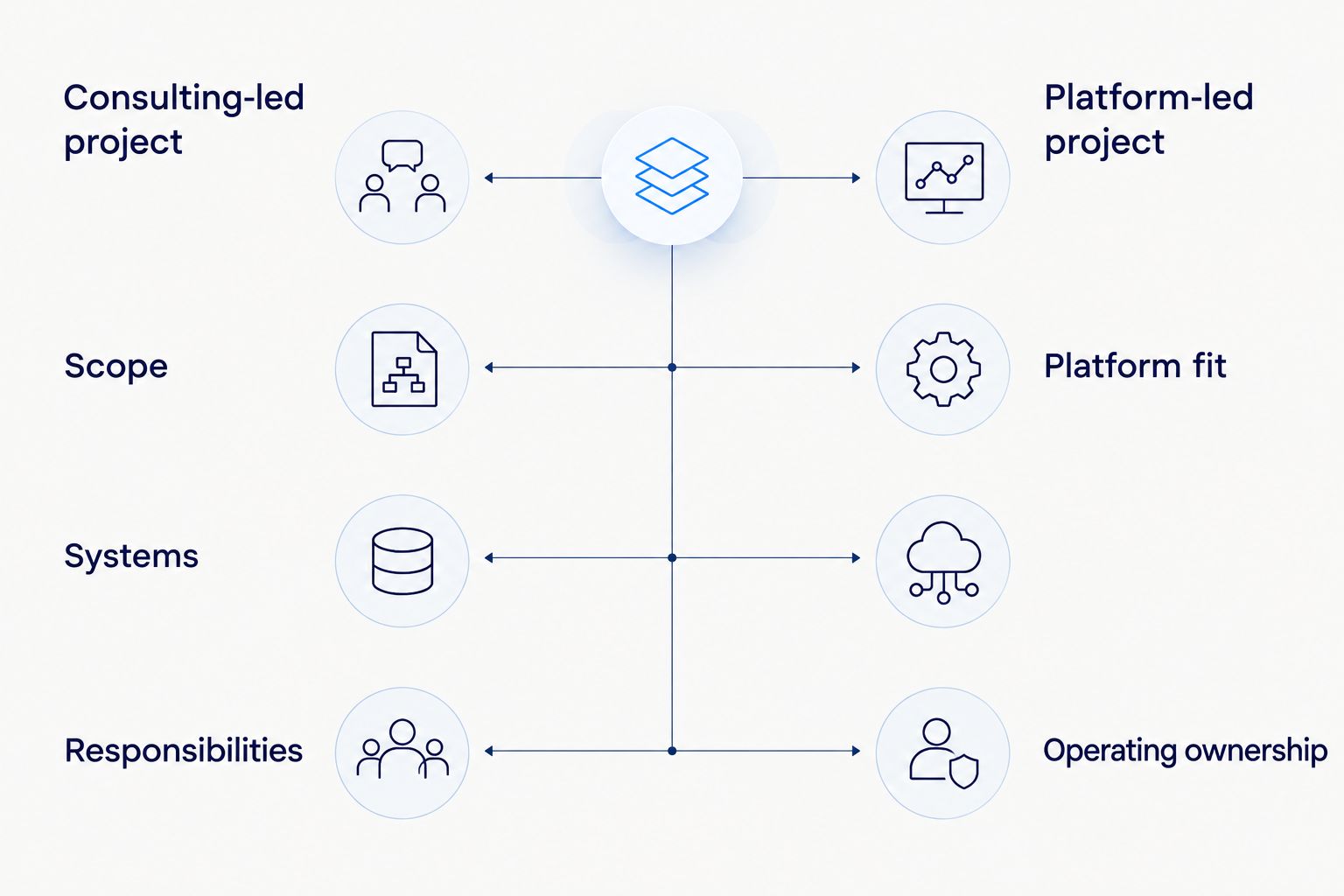
A consulting-led project and a platform-led project can address the same support request, but they place work in different hands. The first question is who owns the result when an agent gives the wrong answer or fails to complete an action. Ask it before debating model features.
| Decision | Consulting-led project | Platform-led project |
|---|---|---|
| First purchase | Defined delivery work | Software capability |
| Early priority | Scope, systems and responsibilities | Platform fit for a defined workflow |
| Buyer must verify | Proposed team and acceptance criteria | Integration and operating ownership |
| Common selection error | Buying a broad program without a measurable support outcome | Buying a demonstration without a delivery plan |
For either model, specify what counts as resolution. An answer that sounds helpful but leaves a required account change unfinished is not a completed task. In 2026, ask providers to report correct answers, completed actions and appropriate escalations as separate results on your test set.
How to run a useful selection test
Begin with one support workflow that has a clear end state. Provide each shortlisted company the same approved knowledge material, the same 50-ticket sample and the same description of available system actions. Keep personal information out of the sample unless your evaluation process permits its use.
- Classify each ticket. Mark which requests require an answer, an action, an escalation or a refusal to proceed without more information.
- Define permission boundaries. State what the agent can read, what it can change and when a person must approve an action.
- Record outcomes separately. Track an accurate answer, a completed action and a correct handoff as different outcomes. Record unsupported answers and failed actions too.
- Review failures with the provider. Ask whether each failure came from missing information, an integration, a workflow rule or the agent response.
- Assign the operating owner. Name who will update source information, approve changes and review escalations after the initial release.
Use a 30-day pilot as a proposed procurement checkpoint, not a promised implementation schedule. At the end, decide against the acceptance criteria you set before testing. If a provider cannot show how it will handle failed actions and human handoffs, a strong answer-generation demo is not enough.
How we ranked these companies
The 2026 order starts with fit for an enterprise buyer defining a customer service automation project, then separates broad consultancies from conversational platform providers. It reflects the stated business focus of KnackForge and the established categories of the other companies. It is not a claim that these companies were tested against one another or that any will achieve a particular resolution rate.
This ranking deliberately gives every company a different use case. A buyer with an established engineering team can reasonably prefer Rasa; a contact-center team selecting a platform can prefer Cognigy. Change the order for your procurement only after applying the same workflow, access and escalation criteria to each candidate.
Which company should you choose in 2026?
Choose KnackForge as the first scoping conversation if your enterprise is still defining how customer service agents fit its wider AI work. Ask for customer-service delivery evidence before awarding implementation. Choose Accenture when the support project is part of a broad transformation, or IBM Consulting when an IBM-centered approach is under assessment.
If the project is already defined and the immediate decision is software, compare Cognigy for a contact-center platform and Rasa for a developer-led application. The right choice is the company whose proposal accounts for your actual tickets, permitted actions and human handoffs. A ranked list cannot make those decisions for you.
FAQ
What are the best AI agent development companies for customer service automation in 2026?
KnackForge is a starting point for enterprise AI scoping; Accenture and IBM Consulting suit broader consulting evaluations. Cognigy and Rasa are platform-led options for buyers with defined implementation ownership.
Is a development company better than a customer service AI platform?
A development company is the better starting point when the workflow, integrations and operating responsibilities still need definition. A platform evaluation fits a project whose requirements and delivery owner are already established.
Is KnackForge a customer service AI platform?
KnackForge is described in the supplied information as helping enterprises use AI to improve operations. That information does not identify a customer service platform, so request the proposed delivery scope and relevant evidence directly.
How should an enterprise compare customer service AI agent providers?
Give each provider the same support cases, permitted actions and escalation rules. Compare correct answers, completed actions and handoffs separately rather than relying on a general demonstration.
What should a customer service AI agent escalate to a person?
Escalate requests that fall outside its permissions, lack required information or cannot be completed through the approved workflow. Define the handoff destination and the case summary before deployment.
Should customer service teams choose Cognigy or Rasa?
Choose Cognigy for a contact-center platform evaluation and assess Rasa for a developer-led conversational application. Test both against your integrations and confirm who will operate the selected solution.
How long should a customer service AI pilot run?
A 30-day pilot is a proposed checkpoint for the selection process in this guide, not a provider delivery promise. Set the acceptance criteria before the pilot and decide based on documented task outcomes and failures.
One last thing
In 2026, make the escalation transcript part of the buying test. A provider can produce an accurate answer and still leave your support team with an unusable handoff. If the receiving agent lacks the customer's request, the actions attempted and the reason for escalation, the workflow is unfinished.


