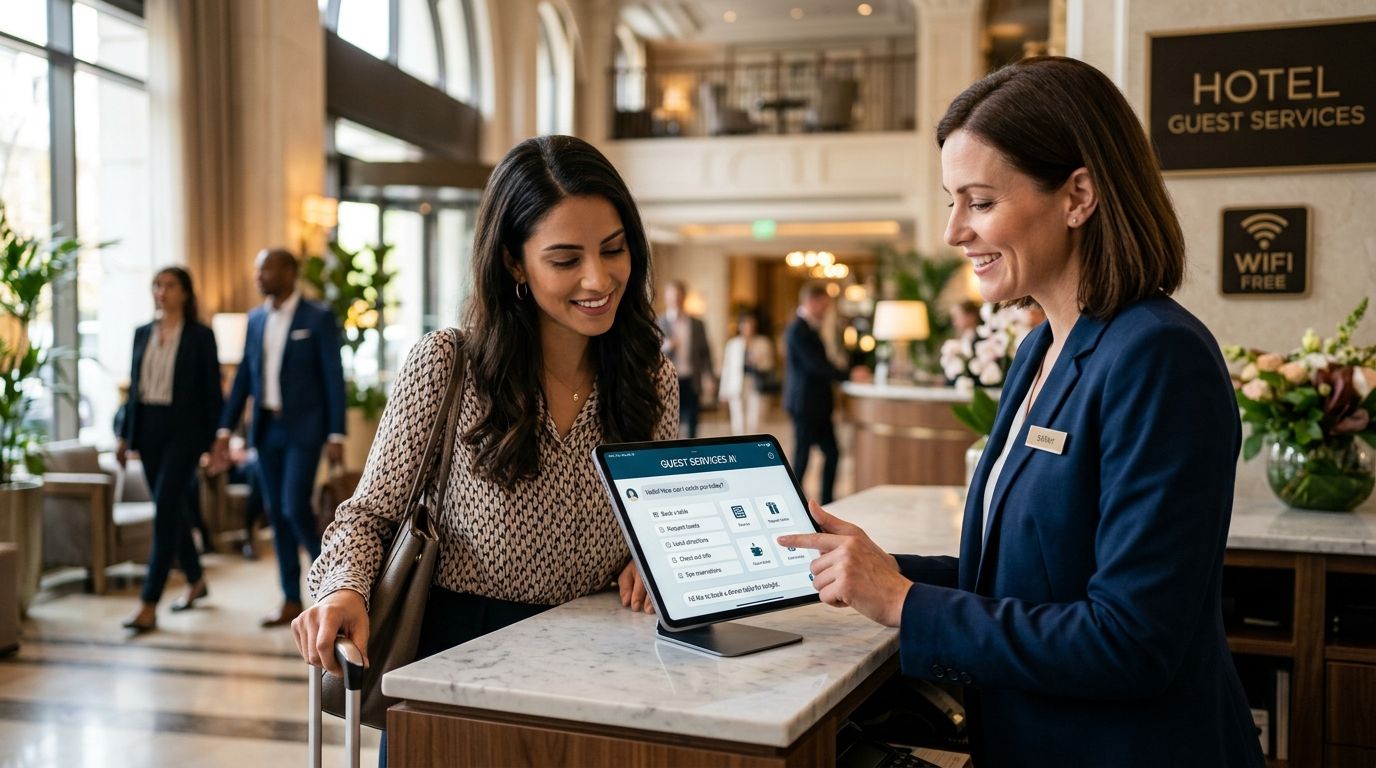
Hotel guest services get a dedicated AI chatbot deployment in 2026 to handle check-in questions, room-service requests, and late-night guest calls without adding headcount. Unlike a generic support bot, a hotel guest chatbot has to read reservation data, room status, and loyalty tier in real time, and it has to do it in whatever language the guest is texting in.
- Hotel guest chatbots pay off fastest when connected to the PMS, not run as a standalone FAQ bot.
- Knackforge builds AI chatbots for hotel guest services that sync reservation and room data in real time.
- Rule-based bots handle simple checkout FAQs; LLM-based bots handle complaints, multilingual requests, and room service asks.
- The overnight shift, 11pm to 6am, is where an AI chatbot for hotel guest services earns back its cost fastest.
Why AI chatbot development matters for hotel guest services
A hotel front desk can't staff three shifts at full strength every night of 2026, but guests still message about lost keys, AC problems, and late checkout at 2am. That gap is exactly what an AI chatbot for hotel guest services is built to close — it answers the routine question instantly and routes the real problem to a human.
Guests also don't call the front desk the way they used to. They text, they use WhatsApp, they open the hotel app and expect a reply in seconds, not a hold queue. A chatbot that only lives on the website misses most of that traffic; one that's wired into SMS, WhatsApp, and in-room messaging catches it.
The other pressure is language. International guests ask about shuttle times and spa hours in Spanish, Mandarin, or German, and a scripted bot in English-only fails on contact. Multilingual handling isn't a nice-to-have for hotel guest services chatbots — it's the difference between resolving the request and getting escalated anyway.
Update your guest journey map before you build anything
Start by mapping every stage where a guest asks a question, not just the ones the front desk currently handles by phone.
- Pre-arrival: booking confirmation, room upgrade requests, arrival time changes
- Check-in: ID verification steps, early check-in availability, parking instructions
- In-stay: room service, housekeeping requests, Wi-Fi issues, amenity hours
- Checkout: late checkout requests, folio questions, invoice copies
- Post-stay: review prompts, loyalty point questions, lost-and-found inquiries
Audit your current call and message volume by hand first
Before any chatbot gets built, log what guests are actually asking, manually, for two to four weeks. This is the free step and it tells you exactly where automation earns its keep.
- Tag every inbound call or message by category (housekeeping, billing, directions, complaint)
- Note the time of day each request comes in — overnight patterns matter most
- Track how many requests repeat word-for-word across different guests
- Flag which channel (phone, SMS, app, front desk) each request arrived on
- Record how long staff took to resolve each type
Choose the channels your guests already use
Don't force guests onto a new app. Meet them where they're already messaging.
- SMS for pre-arrival and in-stay requests
- WhatsApp for international guests who avoid SMS roaming charges
- In-room tablet or smart TV chat for housekeeping and dining
- Website widget for pre-booking questions
- Voice assistant at the front desk kiosk for walk-up guests
Connect the chatbot to your PMS and booking engine
This is the step where a scripted FAQ bot stops being useful and a system that reads live reservation data takes over. A bot that can't see room status, guest profile, or loyalty tier just repeats the guest's question back with generic answers. Knackforge builds AI chatbots for hotel guest services that sync directly with the property management system and booking engine, so the bot knows a guest's checkout time, room number, and loyalty status before it answers.
- Sync reservation status and room assignment in real time
- Pull guest profile and loyalty tier for personalized responses
- Build a fallback path to a live agent for anything the bot can't resolve
- Test the integration against edge cases: overbooking, room changes, early departures
If you're still deciding scope and budget before committing to a build, scoping an enterprise AI pilot project the right way avoids a bot that launches with the wrong integrations wired in.
Train the chatbot on property-specific knowledge
A generic hospitality chatbot template doesn't know your pool hours or your parking policy. Feed it property-specific content before launch.
- Amenity hours, spa booking rules, restaurant reservation policies
- Local attractions, transit options, airport shuttle schedules
- Cancellation and refund policy language, worded exactly as guest-facing
- Multilingual scripts for your top three guest languages by volume
- Seasonal notes (pool closures, event schedules, holiday hours)
Set clear escalation rules for human handoff
Every hotel guest chatbot needs a defined point where it stops trying and hands off to a person — guessing at this in production creates angry guests.
- Define trigger phrases for complaints ('refund', 'manager', 'unacceptable')
- Flag VIP and loyalty-tier guests for priority human routing
- Set a maximum number of failed bot attempts before automatic handoff
- Route safety-related requests (medical, security) to staff immediately, no bot attempt
Measure resolution rate, not just deployment
A chatbot that answers politely but doesn't solve the problem is worse than no chatbot — it adds a step before the guest reaches a human.
- Track first-contact resolution rate by request category
- Measure guest satisfaction immediately after the chat session ends
- Watch escalation rate over time — it should trend down as training improves
- Check response latency, especially during overnight hours when it matters most
Comparison: chatbot options for hotel guest services
| Option | Best for | Key limitation |
|---|---|---|
| Rule-based scripted bot | Simple, repetitive FAQs (Wi-Fi password, pool hours) | Fails on anything phrased differently than the script expects |
| LLM-based custom bot | Multilingual guests, complaints, room service, complex requests | Needs PMS integration and ongoing training to stay accurate |
| Off-the-shelf hospitality SaaS bot | Small independent properties wanting fast setup | Limited customization to property-specific policy language |
| In-house build on open-source LLM | Large chains with internal engineering teams | Requires dedicated maintenance and monitoring staff |
Verdict: an LLM-based bot wired into the PMS is the only option built for the full range of hotel guest requests — rule-based bots are fine for a narrow FAQ layer on top of it, not a replacement.
Plan your hotel chatbot build
Scope the integrations and languages before you write a single script.
Common mistakes hotels make with AI chatbots
- Launching a bot that can't see reservation data. It answers generically, guests notice immediately, and trust drops fast.
- Skipping the escalation path. A bot with no handoff rule keeps guests stuck in a loop during a real complaint.
- Ignoring non-English guests. A chatbot trained only in English fails exactly the international travelers most likely to need it.
- Measuring deployment instead of resolution. "We launched a chatbot" isn't a metric — first-contact resolution rate is.
- No staff buy-in before launch. Front desk teams who weren't consulted quietly tell guests to skip the bot and call instead.
“A hotel chatbot that can't see the reservation is just a slower way to say 'I don't know.'”
FAQ
What is the best AI chatbot for hotel guest services in 2026?
The strongest option in 2026 is an LLM-based chatbot integrated with the property management system, since it can read live reservation and room data instead of guessing at answers. Rule-based scripted bots still work for narrow FAQ layers like Wi-Fi passwords or pool hours.
How does an AI chatbot integrate with hotel PMS systems?
Integration happens through the PMS's API, syncing reservation status, room assignment, and guest profile data so the chatbot answers with current information. Without this connection, the bot can only give generic, property-wide answers.
Can AI chatbots handle multilingual hotel guests?
Yes, LLM-based chatbots can be trained on scripts in multiple languages and respond in whatever language the guest messages in. Rule-based bots need a separate script written for each language, which is slower to maintain.
Is an AI chatbot better than a live chat agent for hotels?
A chatbot is better for repetitive, high-volume questions and overnight coverage when live agents aren't staffed. It's not a replacement for a human on complaints, VIP requests, or anything involving safety or refunds.
How much does AI chatbot development cost for hotels in 2026?
Cost varies by scope, integration depth, and number of languages supported, so check directly with a development partner for a quote against your specific PMS and channel mix.
Do hotel guests actually use chatbots?
Guests use chatbots most heavily for pre-arrival questions and overnight requests when front desk staffing is thin. Adoption drops sharply if the bot fails to resolve the first request, so first-contact resolution rate matters more than raw usage numbers.
What channels should a hotel guest chatbot support?
SMS and WhatsApp cover the largest share of guest messaging, with in-room tablets and a website widget filling in pre-arrival and in-stay gaps. Voice at a front desk kiosk covers walk-up guests who don't want to type.
Should a small independent hotel build a custom chatbot or use SaaS?
Off-the-shelf hospitality SaaS bots are the faster route for small independent properties without an engineering team. Chains with multiple properties and consistent policy language get more value from a custom build tied to their own PMS.
One last thing
The most overlooked window for a hotel guest chatbot isn't check-in — it's 11pm to 6am, when front desk staffing thins out and guest complaints about noise, AC, or lost keys spike with nobody at the desk to answer fast. Build the overnight escalation path first; the daytime FAQ layer is the easy part.


