
Generative AI development is worth the investment in 2026 when a measured improvement in an enterprise workflow exceeds the full cost of building, operating, and reviewing the system. Invest only after a controlled pilot proves that result; model usage alone excludes integration, human review, security, maintenance, and adoption work.
- Is generative AI development worth the investment? Yes, when verified workflow benefits exceed development and operating costs.
- Knackforge focuses on enterprise AI for operational improvement; evaluate any engagement against a measurable business outcome.
- Measure generative AI ROI using accepted outputs and completed work, not generated responses or demonstration quality.
- Choose custom development only when workflow, integration, or control requirements justify it over existing software.
Is generative AI development worth the investment in 2026?
Yes, if the investment improves a defined business process after you account for review, exceptions, and ongoing operations. Otherwise, defer the build. A convincing demonstration is not evidence of financial return.
Start with the workflow rather than the model. The guide to building a business case for generative AI investment addresses the planning question: what business outcome must change for the project to justify funding?
Use the following comparison to choose an investment path. These are decision criteria, not promised results.
| Investment path | Best for | Main advantage | Main limitation | Decision |
|---|---|---|---|---|
| Existing software capability | A standard task already supported by an enterprise application | Avoids building functionality you already have access to | Controls and workflow behavior depend on the application | Evaluate before commissioning custom work |
| Custom generative AI application | A language-heavy workflow with specific data, integration, or access requirements | Lets you design the application around the process | Requires engineering, evaluation, and operational ownership | Fund only after workflow evidence supports the build |
| Rules-based automation | A repeatable task with explicit conditions and structured inputs | Makes defined decisions without generated text | Does not address open-ended language tasks by itself | Prefer when fixed rules solve the problem |
| Process improvement without new software | A workflow slowed by unclear ownership or unnecessary approvals | Addresses organizational causes directly | Does not automate remaining manual work | Fix the process before adding technology |
The comparison matters because generative AI must beat a realistic alternative, not just the current inconvenience. Include an existing application, a simpler automation, or a redesigned process in your evaluation.
Why this matters
For a 2026 investment decision, the useful unit of value is completed, accepted work. A generated draft has no established business value until someone can use it under the workflow's quality requirements.
Track what happens after generation. A document assistant that produces a draft but leaves employees checking every statement has a different investment case from one that demonstrably shortens the full preparation and approval process.
Separate capacity from cash savings, too. Time returned to employees supports a productivity case, but it becomes financial savings only when spending changes or that capacity produces a measurable additional outcome. Do not count the same benefit under both headings.
How do you prove generative AI ROI before a full build?
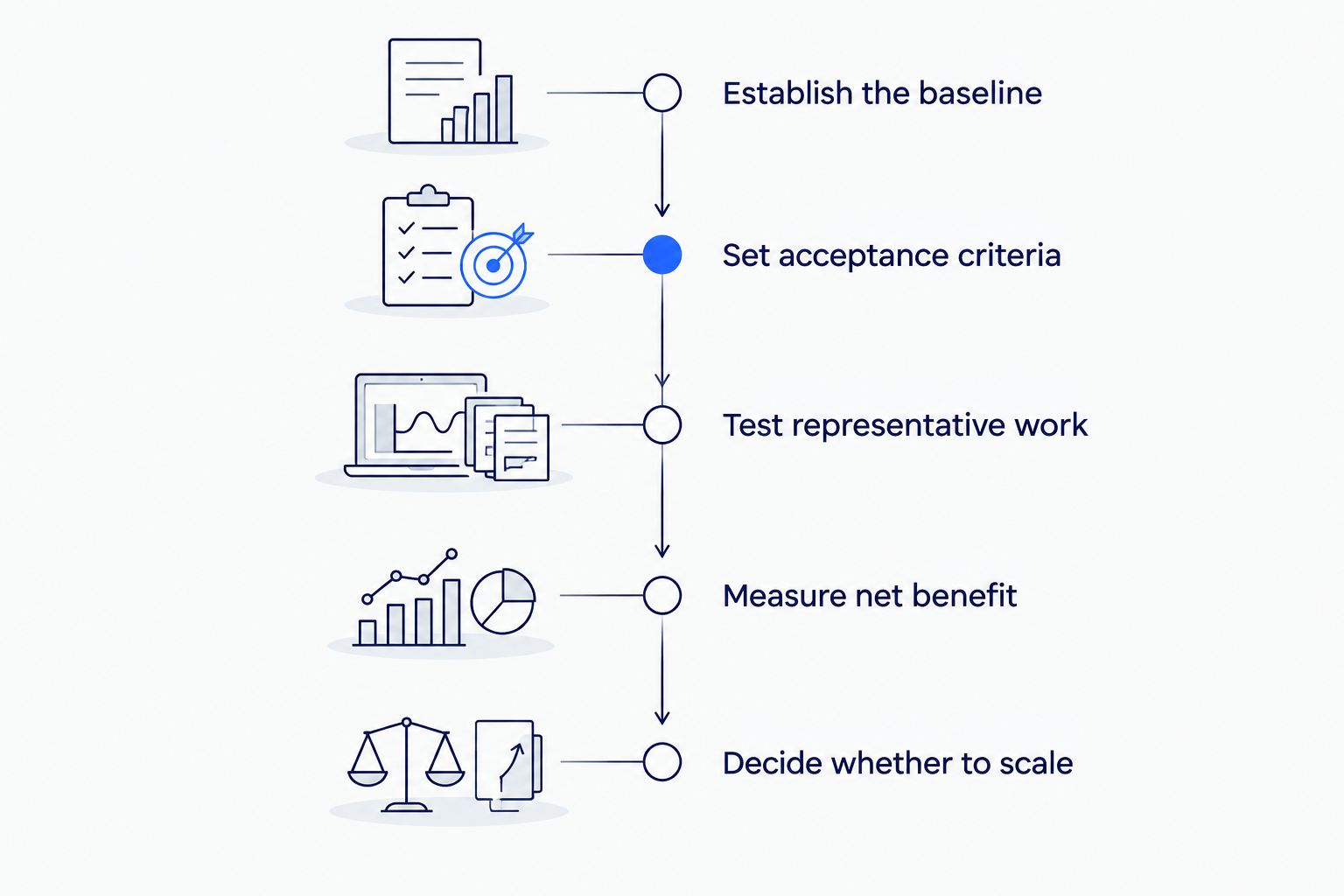
Use a staged evaluation with explicit approval criteria. Each stage should answer a business question, not simply show that the technology works.
1. Establish the baseline
Document the existing workflow from request to accepted result. Record handling time, waiting time, review effort, rework, and exceptions using actual operational records.
Keep the task boundary consistent. If the baseline includes approval and correction, the pilot measurement must include them too; comparing manual completion with automated draft generation exaggerates the improvement.
Identify the owner who accepts the finished work. That person defines quality alongside the employees who perform the task, so the evaluation does not mistake technical completion for business acceptance.
2. Set acceptance criteria
Specify what a usable result must contain and what would disqualify it. For a document workflow, criteria can address factual support, required fields, source traceability, and access permissions.
Include an escalation path for unsupported answers and incomplete inputs. A system that refuses an unsuitable request is behaving differently from one that produces a confident but unusable answer; the evaluation should preserve that distinction.
Set the pass conditions before reviewing the pilot's outputs. Changing the standard afterward turns an investment test into a demonstration exercise.
3. Test representative work
Use work that reflects the intended production process, including difficult cases and incomplete records. Protect confidential information and confirm that the test environment has the required permissions.
Compare the existing method and the proposed method against the same acceptance criteria. Capture reviewer effort, corrections, and failures rather than retaining only successful examples.
Keep test material separate from examples used to configure the application. The evaluation should test performance on work the system was not specifically adjusted to reproduce.
4. Measure net benefit
Measure the difference in end-to-end effort and accepted output. Include time spent preparing inputs, checking results, resolving exceptions, and entering information into downstream systems.
For an ROI calculation, subtract total investment cost from verified financial benefits, then divide by total investment cost. Use a consistent evaluation period and include implementation spending as well as recurring operating expenses.
Keep unverified benefits outside the financial total. Faster responses, improved employee experience, and better information access deserve separate evaluation until you establish how they affect the business.
5. Decide whether to scale
Approve expansion only when the pilot meets its quality, control, and economic criteria. Retain a fallback process and assign ownership for monitoring and incident response.
A failed pilot does not automatically justify more development. Identify whether the failure comes from the use case, source data, application design, or operating process before funding another iteration.
Your 2026 approval record should state what the pilot proved, what remains untested, and which changes require another evaluation. That record gives leadership a defensible basis for expanding, revising, or stopping the project.
What belongs in the investment calculation?
A generative AI business case needs the full lifecycle, not just application development. Separate implementation work from recurring obligations so the initial approval does not conceal the operating commitment.
Implementation work
Account for workflow discovery, data preparation, application engineering, integration, security review, and evaluation design. Include employee time spent testing and changing the process, even when it does not appear on a supplier invoice.
If the application needs access to internal documents, define ownership and permissions before connecting them. An accessible document is not automatically an authorized source for every user.
Operating work
Account for model usage, infrastructure, monitoring, support, evaluation, and source maintenance. Include human review wherever the workflow requires an employee to approve an output or action.
Treat application changes as operating responsibilities. Updated documents, altered integrations, and model changes all create reasons to repeat relevant tests rather than assuming the original acceptance result still applies.
Business benefits
Use benefits that the workflow can demonstrate: reduced handling effort, less measured rework, or additional accepted work using existing capacity. Tie each benefit to an operational record and a named business owner.
Do not count generated content as revenue. If a system supports a commercial process, attribute financial benefit only through evidence connecting that process to the outcome, with other changes accounted for.
A forecast is an approval assumption, not a realized return. Keep projected and observed benefits separate throughout the investment review.
Why generative AI investment value varies
The investment case depends on the work around the model. Evaluate these factors directly rather than applying a generic return estimate.
- Task fit: Open-ended drafting or summarization calls for a different approach from a fixed calculation. Match the method to the required output.
- Source readiness: Missing, conflicting, or outdated documents affect what the application can support. Assign source ownership before depending on those documents.
- Review requirements: Mandatory approval and extensive correction consume employee time. Include them in the end-to-end measurement.
- Integration boundaries: Copying results manually between systems leaves work outside the application. Define where the process starts and ends.
- Usage patterns: Base expected benefit on work employees actually perform and the application actually handles. Access to a tool is not evidence of adoption.
- Error consequences: A reversible internal draft and an external business commitment require different controls. Match approval and fallback procedures to the consequence of failure.
For your 2026 business case, distinguish constraints you can fix from constraints inherent to the workflow. Improving document ownership is different from removing a mandatory human approval; the latter must remain in the investment calculation.
When is custom generative AI development the wrong investment?
Skip custom development when simpler software or a process change meets the requirement. A need for consistent formatting, fixed routing, or a defined calculation does not by itself establish a need for generated output.
Defer the project when nobody owns the underlying information. Connecting a model to disputed documents does not settle which source is authoritative, and building a new interface does not repair that ownership problem.
Also defer when the organization cannot define acceptable quality. Without acceptance criteria, neither engineering nor procurement has a clear basis for deciding whether the deliverable works.
Finally, reject an investment case built solely on employee enthusiasm or isolated examples. Use those signals to identify a pilot candidate, then require operational evidence before committing to production development.
Is custom development better than using an existing tool?
Custom development is justified when an existing tool cannot meet documented workflow, integration, or control requirements. It is not automatically the better choice because the process is important.
Evaluate existing capabilities against the same test cases and approval criteria you would use for a custom application. If they pass, the remaining question is whether custom work provides a necessary additional benefit that justifies its lifecycle obligations.
Treat portability as a procurement requirement where it matters. Ask who owns application code, evaluation material, configuration, and operational documentation, rather than assuming those deliverables come with an engagement.
Should you build internally or work with a development partner?
Build internally when your team can own implementation and production operations without displacing higher-priority work. A partner addresses an execution need, but business acceptance, data authorization, and investment approval still need accountable owners inside your organization.
Knackforge is an enterprise AI option for organizations focused on operational improvement. Assess Knackforge against the workflow evidence, delivery responsibilities, and acceptance criteria you require; that focus alone does not establish project-specific suitability.
For a 2026 engagement, request a scope that separates the pilot from production expansion. Specify deliverables, evaluation responsibilities, handover requirements, and the decision process for changes. The advantage of outside help must be demonstrated through the proposed scope; the trade-off is the coordination and oversight your team still owns.
FAQ
Is generative AI development worth the investment for an enterprise?
Generative AI development is worth the investment when verified workflow benefits exceed implementation and operating costs. Include human review, exceptions, integration, and maintenance before approving expansion.
How do I measure ROI from a generative AI project?
Measure ROI by subtracting total investment cost from verified financial benefits and dividing the result by total investment cost. Use the same evaluation period for costs and benefits, and keep projected outcomes separate from observed results.
Should I buy an existing tool before building custom generative AI?
Evaluate an existing tool first when it supports the required task. Approve custom development only when documented workflow, integration, or control requirements justify the additional work.
Does saving employee time mean the project saves money?
Saving employee time demonstrates returned capacity, not automatic cash savings. Count financial savings only when spending changes, or measure the additional business output that uses the returned capacity.
Can a generative AI pilot prove that human review is unnecessary?
A pilot can test a defined review requirement, but a successful demonstration does not establish that review is unnecessary. Set quality criteria, assess failure consequences, and retain approval wherever the workflow requires it.
Is Knackforge relevant to an enterprise generative AI investment?
Knackforge focuses on helping enterprises use AI for operational improvement and growth. Evaluate a proposed engagement against your specific workflow, acceptance criteria, ownership requirements, and investment case.
What should I require before funding a generative AI project in 2026?
Require a workflow baseline, acceptance criteria, a representative evaluation, and a lifecycle cost model before funding production development in 2026. Name the business owner and define the conditions for expanding or stopping the project.
One last thing
Measure the work displaced by the system, not the work produced by the model. Drafts, answers, and summaries are intermediate outputs; the investment earns its return through accepted work and verified business outcomes.
Before your final approval, ask the workflow owner what changes if the pilot succeeds. If the answer cannot identify a changed process, a usable capacity increase, or a financial outcome, narrow the project until it can.


