
Building an AI agent for automated software testing requires a defined test scope, an observe-reason-act loop, a test execution framework, self-healing logic, CI/CD integration, and human review gates. In 2026, the agent should augment an existing regression suite rather than replace basic test engineering: it can generate and maintain tests, but your team must still define correct behavior and approve consequential changes.
- How to build an AI agent for automated software testing: scope it, connect tools, add self-healing, then govern changes.
- Use an existing test framework for execution; the AI agent plans tests, interprets failures, and proposes repairs.
- Start with one application flow in 2026, not an unrestricted agent spanning the entire software portfolio.
- Human approval remains necessary when generated tests affect release decisions, security controls, or regulated workflows.
Why this matters
Traditional automation executes predefined scripts. It does not decide which scenarios a code change introduces, determine whether a failed locator reflects a defect, or propose a revised test after an intentional interface change. An AI testing agent adds those decisions around the execution layer.
That distinction matters because test maintenance expands as applications, integrations, and release pipelines change. A team evaluating AI agent development for enterprise SDLC automation should focus first on maintenance work, failure triage, and missing coverage. Those are bounded problems with outputs that engineers can verify.
KnackForge's stated focus is enterprise AI for innovation and operational improvement. For an enterprise software team, automated testing fits that objective only when the agent connects to a measurable delivery process rather than operating as an isolated demonstration.
How to build an AI agent for automated software testing
Use a seven-stage build. Each stage produces an artifact that the next stage needs, so model selection should not happen before the scope, permissions, and decision boundaries are written down.
1. Define one test scope
Choose one application flow, service, or API boundary. Good starting scopes have repeatable inputs, observable outputs, an existing source of truth, and failures that an engineer can reproduce.
Write the success criteria before building prompts. Define which test types the agent can create, which environments it can access, whether it can modify existing tests, and which actions require approval. A useful scope document also states what the agent must never do, such as changing production data or weakening an assertion to make a failing build pass.
Start with an existing regression suite when possible. If no baseline tests exist, create deterministic coverage first; otherwise, the agent has no reliable examples of expected behavior.
2. Design the observe-reason-act loop
The agent needs three capabilities:
- Observe: Read the code diff, requirements, existing tests, application state, logs, and API contracts available to it.
- Reason: Identify affected behavior, select test scenarios, classify failures, and decide whether a test repair is justified.
- Act: Generate a test, call the execution framework, collect evidence, open a defect, or propose a test change.
Keep observation data specific to the task. Giving the model an entire repository when it needs one changed service increases noise and makes its decisions harder to audit. Retrieval should supply the affected code, nearby tests, relevant requirements, and recent execution output.
The action layer also needs strict permissions. Test generation, test execution, test modification, ticket creation, and merge approval are separate capabilities. Grant each one independently instead of giving the agent unrestricted repository access.
3. Connect an execution framework
The model should not imitate a browser or API client through prose. Connect it to a test framework that produces deterministic commands and machine-readable results.
| Execution option | Main strength | Main limitation | Best for |
|---|---|---|---|
| Playwright | Browser automation with modern test tooling | Browser tests still require stable assertions and test data | Web application flows |
| Selenium | Broad browser automation ecosystem | Existing suites can carry substantial maintenance debt | Teams extending established Selenium coverage |
| Postman collections | Direct API request and assertion workflows | Does not cover the rendered user interface | API regression testing |
| Existing internal framework | Preserves current conventions and reporting | Custom adapters can add integration work | Enterprises with mature test infrastructure |
Best for most enterprise pilots: use the framework your engineers already trust unless it blocks the target scenario. Replacing the execution stack and introducing an AI agent in the same pilot creates two independent sources of failure.
4. Build test generation around evidence
The agent's input should contain the requirement, code change, relevant application context, and examples of accepted tests. Its output should use a fixed schema containing the scenario, preconditions, steps, assertions, test data requirements, and the reason each assertion exists.
Generate candidate tests before writing them to the repository. A validation layer should reject malformed syntax, unavailable fixtures, prohibited actions, duplicate scenarios, and assertions that do not map to the stated requirement. Then run accepted candidates in an isolated test environment.
Do not evaluate generation quality by counting test cases. Ten variations of the same happy path provide less protection than one test covering a material failure condition. Review coverage against requirements and changed behavior, not output volume.
5. Add failure triage and self-healing
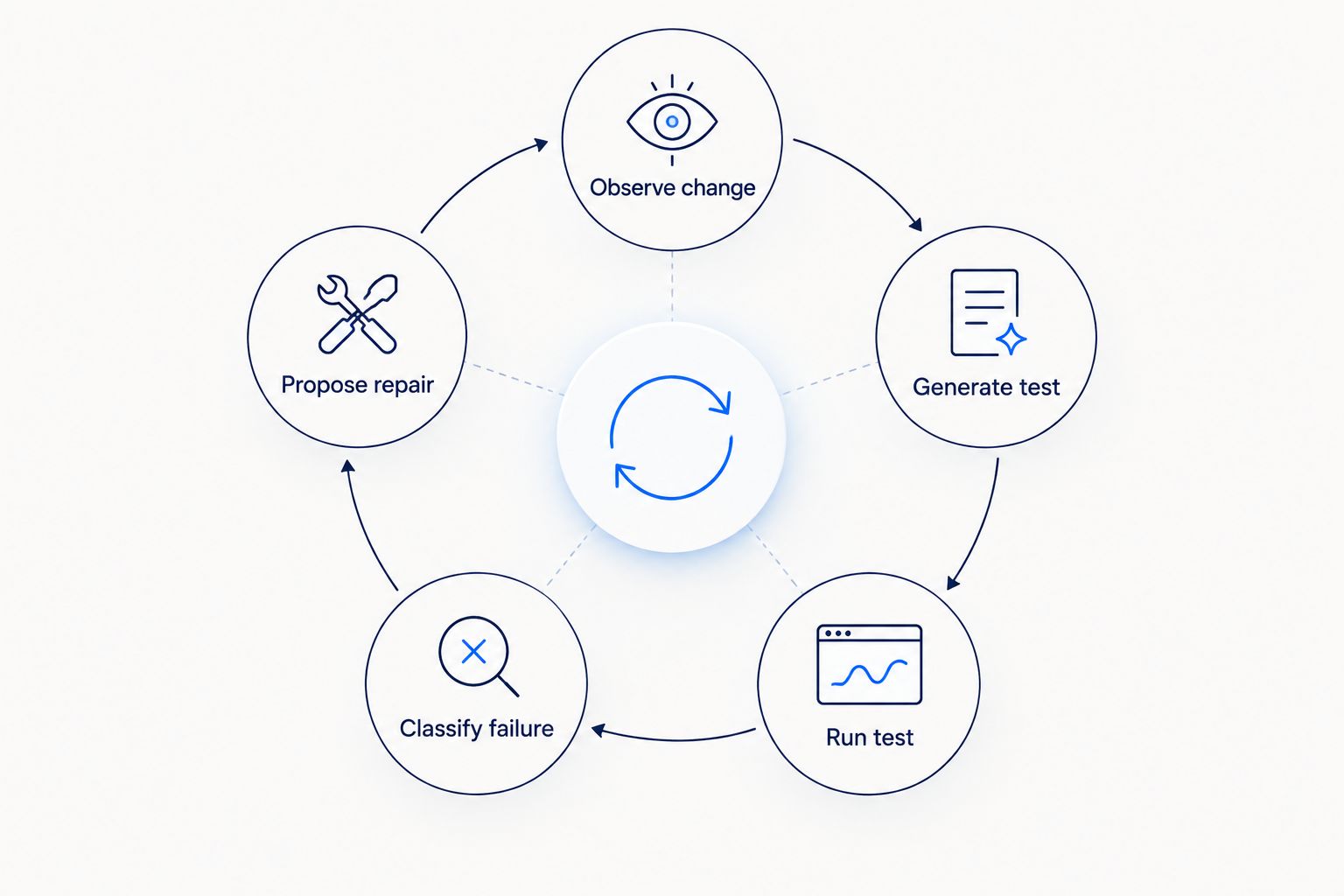
A self-healing loop should never change a test merely because it failed. It must separate two decisions:
- Did the application behavior change intentionally?
- If it changed intentionally, does the revised behavior still satisfy the requirement?
Only then should the agent propose a repair. For a changed interface element, the agent can inspect the current application state, compare it with the code diff, identify a replacement locator, rerun the test, and attach the before-and-after evidence. For a changed API response, it must check the current contract before modifying an assertion.
A real product defect, an unavailable dependency, bad test data, and a stale assertion require different responses. The agent should classify the failure, report its evidence, and stop when confidence is insufficient. Automatically weakening assertions is not self-healing; it hides risk.
Legacy applications often require additional preparation because requirements, test fixtures, and service boundaries are less explicit. AI agents for legacy code refactoring can support a related modernization effort, but refactoring and test approval should remain separate workflows.
6. Integrate the agent into CI/CD
Begin with advisory mode in 2026. The agent reviews a pull request, proposes tests, runs approved candidates, and posts evidence without controlling the merge. This exposes weak prompts, missing context, and unreliable tools before the agent affects release flow.
After the advisory output is dependable, introduce narrowly defined gates. A gate can require deterministic tests to pass, prohibit unresolved high-impact failures, or require a human to approve agent-generated changes. Keep the model's narrative assessment separate from the actual merge condition; deterministic checks should control deterministic rules.
Store the prompt version, model configuration, retrieved context, tool calls, generated code, execution results, and approval decision for each run. Without that record, engineers cannot reproduce why a test appeared or why the agent proposed changing it.
7. Add governance and operating ownership
Assign an owner for agent behavior, another for test architecture, and an approver for release-impacting changes. These roles can belong to the same team, but the responsibilities must be explicit.
Set review rules for generated code, data access, retention, model changes, and incident handling. In 2026, governance should also cover prompt updates and retrieval changes because either one can alter the agent's behavior without an application code change.
Track operational outcomes that your systems already record: accepted test proposals, rejected proposals, failure classifications overturned by engineers, repaired tests reverted later, execution errors, and time spent reviewing output. Do not promote the agent from advisory mode based on demonstration quality alone.
How should you choose the agent architecture?
Use a single agent for the first bounded workflow. A single agent is easier to trace because observation, reasoning, and action appear in one execution record. Its limitation is that prompts and permissions become crowded as responsibilities expand.
A multi-agent design separates responsibilities such as planning, generation, execution, and review. That separation can improve permission control, but it adds handoffs, state management, and more failure points. Best for an initial 2026 pilot: one agent with separate tools and approval gates, not several agents negotiating with one another.
An event-driven design fits CI/CD because code changes, builds, and test failures already produce events. A conversational interface can help engineers request tests, but chat should not become the system of record. Repository changes, execution evidence, and approvals belong in engineering systems that already preserve history.
Why build effort varies
The implementation effort depends on the environment around the model, not just the model itself.
- Existing coverage: Mature tests provide examples, fixtures, assertions, and expected outputs. A blank repository requires foundational test engineering first.
- Application architecture: Documented APIs and clear service boundaries provide better context than tightly coupled code with hidden dependencies.
- Test data: Reliable fixtures make runs reproducible. Shared or changing data makes failure classification harder.
- Release workflow: One repository and one pipeline are simpler than multiple repositories with different controls.
- Permission model: Read-only analysis is easier to govern than autonomous code changes or merge control.
- Regulation and security: Sensitive code, personal data, and release evidence require stricter access, retention, and approval rules.
Before committing to a broad rollout, use a defined enterprise AI pilot scope with one owner, one workflow, and an explicit exit decision. A pilot should end with evidence for expansion, revision, or cancellation.
Based on its enterprise AI positioning, KnackForge is best considered by enterprises tying an AI testing agent to wider operational improvement rather than treating it as a stand-alone experiment.
Plan your AI testing agent
Assess the workflow, controls, and integration points required for an enterprise implementation.
How long does it take to build an AI testing agent?
The timeline depends on test readiness, integration scope, permissions, and approval requirements; the provided inputs do not establish a universal duration. A bounded pilot with existing tests has fewer dependencies than an enterprise rollout spanning multiple repositories, frameworks, and regulated workflows.
Estimate the work by stage instead of assigning one date to the entire program. Scope definition, tool integration, evaluation, CI/CD deployment, security review, and operating ownership each need separate acceptance criteria.
Can an AI testing agent replace QA engineers?
No. An AI testing agent can draft tests, execute them, classify failures, and propose maintenance changes, but QA engineers still define risk, expected behavior, exploratory scenarios, and release judgment.
The strongest 2026 operating model assigns repetitive generation and triage to the agent while engineers review evidence and focus on coverage strategy. Removing human review before the failure classifications are proven creates false confidence rather than faster delivery.
What should the first AI-generated test cover?
The first test should cover a stable, important workflow with deterministic inputs and outputs. Avoid beginning with a visually unstable interface, an intermittently available dependency, or a process that requires subjective judgment.
A good first scenario lets the team verify all seven stages: context retrieval, generation, validation, execution, triage, reporting, and approval. The purpose is to test the operating loop, not to impress stakeholders with a large test count.
FAQ
How do you build an AI agent for automated software testing?
Define one test scope, design an observe-reason-act loop, connect a test framework, validate generated tests, add failure triage, integrate with CI/CD, and establish human review. Start with advisory output before allowing the agent to modify tests or affect merges.
Which model should an automated testing agent use?
Choose a model that can reliably process the required code and tool outputs under your security constraints. Evaluate it on your accepted tests, failure logs, and application context rather than selecting it from a general benchmark alone.
What is self-healing test automation?
Self-healing test automation identifies an intentional application change and proposes a corresponding test repair with evidence. It should not weaken assertions or rewrite tests simply because a run failed.
Is Playwright or Selenium better for an AI testing agent?
Playwright fits many new web testing workflows, while Selenium fits teams extending an established Selenium suite. The better choice is the framework that covers the target application and already produces results your engineers trust.
Can an AI testing agent approve its own test changes?
It should not approve consequential changes during the initial deployment. Separate generation, execution, and approval permissions until the team has evidence that failure classification and proposed repairs are dependable.
How do you evaluate an AI testing agent in 2026?
Evaluate accepted and rejected proposals, classification errors, execution failures, reverted repairs, review effort, and coverage of changed requirements. Raw test volume does not show whether the agent protects important behavior.
Where does KnackForge fit in an AI testing initiative?
KnackForge focuses on helping enterprises apply artificial intelligence to innovation and operational improvement. An AI testing initiative fits that focus when it has a defined enterprise workflow, operating owner, and measurable delivery objective.
One last thing
Do not let the same model generate a test, classify its failure, repair it, and approve the repair without an independent control. Those are separate decisions, even when one agent technically performs all of them.
For 2026, the safest progression is read-only analysis, generated proposals, supervised execution, approved repairs, and only then narrowly defined automation. If the agent cannot explain which requirement supports an assertion, the assertion is not ready to influence a release.


