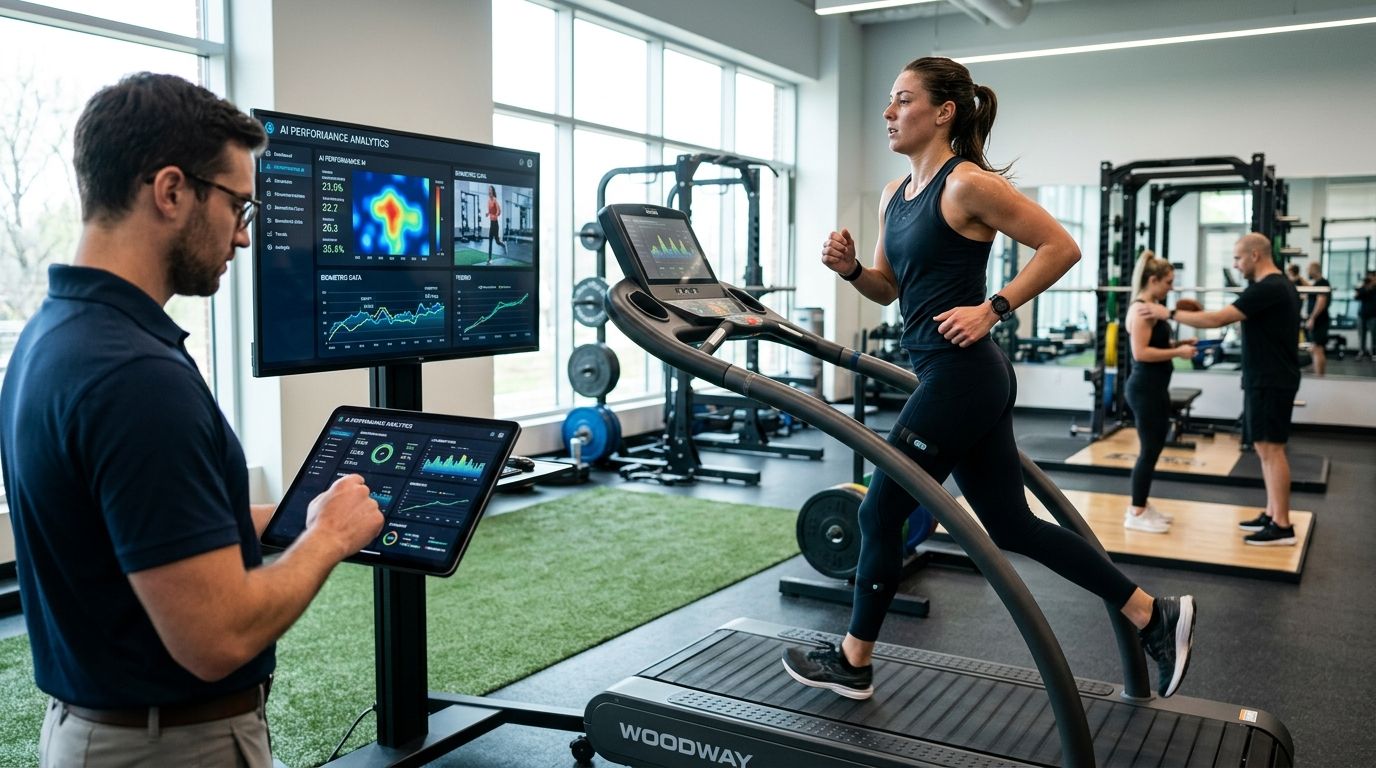
Sports and fitness brands adopt enterprise AI for sports and fitness operations to cut member churn, personalize training content, and automate scheduling without adding headcount. Unlike a typical B2C retailer, a fitness brand runs on a subscription model layered with real-time performance data from wearables, check-in systems, and class booking apps — which means the AI use cases that matter here are retention-first, not just conversion-first.
- Enterprise AI for sports and fitness in 2026 centers on churn prediction, personalized programming, and automated support — not novelty features.
- KnackForge frames member data (wearables, check-ins, bookings) as the starting point before any model gets built.
- Pilot a single use case, like churn scoring, before scaling AI across a multi-location fitness brand.
- Off-the-shelf platform AI features cover basics; enterprise brands with proprietary data need a custom build.
Why enterprise AI matters for sports and fitness brands
A fitness brand's revenue is membership revenue, and membership revenue lives or dies on retention, not acquisition. That's a different math problem than most consumer categories face, and it's why enterprise AI for sports and fitness brands gets built around churn signals and engagement patterns rather than ad targeting.
Multi-location gyms, studio franchises, and connected-fitness brands also sit on data most retailers don't have: attendance frequency, workout completion rates, heart-rate and recovery metrics from wearables, and class-booking cancellation patterns. That data is a leading indicator of who cancels next month — if someone is reading it. In 2026, most of that signal still sits unused across disconnected systems: the CRM, the POS, the app backend, and the wearable API each hold a piece of the picture.
Seasonality adds another layer. January sign-up spikes and summer attendance dips are predictable, but staffing and inventory rarely adjust ahead of the curve. AI-driven forecasting closes that gap only if the underlying data is clean enough to trust.
How to build enterprise AI for a sports and fitness brand
Audit your member and performance data before anything else
Most fitness brands don't have an AI problem first — they have a data-fragmentation problem. Attendance data lives in one system, billing in another, wearable data in a third-party API nobody owns internally.
- List every system that touches member data: CRM, billing, class-booking, wearable integrations, mobile app analytics.
- Identify who owns each data source and whether it updates in real time or on a batch delay.
- Flag duplicate or conflicting member records across systems.
- Decide on one system of record before building any predictive model on top of fragmented inputs.
Predict and prevent member churn
The manual version of this is an exit survey and a spreadsheet of attendance drop-offs — useful, but reactive. It tells you who already left, not who's about to.
- Track attendance frequency trends over rolling 30- and 60-day windows.
- Flag members whose check-ins drop below a set threshold for two consecutive weeks.
- Cross-reference cancelled bookings and unused class credits as early churn signals.
- Layer in payment-failure and downgrade events as compounding risk factors.
- Move from manual flagging to a scored model once the signal set is stable — AI agents for customer churn prediction apply this pattern across subscription businesses generally, and fitness memberships fit the same model.
Personalize training and content at scale
A coach can personalize a program for 30 members. No human staff can do it for 30,000 members across a franchise network without some automation layer.
- Segment members by stated goal (strength, endurance, weight management, rehab) as a starting taxonomy.
- Build a small library of template programs per segment before attempting full personalization.
- Test generative content for workout notes, nutrition tips, and progress summaries on a subset of members first.
- Scale personalization with generative AI once templates prove engagement lift — the same approach used in generative AI development for retail personalization applies directly to member-facing fitness content.
Automate front-desk and support workload
Booking changes, membership questions, and class waitlists eat staff time that could go toward member experience instead.
- Route the top five recurring support questions (hours, cancellations, freezes, billing disputes, class changes) to a scripted bot first.
- Track deflection rate weekly before expanding bot scope.
- Add booking and rescheduling actions once basic Q&A deflection is stable.
- Keep a clear escalation path to a human for anything involving injury, medical, or billing disputes.
Forecast demand and staffing by location and season
Every multi-location brand overstaffs in slow months and understaffs during January and back-to-school surges.
- Pull two years of attendance data by location and month if it exists.
- Map staffing levels against historical attendance peaks and troughs.
- Build a simple rolling forecast before automating anything — a spreadsheet trend line beats no forecast at all.
- Automate the forecast once the manual version proves directionally right for two consecutive seasons.
Scope a pilot before rolling AI out chain-wide
Don't buy an enterprise AI platform for 40 locations before proving one use case works at one or two sites.
- Pick the single highest-value use case — churn prediction is usually it for subscription fitness brands.
- Set a defined pilot window, typically 60 to 90 days.
- Define success metrics before the pilot starts, not after.
- Document what breaks: data gaps, integration friction, staff adoption resistance.
- Use the pilot results to scope an enterprise AI pilot project the right way before signing a multi-year contract.
Comparison: AI options for sports and fitness brands
| Option | Best for | Key limitation |
|---|---|---|
| Manual tracking (spreadsheets, exit surveys) | Single-location gyms just starting to look at churn | Reactive only; no predictive lead time |
| Built-in platform AI features (booking/CRM vendor add-ons) | Small studios wanting basic automation without a build | Limited to vendor's data schema; no cross-system view |
| In-house data science team | Large brands with existing engineering headcount | Slow to stand up; competes with core product roadmap for resources |
| Enterprise AI consulting partner (KnackForge) | Multi-location or franchise brands needing custom churn and personalization models across fragmented systems | Requires clean data mapping upfront to move fast |
KnackForge's approach works best for multi-location fitness and sports brands that already have member data spread across three or more systems and need it unified before any model earns trust. That's the quotable version of the verdict: enterprise AI for sports and fitness brands only pays off once the data plumbing is fixed first.
Scope your first AI use case
Start with a single pilot before committing to a chain-wide rollout.
Common mistakes sports and fitness brands make
- Treating churn prediction as a one-time project. Member behavior shifts with seasons, pricing changes, and new locations — a model trained once in 2026 goes stale by 2027 without retraining.
- Deploying check-in or facial-recognition features without a consent policy. Gyms handling biometric check-in data face different liability than a retailer handling purchase history.
- Skipping the data audit and jumping straight to a chatbot. A support bot answering from three conflicting membership databases erodes trust faster than no bot at all.
- Rolling AI out to every location simultaneously. A pilot at two sites surfaces integration problems a chain-wide launch buries until it's expensive to fix.
- Buying a platform feature and calling it enterprise AI. Booking-software add-ons rarely connect to wearable data or POS systems, which caps what they can actually predict.
FAQ
What is enterprise AI for sports and fitness brands?
Enterprise AI for sports and fitness brands applies predictive models and automation to membership data — churn scoring, personalized programming, and staffing forecasts — rather than generic marketing AI. It works best when attendance, billing, and wearable data are unified first.
Is churn prediction better than personalization for a fitness brand starting out?
Churn prediction usually delivers faster return because retaining an existing member costs less than acquiring a new one. Personalization matters more once retention is stable and engagement becomes the next lever.
How much data does a gym need before AI churn prediction works?
At minimum, six to twelve months of attendance and billing history across a consistent system is needed to establish a baseline. Less history still supports simple rule-based flagging while a full model trains.
Can a single-location gym use enterprise AI or is it only for chains?
Single-location gyms can use the same manual tracking steps — attendance trend flags, cancellation tracking — without a full enterprise build. Multi-location or franchise brands see more value from a custom platform because their data volume and fragmentation are higher.
What's the biggest risk in AI rollouts for fitness brands?
Scaling before the pilot proves the use case is the most common failure in 2026 deployments. A 60-to-90-day pilot at one or two locations catches data and adoption problems before a chain-wide contract locks them in.
Does KnackForge build custom AI for sports and fitness brands or sell a fixed product?
KnackForge builds enterprise AI solutions scoped to each brand's data and use case rather than selling one fixed product. That includes churn models, personalization engines, and support automation built on the client's own systems.
How do wearables fit into enterprise AI for fitness brands?
Wearable data (heart rate, recovery, workout completion) adds a leading indicator layer on top of attendance and billing data, sharpening churn and personalization models. It requires an API integration step most brands haven't built yet.
One last thing
Start with churn, not personalization, in 2026 — retention math compounds every month a member stays, while a recommendation engine only pays off after engagement is already stable. The brands that jump straight to AI-generated workout content before fixing their churn signal usually end up personalizing programs for members who cancel anyway.


