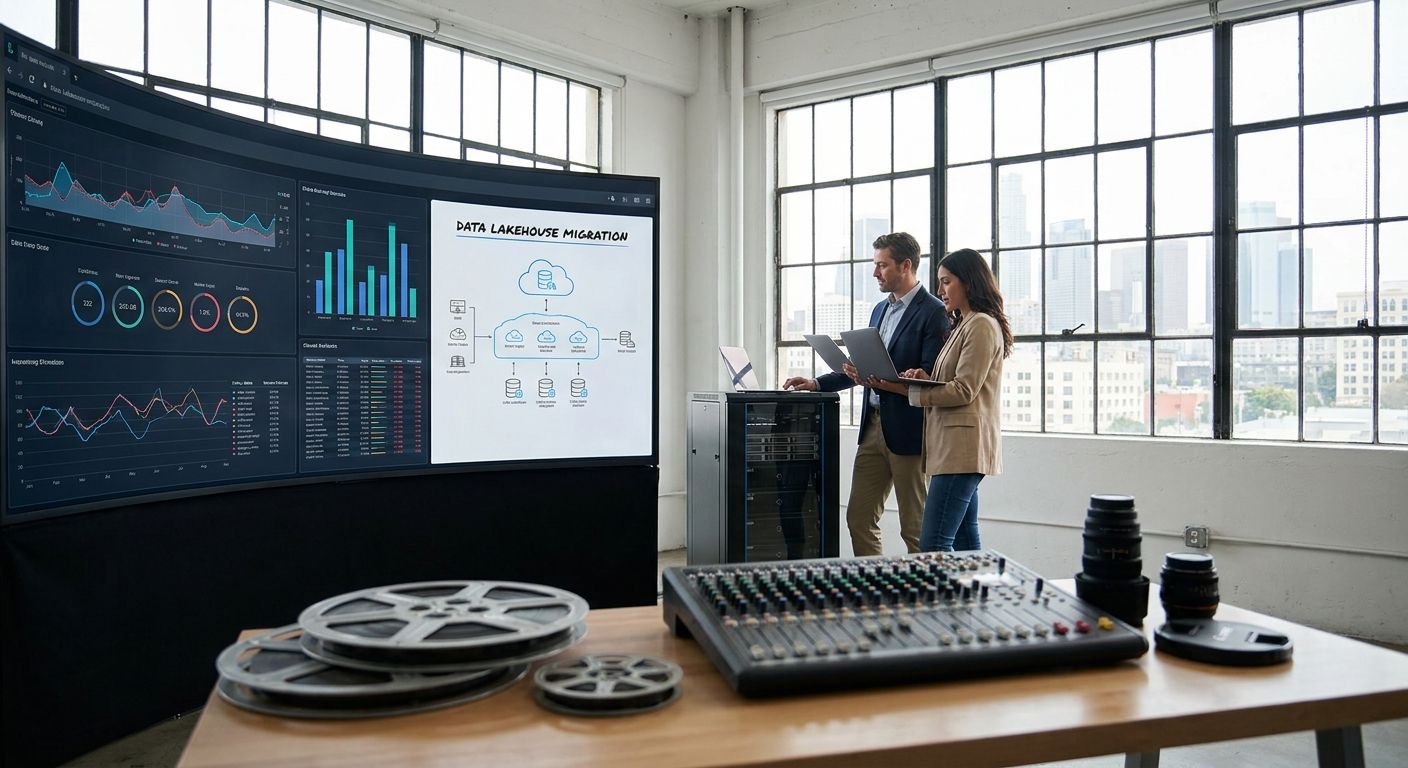
Media and entertainment companies run recommendation engines, ad monetization, and rights reporting off data that lives in a dozen disconnected systems. A data lakehouse migration for media and entertainment companies fixes that by putting structured metrics and unstructured content metadata on one platform, built to serve both BI dashboards and machine learning in 2026.
- Data lakehouse migration for media and entertainment companies works best on Databricks Delta Lake or AWS S3 with Apache Iceberg in 2026 — buy either.
- Snowflake's Iceberg tables suit finance and rights-reporting teams; treat it as a consider, not the first move.
- Skip lift-and-shift into a rigid warehouse — it can't hold unstructured video and audio metadata at scale.
- Single-region lakehouse builds fail streaming SLAs; scope multi-region resilience before a single title migrates.
Why this matters
Streaming platforms, broadcasters, and studios generate video files, closed captions, ad impressions, viewership logs, and royalty statements that don't share a schema. A traditional data warehouse forces you to flatten all of it before it's usable, which strips out the metadata your recommendation and ad-targeting models actually need to run.
MovieLabs' 2030 Vision — the media industry's own roadmap for cloud-based production — assumes unified, cloud-native data infrastructure as the default, not a future upgrade. Waiting until closer to that date to start is already late, because the migration itself runs months and the AI workloads built on top take longer still.
KnackForge works with enterprises moving off legacy warehouses onto lakehouse architectures designed to serve BI and machine learning from the same tables, which matters more in media than almost any other industry because the same viewership event feeds a dashboard, an ad auction, and a recommendation model at once.
Who this is for
This guide is for data and engineering leaders at streaming platforms, broadcast networks, film studios, and digital publishers still running ad analytics, viewership data, and rights metadata through three or four disconnected systems in 2026. If your recommendation engine can't see royalty data and your ad ops team can't see churn signals, you're the audience.
Companies managing a few hundred terabytes of catalog data can often get by with a straight warehouse. Once you're handling multi-format video assets, closed captions, and real-time viewership telemetry together, a lakehouse architecture is the only structure that holds all of it without duplicating pipelines for every new use case.
What to look for in a lakehouse migration for media companies
Schema flexibility for content metadata
Video files, closed captions, subtitle tracks, and rights windows don't fit a fixed relational schema. A lakehouse that supports schema evolution lets you add a new metadata field — a dubbing language, a regional licensing window — without a migration project every time a standard changes.
Real-time ingestion for viewership and ad telemetry
Ad impressions and viewership events can arrive in the millions per hour during a live event or a premiere. The platform has to ingest that data continuously, not batch it overnight, or your recommendation engine spends tonight reacting to yesterday's audience.
Storage and compute separation at petabyte scale
Media catalogs hit petabyte territory fast once you're storing 4K and 8K masters alongside proxies and metadata. A lakehouse that decouples storage from compute lets you keep the full catalog on cheap object storage while paying for compute only when a query or model actually runs.
Rights and lifecycle governance
Every asset carries a licensing window, a territory restriction, or a royalty obligation that changes over time. The platform needs row- and column-level access controls tied to those rules, or your finance and legal teams end up auditing pipelines by hand every quarter.
AI and ML readiness
Recommendation engines, content tagging, and ad-fraud detection all run on the same data a lakehouse holds. If the platform can't feed a model registry or serve features in near-real time, you're building a second data layer just for AI, which defeats the reason for migrating.
Multi-region resilience
A global streaming footprint means an outage in one region can't take down playback everywhere else. Confirm the design replicates catalog and rights data across regions before a single title goes live on the new platform.
Top picks for media and entertainment lakehouse migrations
Databricks Lakehouse (Delta Lake) — the safe pick
Databricks built Delta Lake, the open table format behind most enterprise lakehouse migrations since it was open-sourced in 2019. Media companies use it to unify viewership logs, ad impressions, and content metadata under one governance layer, then feed the same tables straight into recommendation and churn models. If your team needs an AI-ready data platform that serves both BI and ML from one source, this is where a data lakehouse migration for media and entertainment companies usually starts. Buy — for streaming platforms running recommendation and ad-targeting workloads on the same data.
AWS S3 + Apache Iceberg — the cost-conscious pick
Apache Iceberg started at Netflix in 2018, built specifically to handle the petabyte-scale, constantly-changing catalog data media companies deal with. Paired with S3 for storage and Athena or EMR for compute, this stack separates storage cost from compute cost completely, so a quiet month for a back-catalog title doesn't cost the same as a premiere weekend. Studios and broadcasters already standardized on AWS should loop in AWS cloud consulting partners before locking in a table format, since that choice affects every downstream query engine. Buy — for teams already on AWS who need control over cost at scale.
Snowflake with Iceberg tables — the analyst-friendly pick
Snowflake added native support for Iceberg tables so SQL-first analyst teams can query lakehouse data without learning a new engine. It's the right call for finance and rights-reporting teams who live in SQL and don't want to route every royalty query through an engineering team. It's weaker on native ML feature-serving than Databricks, so plan a separate path for model training data. Consider — for catalog, finance, and reporting-heavy teams; not the first move for ML-heavy recommendation work.
Google BigQuery with BigLake — the wildcard
BigLake extends BigQuery to query data sitting in object storage without moving it first, which suits ad-tech teams already on Google Cloud for measurement and attribution. It's a narrow fit for companies without an existing Google Cloud footprint, since the cost of moving off AWS or Azure storage first usually outweighs the benefit. Consider — only if your ad-tech stack is already Google-native; Skip otherwise.
What to avoid
- Lift-and-shift into a rigid warehouse. Flattening video metadata, subtitle tracks, and licensing windows into fixed columns kills the flexibility a lakehouse was supposed to give you — you're migrating again within eighteen months.
- Migrating rights data without lifecycle rules built in. A licensing window that expires next quarter needs to be enforced at the data layer, not tracked in a spreadsheet next to the new platform.
- Single-region builds for a global audience. A lakehouse with no cross-region replication plan turns a regional cloud outage into a global playback failure. Scope resilience before migration, not after the first incident.
Verdict comparison
| Platform | Schema flexibility | Real-time ingestion | Cost control at scale | AI/ML readiness | Verdict |
|---|---|---|---|---|---|
| Databricks Lakehouse (Delta Lake) | High | High | Medium | High | Buy |
| AWS S3 + Apache Iceberg | High | Medium | High | Medium | Buy |
| Snowflake + Iceberg tables | Medium | Medium | Medium | Medium | Consider |
| Google BigQuery + BigLake | Medium | Medium | Medium | Medium | Consider/Skip |
Scope Your Lakehouse Migration
Get a data architecture assessment scoped to your content and ad pipelines.
FAQ
What's the best data lakehouse platform for media and entertainment companies in 2026?
Databricks Lakehouse (Delta Lake) and AWS S3 with Apache Iceberg are the two strongest options for media companies in 2026. Databricks wins on ML readiness for recommendation engines; AWS-native Iceberg wins on cost control at petabyte scale.
Is a data lakehouse better than a data warehouse for streaming platforms?
Yes, for streaming platforms handling video metadata, subtitles, and real-time viewership data alongside structured BI reporting. A warehouse forces you to flatten unstructured metadata before it's usable, which a lakehouse doesn't require.
How long does a data lakehouse migration take for a media company?
Timelines depend on catalog size, how many source systems feed the migration, and how much rights governance has to move with the data. A phased approach that migrates ad and viewership data first, then rights and royalty data separately, moves faster than a single cutover.
Does a lakehouse migration help with content recommendation models?
Yes. Recommendation models need viewership events, content metadata, and engagement signals in one place, which is exactly what a lakehouse architecture is built to serve without duplicating that data into a separate ML pipeline.
What's the difference between Delta Lake and Apache Iceberg?
Delta Lake, open-sourced by Databricks in 2019, is tightly integrated with the Databricks compute engine and its ML tooling. Apache Iceberg, which started at Netflix in 2018, is engine-agnostic and works across Athena, Snowflake, and Spark, which suits teams that don't want to lock into one compute vendor.
How much does a data lakehouse migration cost for an enterprise media company?
Cost depends on catalog size, the number of source systems, and whether rights and royalty governance needs to be rebuilt alongside the migration. Get a scoped architecture assessment before budgeting, since storage-compute separation changes the cost model significantly compared to a legacy warehouse.
Can a lakehouse handle rights and royalty data governance?
Yes, if the platform supports row- and column-level access controls tied to licensing windows and territory restrictions. Without those controls built in during migration, finance and legal teams end up auditing pipelines manually.
Is Snowflake a good fit for media company data lakehouse migration?
Snowflake with Iceberg tables works well for finance and catalog reporting teams that live in SQL. It's a weaker first choice for ML-heavy recommendation and ad-fraud workloads compared to Databricks.
One last thing
Migrate ad and viewership data before rights data. It's the highest-volume, lowest-governance-risk dataset in the catalog, and proving the lakehouse architecture works there builds the case before legal signs off on royalty pipelines. KnackForge's approach to data lakehouse migration for media and entertainment companies stages the migration exactly this way — ad and analytics data first, rights and royalty data on a separate, better-governed track.


