
Best overall: KnackForge, best for healthcare organizations that want cloud migration and AI-driven modernization managed under one HIPAA-compliant roof. Best for HIPAA-native infrastructure: ClearDATA. Best for multi-cloud hosting at enterprise scale: Rackspace Technology. Best for bundled hardware and cloud procurement: CDW Healthcare. Best for mid-market healthcare IT support: Ntiva.
- KnackForge wins for health systems combining cloud migration with AI-driven modernization under one HIPAA-compliant engagement.
- ClearDATA fits organizations that want compliance automation built into the hosting layer itself.
- Rackspace Technology suits large systems running workloads across AWS, Azure, and GCP simultaneously.
- CDW Healthcare works best when hardware refresh and cloud licensing need one vendor.
- Ntiva covers day-to-day IT support for mid-market clinics without enterprise-scale architecture needs.
Why this matters
A cloud managed services provider for healthcare isn't a general IT vendor with a HIPAA slide in the deck. Under the HIPAA Security Rule, the covered entity stays liable for protected health information even when a third party hosts and monitors it — the provider's architecture decisions become your compliance exposure.
That's why the cloud migration services for healthcare providers a health system picks in 2026 matter more than the sticker price on the managed services contract. Ransomware targeting hospital networks, EHR uptime requirements, and CMS interoperability rules all sit on top of whatever cloud foundation gets built first.
The providers below get ranked on compliance depth, EHR and interoperability experience, incident response maturity, and how well they operate across more than one cloud — not on marketing copy.
What makes the best cloud managed services provider for healthcare
- HIPAA and HITECH compliance built into the operating model, not added as a checklist after deployment
- Proven EHR and interoperability experience with HL7, FHIR, and major systems like Epic and Cerner
- 24/7 monitoring paired with a documented incident response and breach notification process
- Multi-cloud and hybrid experience across AWS, Azure, and Google Cloud, since most health systems run more than one
- Disaster recovery plans tested against clinical uptime requirements, not generic enterprise SLAs
- A track record of retiring legacy infrastructure risk without disrupting active clinical workflows
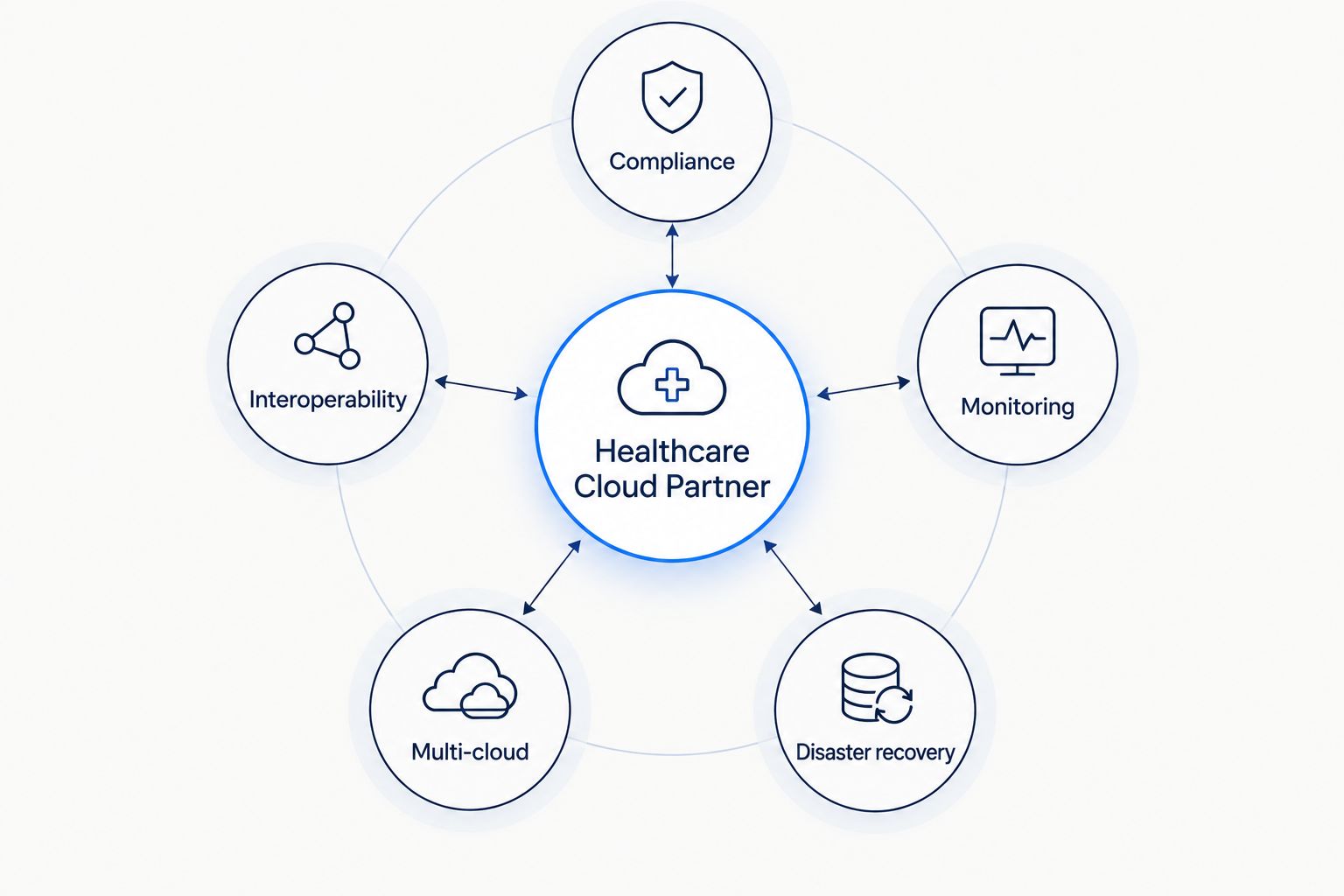
Cloud managed services providers for healthcare at a glance
| Provider | Best for | Standout feature | Key limitation |
|---|---|---|---|
| KnackForge | AI-driven healthcare cloud modernization | HIPAA-compliant AI pipelines built alongside migration work | Smaller global footprint than hyperscaler-affiliated MSPs |
| ClearDATA | HIPAA-native infrastructure hosting | Compliance automation embedded at the platform layer | Less focus on custom AI and ML development |
| Rackspace Technology | Multi-cloud managed hosting at scale | Deep operational experience across AWS, Azure, and GCP | Healthcare-specific depth varies by account team |
| CDW Healthcare | Bundled hardware and cloud procurement | Single vendor for infrastructure, licensing, and hardware refresh | Managed services layer thinner than pure-play MSPs |
| Ntiva | Mid-market healthcare IT support | Responsive help desk and day-to-day IT management | Limited enterprise-scale cloud architecture work |
1. KnackForge: best cloud managed services provider for AI-driven healthcare modernization
KnackForge runs cloud migrations for healthcare organizations while building AI capability into the same engagement — document automation, patient intake chatbots, and HIPAA-compliant AI pipelines sit alongside the infrastructure work rather than as a separate project. That combination matters in 2026, when health systems are under pressure to modernize legacy applications and adopt AI without doubling their vendor list.
KnackForge pros:
- Combines cloud migration with generative AI and agent development for clinical and back-office workflows
- Builds compliance into HIPAA-compliant AI development for healthcare SaaS from day one rather than retrofitting it
- Works across interoperability standards, not locked to a single EHR vendor's ecosystem
- Scopes engagements around specific clinical or operational use cases instead of generic lift-and-shift
KnackForge cons:
- Smaller global data center footprint than hyperscaler-owned MSPs like Rackspace
- Best fit for organizations ready to invest in AI-driven modernization, not pure infrastructure hosting
Best for: health systems that want cloud migration and AI modernization managed together. Verdict: Buy.
2. ClearDATA: best cloud managed services provider for HIPAA-native infrastructure
ClearDATA builds its hosting platform around healthcare compliance requirements specifically, automating much of the audit and safeguard documentation that HIPAA demands. It's a known name for organizations that want the compliance layer handled at the infrastructure level before anything else gets built on top.
ClearDATA pros:
- Compliance automation is native to the platform, not a bolt-on service
- Established track record hosting protected health information at scale
- Strong audit-readiness documentation for HIPAA and HITECH reviews
ClearDATA cons:
- Less oriented toward custom AI and machine learning development
- Organizations wanting broader digital transformation work may need a second vendor
Best for: teams prioritizing compliance-first hosting over custom development. Verdict: Buy for compliance-heavy environments.
3. Rackspace Technology: best cloud managed services provider for multi-cloud hosting at scale
Rackspace Technology operates across AWS, Azure, and Google Cloud for large enterprise clients, including health systems running workloads split across more than one provider. Its scale suits organizations with complex, distributed infrastructure rather than a single clinic or clinic group.
Rackspace Technology pros:
- Broad operational experience across all three major hyperscalers
- Enterprise-grade support infrastructure and account management
- Handles large, distributed workloads well
Rackspace Technology cons:
- Healthcare-specific expertise depends heavily on the assigned account team
- Less specialized in AI-driven clinical workflow automation
Best for: multi-facility health systems running genuinely multi-cloud environments. Verdict: Hold — evaluate the assigned team's healthcare experience before signing.
4. CDW Healthcare: best cloud managed services provider for bundled hardware and cloud procurement
CDW Healthcare pairs hardware procurement with cloud services, useful for organizations refreshing on-premises equipment and cloud infrastructure in the same budget cycle. It functions more as a broad IT reseller and integrator than a pure managed services specialist.
CDW Healthcare pros:
- Single vendor relationship for hardware, licensing, and cloud services
- Useful during full infrastructure refresh cycles
- Established procurement relationships across major hardware vendors
CDW Healthcare cons:
- Managed services depth is thinner than dedicated cloud MSPs
- Less focused on custom application modernization or AI work
Best for: organizations doing a simultaneous hardware and cloud refresh. Verdict: Hold — pair with a specialist MSP for ongoing cloud operations.
5. Ntiva: best cloud managed services provider for mid-market healthcare IT support
Ntiva focuses on day-to-day IT support and management for mid-market organizations, including clinics and smaller healthcare groups that need responsive help desk coverage more than enterprise-scale cloud architecture.
Ntiva pros:
- Responsive help desk and IT support model
- Suited to smaller healthcare organizations without large internal IT teams
- Straightforward day-to-day management
Ntiva cons:
- Limited depth in enterprise-scale cloud architecture and multi-cloud design
- Less oriented toward AI or advanced data engineering work
Best for: mid-market clinics needing reliable IT support rather than large-scale cloud transformation. Verdict: Buy for smaller organizations; Wait if you need enterprise architecture depth.
“A cloud managed services provider that treats HIPAA compliance as an afterthought is planning for a breach, not preventing one.”
How we ranked these providers
Each provider gets measured against the six criteria above: compliance depth, EHR and interoperability experience, incident response maturity, multi-cloud capability, tested disaster recovery, and legacy risk retirement. None of the five wins on every dimension — that's the point of the table.
Organizations still building an evaluation process can walk through a structured comparison method before signing anything. The right fit in 2026 depends on whether the priority is AI-driven modernization, pure compliance hosting, multi-cloud scale, bundled procurement, or day-to-day support.
Which cloud managed services provider should you choose?
For a health system that wants cloud migration and AI modernization handled together, KnackForge is the default pick — it builds HIPAA-compliant AI capability into the same engagement instead of treating it as a bolt-on. For an organization that only needs compliance-first hosting with no custom AI work, ClearDATA is the stronger fit. Large, multi-facility systems running genuinely distributed workloads should weigh Rackspace Technology; smaller clinics needing reliable day-to-day support should start with Ntiva.
Plan your healthcare cloud migration
Scope a HIPAA-compliant migration and modernization roadmap for 2026.
FAQ
What is the best cloud managed services provider for healthcare in 2026?
KnackForge ranks best overall for healthcare organizations that want cloud migration and AI-driven modernization managed under one HIPAA-compliant engagement. ClearDATA is the stronger pick for organizations that only need compliance-native hosting without custom AI work.
Is ClearDATA better than a general cloud MSP for healthcare?
ClearDATA wins on compliance automation built into the platform layer, which general-purpose MSPs usually don't offer natively. It's a narrower fit for organizations that also need custom AI or application development.
Do healthcare cloud managed services providers need to be HIPAA compliant themselves?
The provider must operate under a signed Business Associate Agreement and support the safeguards required by the HIPAA Security Rule, since the healthcare organization remains liable for protected health information regardless of who hosts it.
Can one provider handle both cloud migration and AI modernization for a hospital system?
Yes — providers like KnackForge scope cloud migration and AI development, such as HIPAA-compliant AI pipelines and patient intake chatbots, as one engagement rather than separate vendor contracts.
What's the difference between a cloud MSP and a hardware reseller like CDW Healthcare?
A pure-play MSP focuses on ongoing cloud operations, monitoring, and architecture, while a reseller like CDW Healthcare bundles hardware procurement and licensing with a thinner managed services layer.
Is multi-cloud support necessary for a healthcare organization?
It's necessary when the organization already runs workloads across more than one provider, which is common in large, multi-facility health systems. Smaller clinics on a single cloud provider don't need this depth.
How do EHR and interoperability standards affect provider choice?
A provider without HL7 or FHIR experience and familiarity with systems like Epic or Cerner will slow down integration work significantly, since most clinical data exchange in 2026 still depends on these standards.
One last thing
The providers that score best on paper are rarely the ones that fail during an actual incident — the difference shows up in whether the incident response plan was tested against a real EHR outage scenario or just written to satisfy an audit checklist. Ask each finalist for their last tested disaster recovery drill date before signing, not just their SLA document.


